


Severe Maternal Morbidity and Mortality Among Indigenous Women in the United States
- PMID: 31923072
- PMCID: PMC7012336
- DOI: 10.1097/AOG.0000000000003647
Severe Maternal Morbidity and Mortality Among Indigenous Women in the United States
Abstract
Objective: To describe delivery-related severe maternal morbidity and mortality among indigenous women compared with non-Hispanic white (white) women, distinguishing rural and urban residents.
Methods: We used 2012-2015 maternal hospital discharge data from the National Inpatient Sample to conduct a pooled, cross-sectional analysis of indigenous and white patients who gave birth. We used weighted multivariable logistic regression and predictive population margins to measure health conditions and severe maternal morbidity and mortality (identified using International Classification of Diseases, Ninth Revision, Clinical Modification diagnosis and procedure codes) among indigenous and white patients, to test for differences across both groups, and to test for differences between rural and urban residents within each racial category.
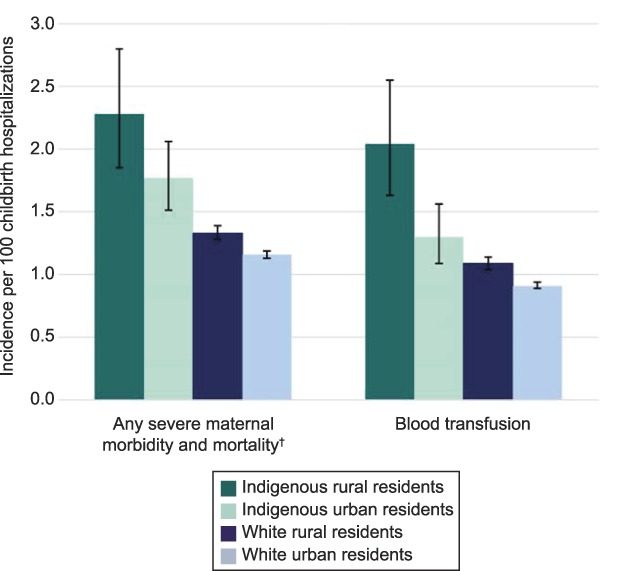
Results: We identified an estimated 7,561,729 (unweighted n=1,417,500) childbirth hospitalizations that were included in the analyses. Of those, an estimated 101,493 (unweighted n=19,080) were among indigenous women, and an estimated 7,460,236 (unweighted n=1,398,420) were among white women. The incidence of severe maternal morbidity and mortality was greater among indigenous women compared with white women (2.0% vs 1.1%, respectively; relative risk [RR] 1.8, 95% CI 1.6-2.0). Within each group, incidence was higher among rural compared with urban residents (2.3% for rural indigenous women vs 1.8% for urban indigenous women [RR 1.3, 95% CI 1.0-1.6]; 1.3% for rural white women vs 1.2% for urban white women [RR 1.1, 95% CI 1.1-1.2]).
Conclusion: Severe maternal morbidity and mortality is elevated among indigenous women compared with white women. Incidence is highest among rural indigenous residents. Efforts to improve maternal health should focus on populations at greatest risk, including rural indigenous populations.
Figures
References
-
- Norris T, Vines PL, Hoeffel EM. The American Indian and Alaska native population: 2010. Washington, DC: United States Department of Commerce; 2012.
-
- Dewees S, Marks B. Twice Invisible: Understanding Rural Native America. Albuquerque, NM: First Nations Development Institute; 2017.
-
- Ratcliffe M, Burd C, Holder K, Fields A. American community survey and geography brief: defining rural at the U.S. Census bureau. Available at: https://www.census.gov/content/dam/Census/library/publications/2016/acs/.... Retrieved August 21, 2019.
-
- Henning-Smith C, Hernandez AM, Ramirez M, Hardeman R, Kozhimannil K. Dying too soon: County-level disparities in premature death by rurality, race, and ethnicity. Available at: https://3pea7g1qp8f3t9ooe3z3npx1-wpengine.netdna-ssl.com/wp-content/uplo.... Retrieved July 30, 2019.
Publication types
MeSH terms
LinkOut - more resources
Full Text Sources
Medical
