


Population and evolutionary genetics of the PAH locus to uncover overdominance and adaptive mechanisms in phenylketonuria: Results from a multiethnic study
- PMID: 31923802
- PMCID: PMC7000351
- DOI: 10.1016/j.ebiom.2019.102623
Population and evolutionary genetics of the PAH locus to uncover overdominance and adaptive mechanisms in phenylketonuria: Results from a multiethnic study
Abstract
Background: Phenylketonuria (PKU) is the most common inborn error of amino acid metabolism in Europe. The reasons underlying the high prevalence of heterozygous carriers are not clearly understood. We aimed to look for pathogenic PAH variant enrichment according to geographical areas and patients' ethnicity using a multiethnic nationwide cohort of patients with PKU in France. We subsequently appraised the population differentiation, balancing selection and the molecular evolutionary history of the PAH locus.
Methods: The French nationwide PKU study included patients who have been referred at the national level to the University Hospital of Nancy, and for whom a molecular diagnosis of phenylketonuria was made by Sanger sequencing. We performed enrichment analyses by comparing alternative allele frequencies using Fisher's exact test with Bonferroni adjustment. We estimated the amount of genetic differentiation among populations using Wright's fixation index (Fst). To estimate the molecular evolutionary history of the PAH gene, we performed phylogenetic and evolutionary analyses using whole-genome and exome-sequencing data from healthy individuals and non-PKU patients, respectively. Finally, we used exome-wide association study to decipher potential genetic loci associated with population divergence on PAH.
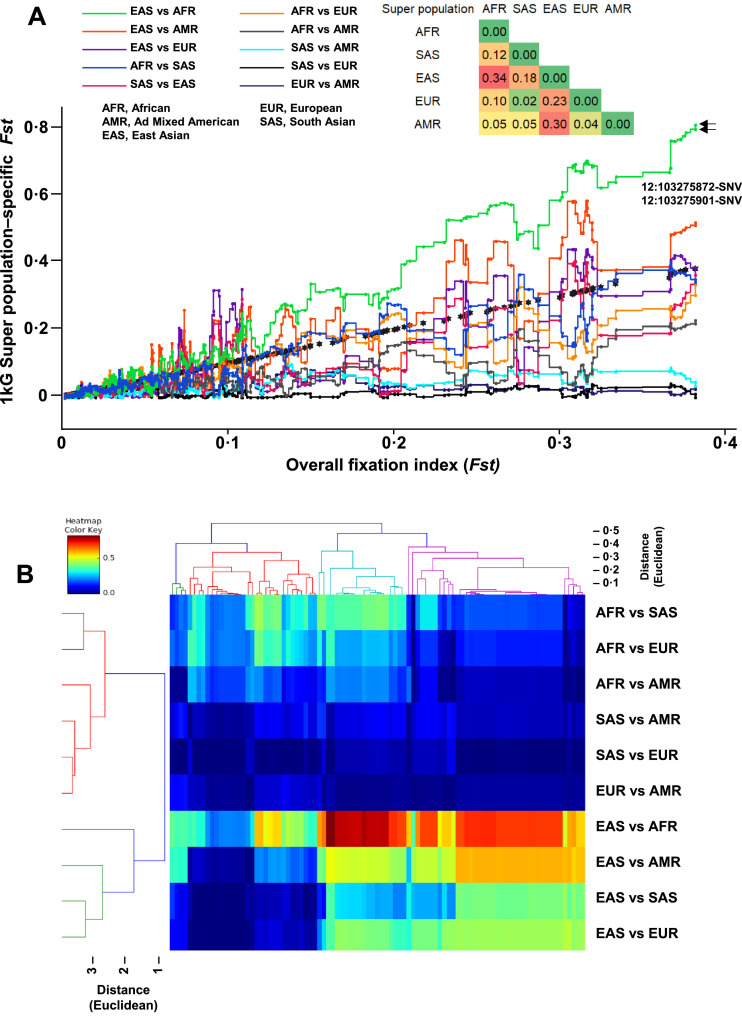
Findings: The study included 696 patients and revealed 132 pathogenic PAH variants. Three geographical areas showed significant enrichment for a pathogenic PAH variant: North of France (p.Arg243Leu), North-West of France (p.Leu348Val), and Mediterranean coast (p.Ala403Val). One PAH variant (p.Glu280Gln) was significantly enriched among North-Africans (OR = 23·23; 95% CI: 9·75-55·38). PAH variants exhibiting a strong genetic differentiation were significantly enriched in the 'Biopterin_H' domain (OR = 6·45; 95% CI: 1·99-20·84), suggesting a balancing selection pressure on the biopterin function of PAH. Phylogenetic and timetree analyses were consistent with population differentiation events on European-, African-, and Asian-ancestry populations. The five PAH variants most strongly associated with a high selection pressure were phylogenetically close and were located within the biopterin domain coding region of PAH or in its vicinity. Among the non-PAH loci potentially associated with population divergence, two reached exome-wide significance: SSPO (SCO-spondin) and DBH (dopamine beta-hydroxylase), involved in neuroprotection and metabolic adaptation, respectively.
Interpretation: Our data provide evidence on the combination of evolutionary and adaptive events in populations with distinct ancestries, which may explain the overdominance of some genetic variants on PAH.
Funding: French National Institute of Health and Medical Research (INSERM) UMR_S 1256.
Keywords: Balancing selection; Metabolic adaptation; Overdominance; Phenylketonuria; Population divergence.
Copyright © 2019 The Authors. Published by Elsevier B.V. All rights reserved.
Conflict of interest statement
Declaration of Competing Interest The authors who have taken part in this study declare that they do not have anything to disclose regarding conflicts of interest concerning this manuscript.
Figures




References
-
- Scriver C.R. The PAH gene, phenylketonuria, and a paradigm shift. Hum Mutat. 2007;28:831–845. - PubMed
MeSH terms
Substances
LinkOut - more resources
Full Text Sources
Medical
Miscellaneous
