Multicenter Study
. 2020 Nov 9;12(1):1707610.
doi: 10.1080/19490976.2019.1707610. Epub 2020 Jan 10.

Gut microbiota profiles in critically ill patients, potential biomarkers and risk variables for sepsis

Affiliations
Multicenter Study

Gut microbiota profiles in critically ill patients, potential biomarkers and risk variables for sepsis

Gloria M Agudelo-Ochoa et al. Gut Microbes. .

Abstract

Critically ill patients are physiologically unstable and recent studies indicate that the intestinal microbiota could be involved in the health decline of such patients during ICU stays. This study aims to assess the intestinal microbiota in critically ill patients with and without sepsis and to determine its impact on outcome variables, such as medical complications, ICU stay time, and mortality. A multi-center study was conducted with a total of 250 peri-rectal swabs obtained from 155 patients upon admission and during ICU stays. Intestinal microbiota was assessed by sequencing the V3-V4 hypervariable regions of the 16S rRNA gene. Linear mixed models were used to integrate microbiota data with more than 40 clinical and demographic variables to detect covariates and minimize the effect of confounding factors. We found that the microbiota of ICU patients with sepsis has an increased abundance of microbes tightly associated with inflammation, such as Parabacteroides, Fusobacterium and Bilophila species. Female sex and aging would represent an increased risk for sepsis possibly because of some of their microbiota features. We also evidenced a remarkable loss of microbial diversity, during the ICU stay. Concomitantly, we detected that the abundance of pathogenic species, such as Enterococcus spp., was differentially increased in sepsis patients who died, indicating these species as potential biomarkers for monitoring during ICU stay. We concluded that particular intestinal microbiota signatures could predict sepsis development in ICU patients. We propose potential biomarkers for evaluation in the clinical management of ICU patients.

Keywords: Intestinal microbiota; antibiotics; critically ill patient; intensive care unit; sepsis.


Figures
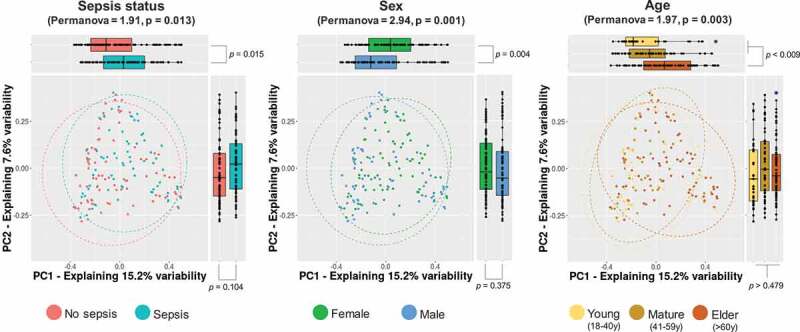
Figure 1.
Figure 1.
Microbial community structure of the study groups. Principal coordinate analysis (PCoA) of multidimensional data is drawn to display changes in microbial communities according to major variables retrieved to shape the IM, sepsis status, sex, and age. The x- and y-axes represent the two most informative principal coordinates (PCs) of the PCoA, and marginal boxplots describe the distribution of those values for the different groups. Color legends represent the respective variables under analysis. Blue-shaded points show outliers. A pairwise Wilcoxon rank-sum test was used to compare PC1 or PC2 values between groups, and p-values are shown beside marginal boxplots. The results of the permutation-based test (PERMANOVA) to compare dissimilarity indexes among samples are shown on top of plots accordingly.
Figure 2.
Figure 2.
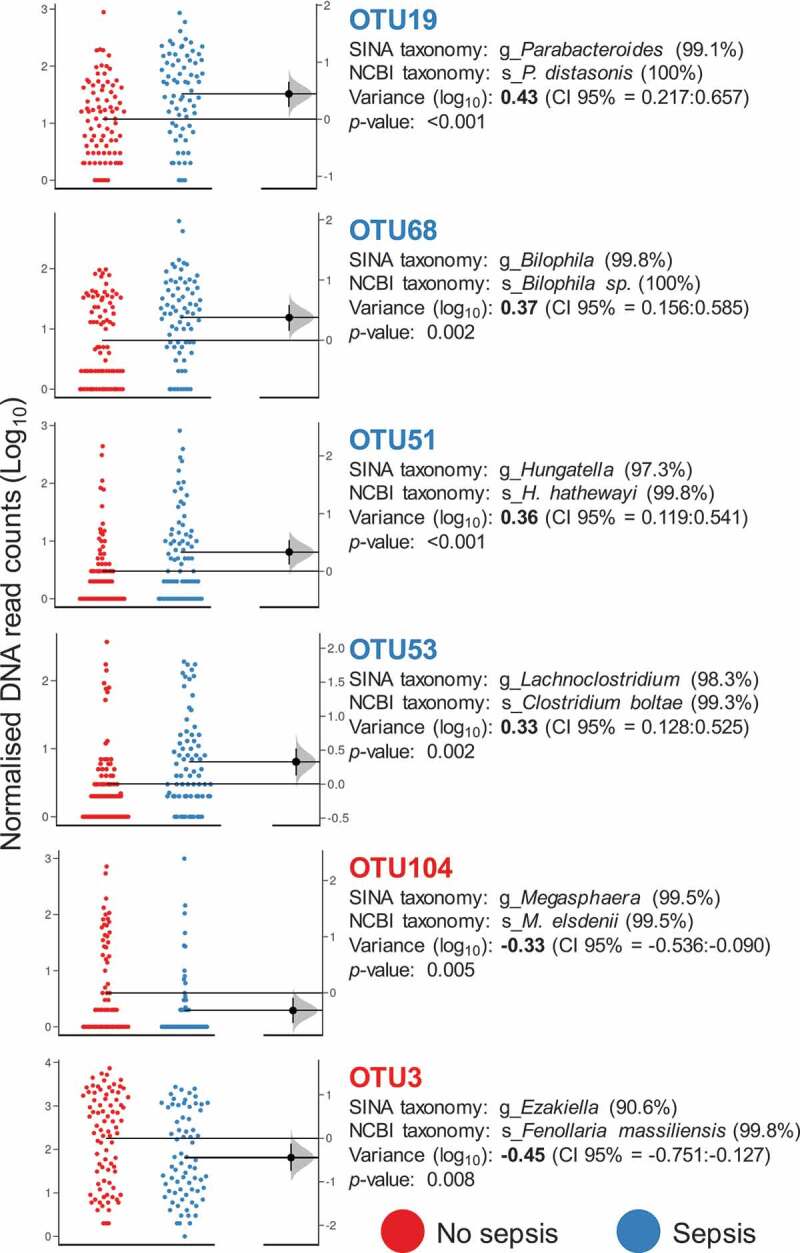
OTUs associated with the sepsis condition. Gardner–Altman estimation plots showing the distribution of the number of rarefied DNA reads obtained for OTUs with extreme variation between groups. In all cases, the variance is reported on a log scale and is referred to as observed in the “No sepsis” group (p ≤ 0.01) and accompanied by confidence intervals (CI 95%). The color legend represents the primary variable of the study, sepsis status. SINA aligner (https://www.arb-silva.de/aligner/) with the SILVA database and a Blast-based search against the non-redundant NCBI 16S database (https://blast.ncbi.nlm.nih.gov/Blast.cgi?) were used as methods to disclose the taxonomy of selected OTUs. The sequence identity percentage is shown within parentheses. The distribution of unpaired mean differences between groups (based on 5000 replicates) is shown on the right of the respective Gardner–Altman plots.
Figure 3.
Figure 3.
Alpha diversity analysis of longitudinal samples from the sepsis groups. The observed OTUs (a), Chao’s index (b), Simpson’s evenness (c), and Simpson’s reciprocal index (d) were assessed across the M1, M2.5, M2.6, and M2.7 samples. Statistical assessment was carried out with the pairwise Wilcoxon rank-sum test for unpaired samples with the post hoc Benjamini–Hochberg method for multiple testing correction, and p-values derived from respective tests are depicted on top of Gardner–Altman estimation plots accordingly (p ≤ 0.05). Distributions at the bottom of the plots show the unpaired median difference based on 5000 replicates.
Figure 4.
Figure 4.
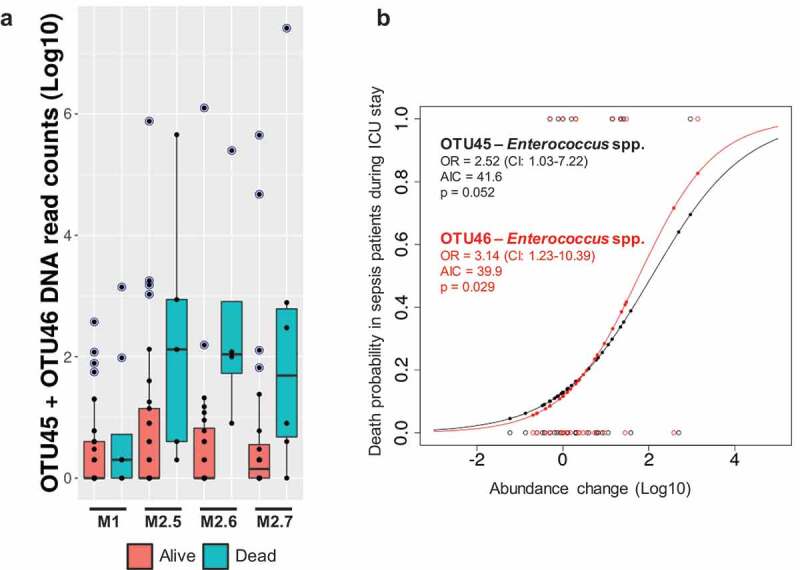
OTUs associated with death. A – The normalized DNA read counts (log10) for OTU45 and OTU46 are depicted in a boxplot manner for sepsis samples across the time (M1 to M2.7) of stay in the ICU. The color legend discriminates the samples from patients with ICU discharge as “alive” and “dead”. Blue-shaded points indicate outliers. B – A logistic regression with data regarding OTUs potentially related to death of ICU patients with sepsis, based on their abundance changes across the ICU stay. Abundance changes were calculated as log[average(M2 samples)] – log[M1 samples]. The OTU information and the associated taxonomy as well as main parameters retrieved after logistic regression, such as the odds ratio (OR), Akaike information criterion (AIC), and p-values, are shown inside the plot.

References

    1. Jacobs MC, Haak BW, Hugenholtz F, Wiersinga WJ.. Gut microbiota and host defense in critical illness. Curr Opin Crit Care. 2017;23:257–16. doi:10.1097/MCC.0000000000000424. - DOI - PubMed
    1. Shimizu K, Ogura H, Hamasaki T, Goto M, Tasaki O, Asahara T, Nomoto K, Morotomi M, Matsushima A, Kuwagata Y, et al. Altered gut flora are associated with septic complications and death in critically ill patients with systemic inflammatory response syndrome. Dig Dis Sci. 2011;56:1171–1177. doi:10.1007/s10620-010-1418-8. - DOI - PMC - PubMed
    1. Shimizu K, Yamada T, Ogura H, Mohri T, Kiguchi T, Fujimi S, Asahara T, Yamada T, Ojima M, Ikeda M, et al. Synbiotics modulate gut microbiota and reduce enteritis and ventilator-associated pneumonia in patients with sepsis: a randomized controlled trial. Crit Care. 2018;22:239. doi:10.1186/s13054-018-2167-x. - DOI - PMC - PubMed
    1. D’Argenio V, Salvatore F. The role of the gut microbiome in the healthy adult status. Clin Chim Acta. 2015;451:97–102. doi:10.1016/j.cca.2015.01.003. - DOI - PubMed
    1. Lynch SV, Pedersen O. The human intestinal microbiome in health and disease. N Engl J Med. 2016;375:2369–2379. - PubMed

Publication types

MeSH terms