


Body composition and neuromotor development in the year after NICU discharge in premature infants
- PMID: 31926484
- PMCID: PMC7351612
- DOI: 10.1038/s41390-020-0756-2
Body composition and neuromotor development in the year after NICU discharge in premature infants
Abstract
Background: Hypothesis: neuromotor development correlates to body composition over the first year of life in prematurely born infants and can be influenced by enhancing motor activity.
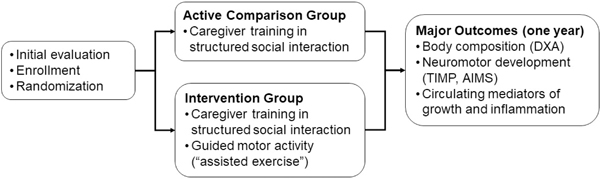
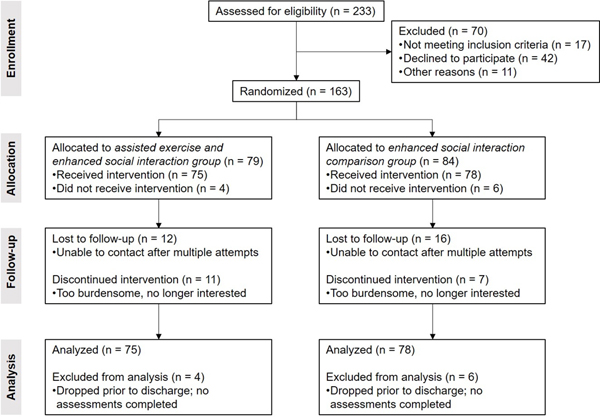
Methods: Forty-six female and 53 male infants [27 ± 1.8 (sd) weeks] randomized to comparison or exercise group (caregiver provided 15-20 min daily of developmentally appropriate motor activities) completed the year-long study. Body composition [lean body and fat mass (LBM, FM)], growth/inflammation predictive biomarkers, and Alberta Infant Motor Scale (AIMS) were assessed.
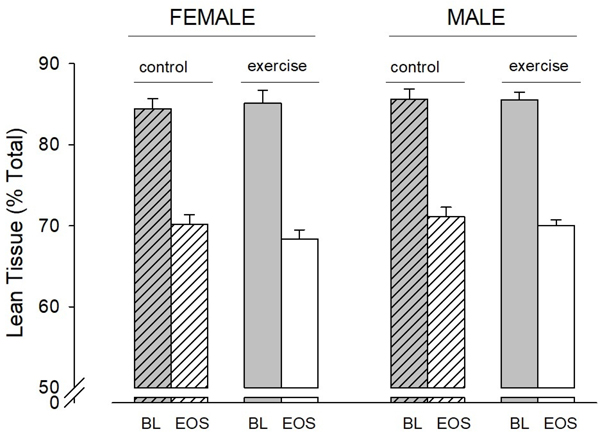
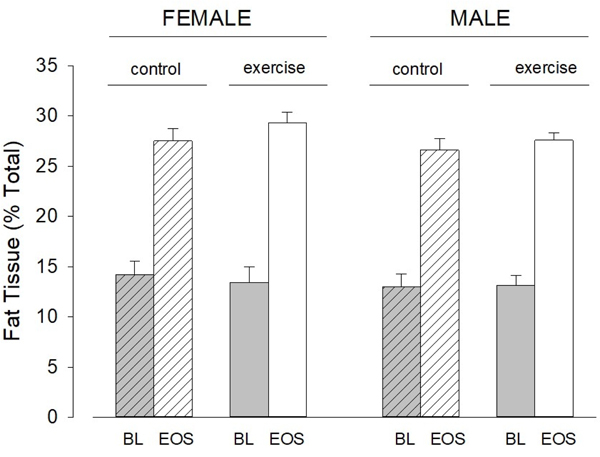
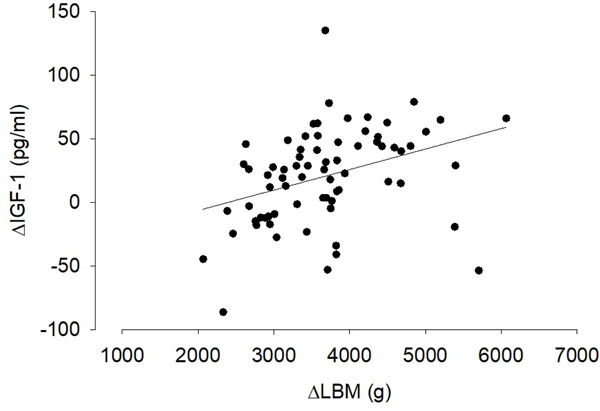
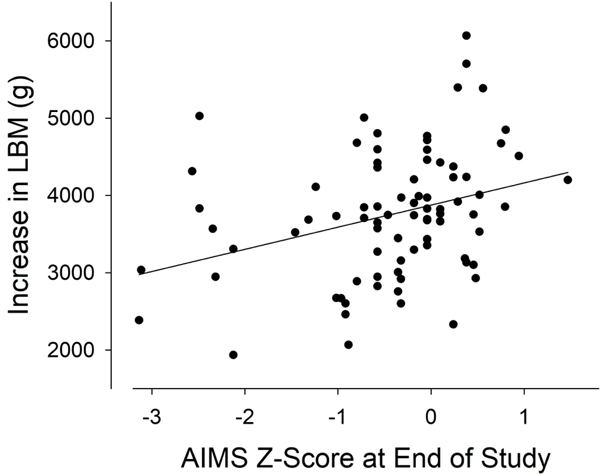
Results: AIMS at 1 year correlated with LBM (r = 0.32, p < 0.001) in the whole cohort. However, there was no effect of the intervention. LBM increased by ~3685 g (p < 0.001)); insulin-like growth factor-1 (IGF-1) was correlated with LBM (r = 0.36, p = 0.002). IL-1RA (an inflammatory biomarker) decreased (-75%, p < 0.0125). LBM and bone mineral density were significantly lower and IGF-1 higher in the females at 1 year.
Conclusions: We found an association between neuromotor development and LBM suggesting that motor activity may influence LBM. Our particular intervention was ineffective. Whether activities provided largely by caregivers to enhance motor activity in prematurely born infants can affect the interrelated (1) balance of growth and inflammation mediators, (2) neuromotor development, (3) sexual dimorphism, and/or (4) body composition early in life remains unknown.
Conflict of interest statement
Figures
References
-
- Eliakim A, Litmanovitz I, Nemet D. The Role of Exercise in Prevention and Treatment of Osteopenia of Prematurity: An Update. Pediatr Exerc Sci [Internet] 2017. [cited 2019 Jun 16];29:450–5. Available from: http://www.ncbi.nlm.nih.gov/pubmed/28338426 - PubMed
-
- Stewart DL, Barfield WD. Updates on an At-Risk Population: Late-Preterm and Early-Term Infants. Pediatrics [Internet] 2019. [cited 2019 Jun 16];144:e20192760. Available from: http://pediatrics.aappublications.org/lookup/doi/10.1542/peds.2019-2760 - DOI - PubMed
-
- Premji SS, et al. A qualitative study: Mothers of late preterm infants relate their experiences of community-based care. PLoS One [Internet] 2017. [cited 2019 Jun 16];12:e0174419. Available from: http://www.ncbi.nlm.nih.gov/pubmed/28334033 - PMC - PubMed
-
- Spittle A, Orton J, Anderson PJ, Boyd R, Doyle LW. Early developmental intervention programmes provided post hospital discharge to prevent motor and cognitive impairment in preterm infants. Cochrane Database Syst Rev [Internet] 2015. [cited 2019 Jun 16];CD005495. Available from: http://www.ncbi.nlm.nih.gov/pubmed/26597166 - PMC - PubMed
-
- Kakebeeke TH, et al. Association between Body Composition and Motor Performance in Preschool Children. Obes Facts [Internet] 2017. [cited 2019 Jun 16];10:420–31. Available from: http://www.ncbi.nlm.nih.gov/pubmed/28934745 - PMC - PubMed
Publication types
MeSH terms
Substances
Grants and funding
LinkOut - more resources
Full Text Sources
Miscellaneous
