Review
. 2020 Mar;104(5):1871-1881.
doi: 10.1007/s00253-020-10349-w. Epub 2020 Jan 11.

Prevention of biofilm formation by quorum quenching

Affiliations
Review

Prevention of biofilm formation by quorum quenching

E Paluch et al. Appl Microbiol Biotechnol. 2020 Mar.

Abstract

Quorum sensing (QS) is a mechanism that enables microbial communication. It is based on the constant secretion of signaling molecules to the environment. The main role of QS is the regulation of vital processes in the cell such as virulence factor production or biofilm formation. Due to still growing bacterial resistance to antibiotics that have been overused, it is necessary to search for alternative antimicrobial therapies. One of them is quorum quenching (QQ) that disrupts microbial communication. QQ-driving molecules can decrease or even completely inhibit the production of virulence factors (including biofilm formation). There are few QQ strategies that comprise the use of the structural analogues of QS receptor autoinductors (AI). They may be found in nature or be designed and synthesized via chemical engineering. Many of the characterized QQ molecules are enzymes with the ability to degrade signaling molecules. They can also impede cellular signaling cascades. There are different techniques used for testing QS/QQ, including chromatography-mass spectroscopy, bioluminescence, chemiluminescence, fluorescence, electrochemistry, and colorimetry. They all enable qualitative and quantitative measurements of QS/QQ molecules. This article gathers the information about the mechanisms of QS and QQ, and their effect on microbial biofilm formation. Basic methods used to study QS/QQ, as well as the medical and biotechnological applications of QQ, are also described. Basis research methods are also described as well as medical and biotechnological application.

Keywords: Biofilm; Quorum quenching; Quorum sensing; Research methods.


Conflict of interest statement

The authors declare that they have no conflict of interest.

Figures
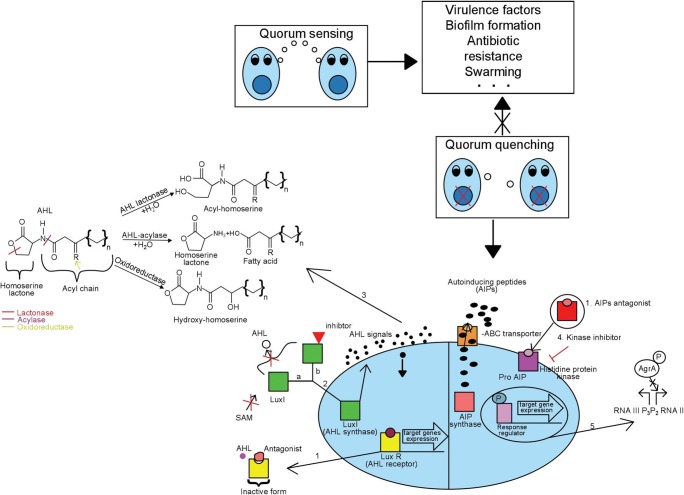
Fig. 1
Fig. 1
Mechanisms of blocking quorum sensing in Gram-negative and Gram-positive bacteria. Cell-cell communication in many bacteria is responsible for the production of various virulence factors. Disturbances in quorum sensing will inhibit the production of virulence factors. QS systems differ in Gram-negative and Gram-positive bacteria. In Gram-negative bacteria, the role of autoinductors is played by AHLs, synthesized by a LuxI type enzyme. These molecules penetrate the bacterial cell membrane, and after reaching the appropriate threshold concentration, the LuxR receptor protein is activated and transcription of target effector genes occurs. Signal molecules in Gram-positive bacteria are AIPs. They are synthesized in the form of pre-peptides, and after modification they are exported outside the cell via the ABC-ATP binding cassette transport system. After reaching the threshold concentration in the environment, the autoinducer molecules are bound by sensor proteins with kinase activity. Kinase is activated by phosphorylation. The phosphate group is transferred to the transcription regulator, which results in activation of the transcription of the target genes. Mechanisms interfering with QS cascades are marked with numbers on the diagram: 1—application of inductor antagonists; 2—inhibition of AHL molecule synthesis ((a)blocking SAM biosynthesis (b) inhibiting LuxI); 3—enzymatic degradation of AHL molecules (lactonase—hydrolyzes the HSL ring; acylase—hydrolyzes the amide bonds; oxidoreductase—reduces carbonyl or hydroxyl groups); 4—inhibition of histidine protein kinase activation by kinase inhibitor; 5—blocking of signal transduction cascades (inhibition of RNA III production by disturbing AgrA DNA binding)
Fig. 2
Fig. 2
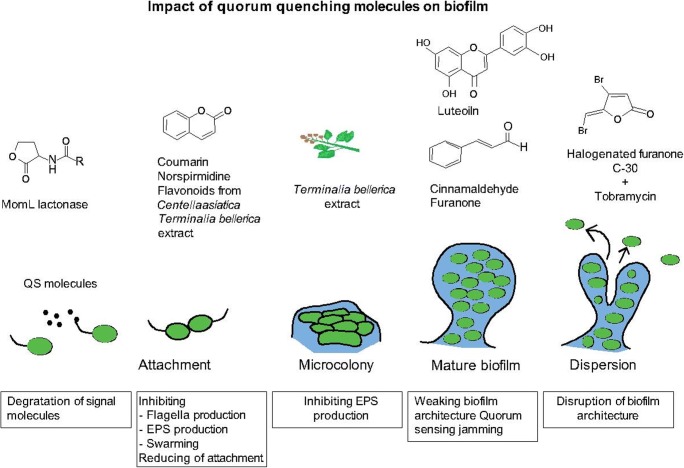
Impact of quorum quenching molecules on biofilm formation. QS affects various bacterial behaviors including biofilm formation, EPS production, and dispersion. Interference in communication between bacteria affects in the various biofilm stages. Degradation of signal molecules results in insufficient number of inductors to reach threshold concentration, thus inhibiting the whole QS process. Examples of QQ enzymes that degrade the signal molecules are lactonases and acylases. The use of QS inhibitors such as C8-HSL inhibits the production of virulence factors facilitating attachment. Quorum sensing inhibitors cause loosening of the biofilm structure by reducing the hydrophobicity of cell surface. The synergistic use of QSI with antibiotics was successfully applied to target mature biofilm

References

    1. Abisado RG, Benomar S, Klaus JR, Dandekar AA, Chandler JR (2018) Bacterial quorum sensing and microbial community interactions. mBio 9(3): e02331-17. 10.1128/mBio.02331-17 - PMC - PubMed
    1. Asfour HZ. Anti-quorum sensing natural compounds. J Microsc Ultrastruct. 2018;6(1):1–10. doi: 10.4103/JMAU.JMAU_10_18. - DOI - PMC - PubMed
    1. Bikash CR, Hamry SR, Tal-Gan Y. Structure–activity relationships of the competence stimulating peptide in Streptococcus mutans reveal motifs critical for membrane protease SepM recognition and ComD receptor activation. ACS Infect Dis. 2018;4(9):1385–1394. doi: 10.1021/acsinfecdis.8b00115. - DOI - PMC - PubMed
    1. Bjarnsholt T, Givskov M. Quorum-sensing blockade as a strategy for enhancing host defenses against bacterial pathogens. Philos Trans R Soc Lond Ser B Biol Sci. 2007;362(1483):1213–1222. doi: 10.1098/rstb.2007.2046. - DOI - PMC - PubMed
    1. Bodede O, Shaik S, Chenia H, Singh P, Moodley R. Quorum sensing inhibitory potential and in silico molecular docking of flavonoids and novel terpenoids from Senegalia nigrescens. J Ethnopharmacol. 2018;216:134–146. doi: 10.1016/j.jep.2018.01.031. - DOI - PubMed

MeSH terms

LinkOut - more resources