


Innate immunological memory: from plants to animals
- PMID: 31931432
- PMCID: PMC7067670
- DOI: 10.1016/j.coi.2019.12.001
Innate immunological memory: from plants to animals
Abstract
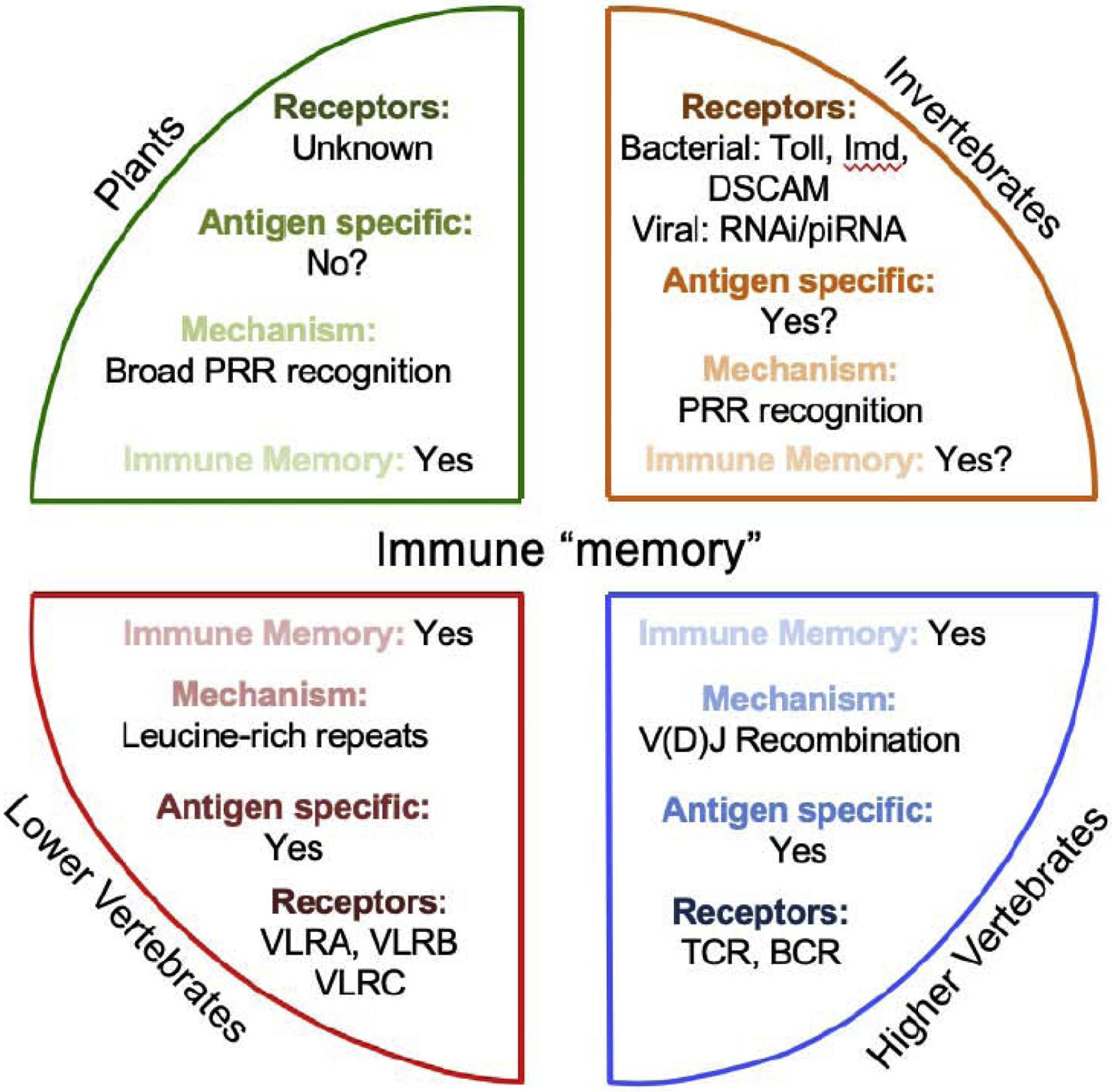
Immunological memory is defined by the ability of the host to recognise and mount a robust secondary response against a previously encountered pathogen. Classic immune memory is an evolutionary adaptation of the vertebrate immune system that has been attributed to adaptive lymphocytes, including T and B cells. In contrast, the innate immune system was known for its conserved, non-specific roles in rapid host defence, but historically was considered to be unable to generate memory. Recent studies have challenged our understanding of innate immunity and now provides a growing body of evidence for innate immune memory. However, in many species and in various cell types the underlying mechanisms of immune 'memory' formation remain poorly understood. The purpose of this review is to explore and summarise the emerging evidence for immunological 'memory' in plants, invertebrates, and vertebrates.
Copyright © 2019 Elsevier Ltd. All rights reserved.
Conflict of interest statement
Figures
References
-
- Netea MG, Schlitzer A, Placek K, Joosten LAB & Schultze JL Innate and Adaptive Immune Memory: an Evolutionary Continuum in the Host’s Response to Pathogens. Cell Host Microbe 25, 13–26 (2019). - PubMed
-
- Gourbal B et al. Innate immune memory: An evolutionary perspective. Immunol. Rev 283, 21–40 (2018). - PubMed
-
- Jones JDG & Dangl JL The plant immune system. Nature 444, 323–329 (2006). - PubMed
-
- Chester KS The Problem of Acquired Physiological Immunity in Plants. Q. Rev. Biol 8, 129–154 (1933).
-
- Kuć J Induced Immunity to Plant Disease. BioScience 32, 854–860 (1982).
Publication types
MeSH terms
Grants and funding
LinkOut - more resources
Full Text Sources
