


The importance of synchronicity in the management of colorectal peritoneal metastases with cytoreductive surgery and hyperthermic intraperitoneal chemotherapy
- PMID: 31931817
- PMCID: PMC6958608
- DOI: 10.1186/s12957-020-1784-4
The importance of synchronicity in the management of colorectal peritoneal metastases with cytoreductive surgery and hyperthermic intraperitoneal chemotherapy
Abstract
Background: Colorectal peritoneal metastases (CPM) occur in up to 13% of patients with colorectal cancer, presenting either synchronously or metachronously. Cytoreductive surgery and hyperthermic intraperitoneal chemotherapy (CRS and HIPEC) have been increasingly utilised for selected CPM patients with favourable outcomes, though its benefits may differ for synchronous (s-CPM) and metachronous CPM (m-CPM).
Methods: A retrospective analysis of CPM patients treated with CRS and HIPEC at the National Cancer Centre Singapore over 15 years was performed. In the s-CPM group, CPM was diagnosed at primary presentation with CRS and HIPEC performed at the time of or within 6 months from primary surgery. In the m-CPM group, patients developed CPM > 6 months after primary curative surgery.
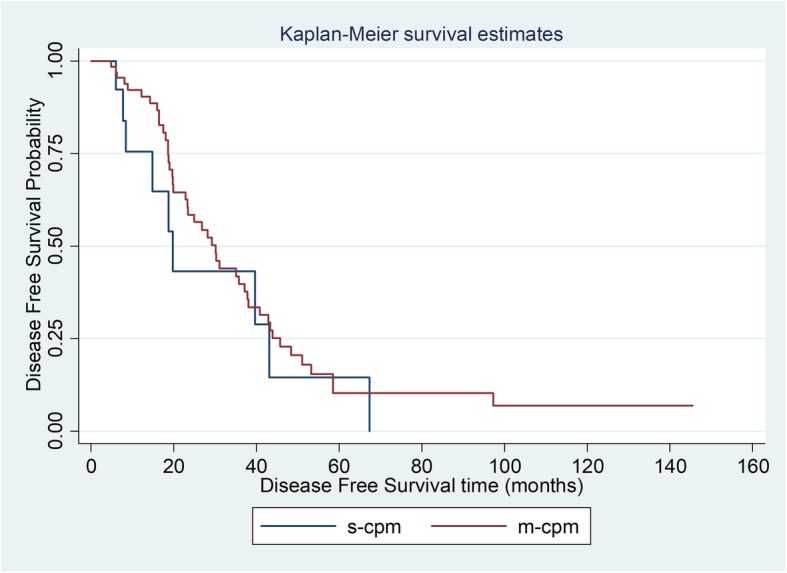
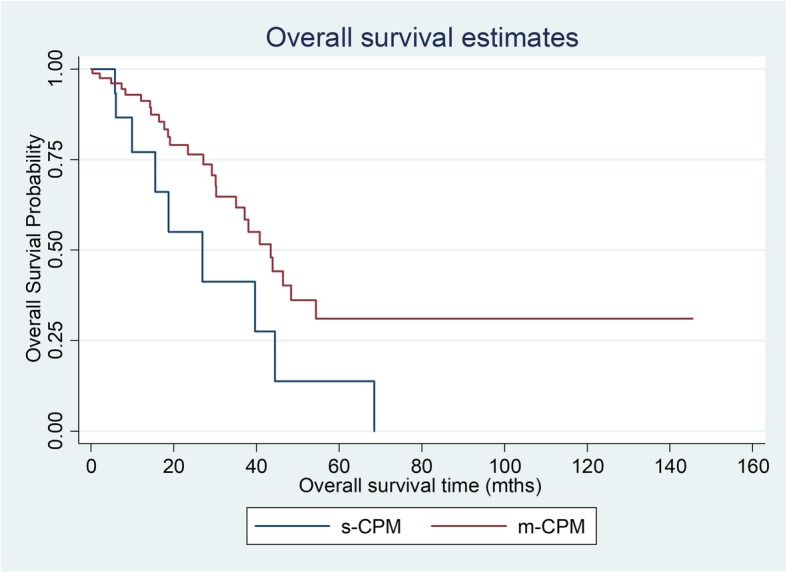
Results: One hundred two patients with CPM were treated with CRS and HIPEC. Twenty (19.6%) patients had s-CPM and 82 (80.4%) had m-CPM. Recurrences occurred in 45% of s-CPM and in 54% of m-CPM (p = 0.619). Median overall survival was significantly prolonged in patients with m-CPM (45.2 versus 26.9 months, p = 0.025). In a subset of m-CPM patients with limited PCI in whom ICU stay was not required, a survival advantage was seen (p = 0.031).
Conclusion: A survival advantage was seen a subset of m-CPM patients, possibly representing differences in disease biology.
Keywords: Colorectal peritoneal metastases; Metachronous; Synchronous.
Conflict of interest statement
The authors declare that they have no competing interests.
Figures
References
-
- Teicher BA, Kowal CD, Kennedy KA, Sartorelli AC. Enhancement by hyperthermia of the in vitro cytotoxicity of mitomycin C toward hypoxic tumor cells. Cancer Res. 1981;41:1096–1099. - PubMed
-
- Spratt JS, Adcock RA, Muskovin M, et al. Clinical delivery system for intraperitoneal hyperthermic chemotherapy. CancerRes. 1980;40:256–260. - PubMed
-
- Gilly FN, Beaujard A, Glehen O et al. Peritonectomy combined with intraperitoneal chemohyperthermia in abdominal cancer with peritoneal carcinomatosis: phase I-II study. Anticancer Res1999; 19: 2317-2321. - PubMed
MeSH terms
LinkOut - more resources
Full Text Sources
Medical
Miscellaneous
