A Computer Modelling Approach To Evaluate the Accuracy of Microsatellite Markers for Classification of Recurrent Infections during Routine Monitoring of Antimalarial Drug Efficacy
- PMID: 31932376
- PMCID: PMC7179279
- DOI: 10.1128/AAC.01517-19
A Computer Modelling Approach To Evaluate the Accuracy of Microsatellite Markers for Classification of Recurrent Infections during Routine Monitoring of Antimalarial Drug Efficacy
Abstract
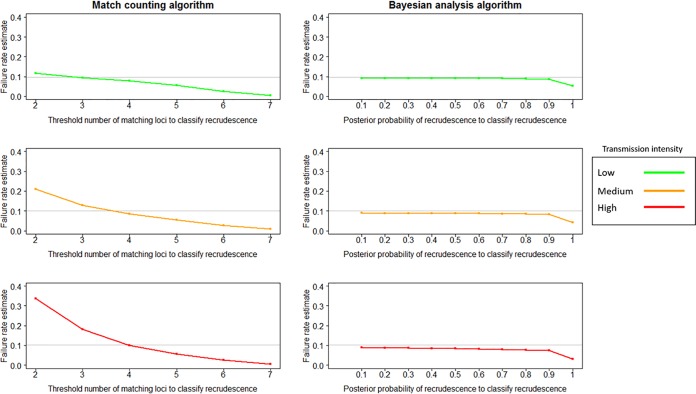
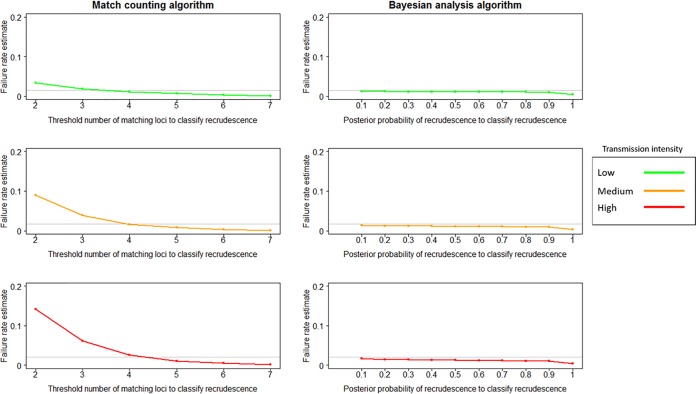
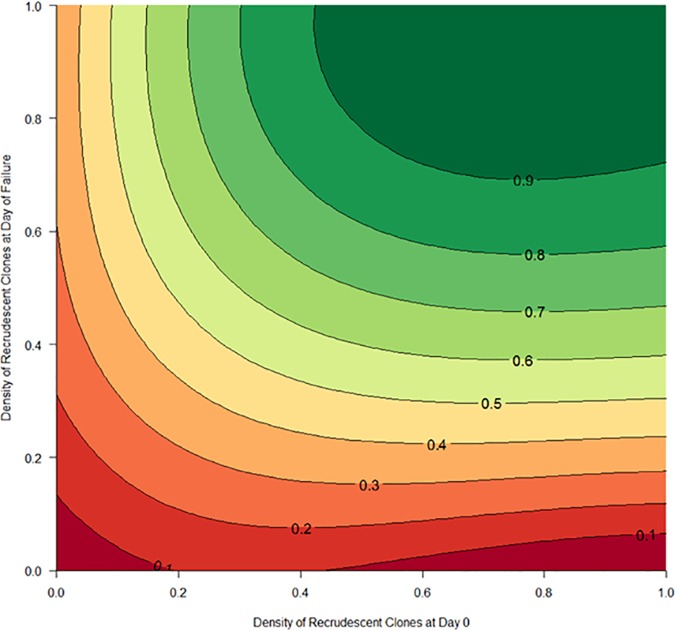
Antimalarial drugs have long half-lives, so clinical trials to monitor their efficacy require long periods of follow-up to capture drug failure that may become patent only weeks after treatment. Reinfections often occur during follow-up, so robust methods of distinguishing drug failures (recrudescence) from emerging new infections are needed to produce accurate failure rate estimates. Molecular correction aims to achieve this by comparing the genotype of a patient's pretreatment (initial) blood sample with that of any infection that occurs during follow-up, with matching genotypes indicating drug failure. We use an in silico approach to show that the widely used match-counting method of molecular correction with microsatellite markers is likely to be highly unreliable and may lead to gross under- or overestimates of the true failure rates, depending on the choice of matching criterion. A Bayesian algorithm for molecular correction was previously developed and utilized for analysis of in vivo efficacy trials. We validated this algorithm using in silico data and showed it had high specificity and generated accurate failure rate estimates. This conclusion was robust for multiple drugs, different levels of drug failure rates, different levels of transmission intensity in the study sites, and microsatellite genetic diversity. The Bayesian algorithm was inherently unable to accurately identify low-density recrudescence that occurred in a small number of patients, but this did not appear to compromise its utility as a highly effective molecular correction method for analyzing microsatellite genotypes. Strong consideration should be given to using Bayesian methodology to obtain accurate failure rate estimates during routine monitoring trials of antimalarial efficacy that use microsatellite markers.
Keywords: Bayesian; efficacy; malaria; microsatellite; molecular correction; recrudescence; reinfection; resistance; therapeutic efficacy study.
Figures


References
-
- World Health Organization. 2009. Methods for surveillance of antimalarial drug efficacy. World Health Organization, Geneva, Switzerland.
-
- World Health Organization. 2016. Global technical strategy for malaria 2016–2030. World Health Organization, Geneva, Switzerland.
-
- World Health Organization. 2008. Methods and techniques for clinical trials on antimalarial drug efficacy: Genotyping to identify parasite populations. World Health Organization, Geneva, Switzerland.
Publication types
MeSH terms
Substances
Grants and funding
LinkOut - more resources
Full Text Sources