


Quantitative analysis of medical students' and physicians' knowledge of degenerative cervical myelopathy
- PMID: 31932384
- PMCID: PMC7044983
- DOI: 10.1136/bmjopen-2018-028455
Quantitative analysis of medical students' and physicians' knowledge of degenerative cervical myelopathy
Abstract
Objectives: We have previously identified a delay in general practitioner (GP) referrals for patients with degenerative cervical myelopathy (DCM). The aim of this study was to evaluate whether an education gap existed for DCM along the GP training pathway by quantitatively assessing training in, and knowledge of, this condition.
Design: Gap analysis: comparison of DCM to other conditions. Comparators selected on the basis of similar presentation/epidemiology (multiple sclerosis), an important spinal emergency (cauda equina syndrome) and a common disease (diabetes mellitus).
Subjects: Medical students, foundation doctors and GP trainees. PRIMARY AND SECONDARY OUTCOME MEASURES: (1) Assessment of training: quantitative comparison of references to DCM in curricula (undergraduate/postgraduate) and commonly used textbooks (Oxford Handbook Series), to other conditions using modal ranks. (2) Assessment of knowledge: using standardised questions placed in an online question-bank (Passmedicine). Results were presented relative to the question-bank mean (+/-).
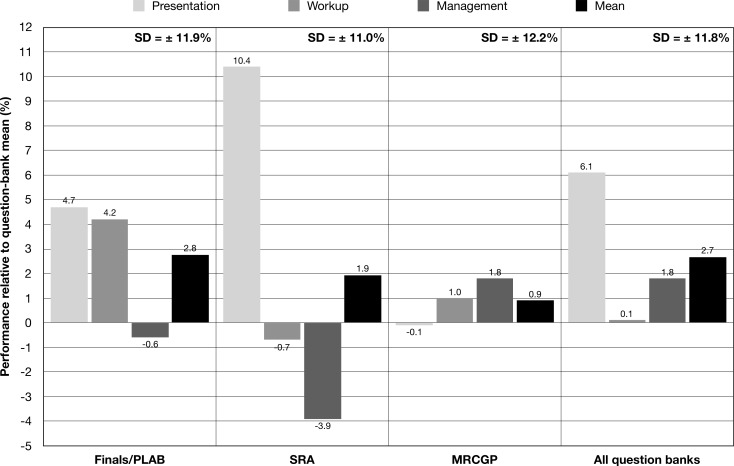
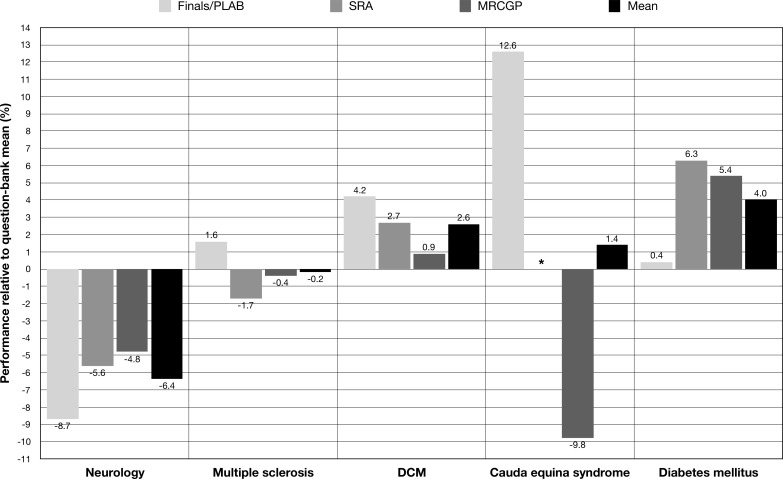
Results: DCM had the lowest modal rank of references to the condition in curricula analysis and second lowest modal rank in textbook analysis. In knowledge analysis questions were attempted 127 457 times. Performance for DCM questions in themes of presentation (+6.1%), workup (+0.1%) and management (+1.8%) were all greater than the question-bank mean and within one SD. For students and junior trainees, there was a serial decrease in performance from presentation and workup (-0.7% to +10.4% relative to question-bank mean) and management (-0.6% to -3.9% relative to question-bank mean).
Conclusions: Although infrequently cited in curricula and learning resources, knowledge relating to DCM was above average. However, knowledge relating to its management was relatively poor.
Keywords: cervical myelopathy; degenerative spine; gap analysis; physician knowledge; spondylosis.
© Author(s) (or their employer(s)) 2020. Re-use permitted under CC BY. Published by BMJ.
Conflict of interest statement
Competing interests: Research in the senior author’s laboratory is supported by a core support grant from the Wellcome Trust and MRC to the Wellcome Trust-Medical Research Council Cambridge Stem Cell Institute. MK is supported by a NIHR Clinician Scientist Award.
Figures
References
-
- Fehlings MG, Tetreault LA, Riew KD, et al. A clinical practice guideline for the management of patients with degenerative cervical myelopathy: recommendations for patients with mild, moderate, and severe disease and Nonmyelopathic patients with evidence of cord compression. Global Spine J 2017;7:70S–83. 10.1177/2192568217701914 - DOI - PMC - PubMed
-
- Fehlings MG, Ibrahim A, Tetreault L, et al. A global perspective on the outcomes of surgical decompression in patients with cervical spondylotic myelopathy: results from the prospective multicenter AOSpine International study on 479 patients. Spine 2015;40:1322–8. 10.1097/BRS.0000000000000988 - DOI - PubMed
Publication types
MeSH terms
Grants and funding
LinkOut - more resources
Full Text Sources
Medical
Miscellaneous
