. 2020 Mar;5(3):443-454.
doi: 10.1038/s41564-019-0637-9. Epub 2020 Jan 13.

Metagenomic sequencing with spiked primer enrichment for viral diagnostics and genomic surveillance

Affiliations

Metagenomic sequencing with spiked primer enrichment for viral diagnostics and genomic surveillance

Xianding Deng et al. Nat Microbiol. 2020 Mar.

Erratum in

  • Author Correction: Metagenomic sequencing with spiked primer enrichment for viral diagnostics and genomic surveillance.
    Deng X, Achari A, Federman S, Yu G, Somasekar S, Bártolo I, Yagi S, Mbala-Kingebeni P, Kapetshi J, Ahuka-Mundeke S, Muyembe-Tamfum JJ, Ahmed AA, Ganesh V, Tamhankar M, Patterson JL, Ndembi N, Mbanya D, Kaptue L, McArthur C, Muñoz-Medina JE, Gonzalez-Bonilla CR, López S, Arias CF, Arevalo S, Miller S, Stone M, Busch M, Hsieh K, Messenger S, Wadford DA, Rodgers M, Cloherty G, Faria NR, Thézé J, Pybus OG, Neto Z, Morais J, Taveira N, Hackett JR Jr, Chiu CY. Deng X, et al. Nat Microbiol. 2020 Mar;5(3):525. doi: 10.1038/s41564-020-0671-7. Nat Microbiol. 2020. PMID: 31965087 Free PMC article.

Abstract

Metagenomic next-generation sequencing (mNGS), the shotgun sequencing of RNA and DNA from clinical samples, has proved useful for broad-spectrum pathogen detection and the genomic surveillance of viral outbreaks. An additional target enrichment step is generally needed for high-sensitivity pathogen identification in low-titre infections, yet available methods using PCR or capture probes can be limited by high cost, narrow scope of detection, lengthy protocols and/or cross-contamination. Here, we developed metagenomic sequencing with spiked primer enrichment (MSSPE), a method for enriching targeted RNA viral sequences while simultaneously retaining metagenomic sensitivity for other pathogens. We evaluated MSSPE for 14 different viruses, yielding a median tenfold enrichment and mean 47% (±16%) increase in the breadth of genome coverage over mNGS alone. Virus detection using MSSPE arboviral or haemorrhagic fever viral panels was comparable in sensitivity to specific PCR, demonstrating 95% accuracy for the detection of Zika, Ebola, dengue, chikungunya and yellow fever viruses in plasma samples from infected patients. Notably, sequences from re-emerging and/or co-infecting viruses that have not been specifically targeted a priori, including Powassan and Usutu, were successfully enriched using MSSPE. MSSPE is simple, low cost, fast and deployable on either benchtop or portable nanopore sequencers, making this method directly applicable for diagnostic laboratory and field use.


Conflict of interest statement

C.Y.C. is the director of the UCSF–Abbott Viral Diagnostics and Discovery Center and receives research support funding from Abbott Laboratories, Inc. X.D. and C.Y.C. are inventors on a patent application titled ‘Spiked Primer Design for Targeted Enrichment of Metagenomic Libraries’ (US application no. 62/667,344, filed 4 May 2018 by the University of California San Francisco) that includes a description of the methods and primer sets presented in this paper. A.A.A. is an employee of Karius, Inc.

Figures
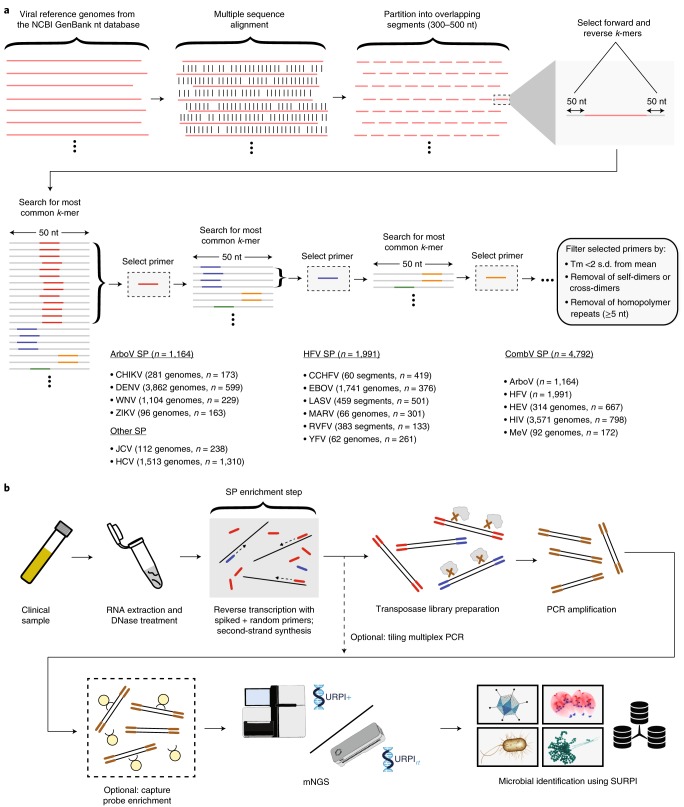
Fig. 1
Fig. 1. MSSPE viral primer design and metagenomic sequencing workflow.
a, An algorithm for the design of viral spiked primers (SP). Sets of viral reference genomes (n = 60–3,571 for each virus) were aligned using MAFFT multiple sequence alignment software, followed by the partitioning of each genome into 300–500-nt overlapping segments. Forward and reverse 13-nt primers were selected and filtered according to specific criteria (rounded rectangular box). Unique primer sequences are individually coloured in red, blue, orange and green. Using this algorithm, primers were designed for 15 RNA viruses. SP panels for ArboV (n = 4), HFV (n = 6) and CombV (n = 13, excluding HCV and JCV SP) were also constructed. b, The metagenomic sequencing workflow. MSSPE primers (red) were added (spiked) to a reaction mix containing random primers (blue) during the reverse transcription step of cDNA synthesis, without adding to the overall turnaround time for the subsequent transposase-based library amplification with adapter primers (brown) and sequencing analysis protocols. The MSSPE workflow is compatible with subsequent enrichment using tiling multiplex PCR and/or capture probes (dashed lines). Metagenomic sequence data were analysed for pathogen identification using SURPI (ref. ; also see Methods). MARV, Marburg virus; RVFV, Rift Valley fever virus; HEV, hepatitis E virus; and Tm, melting temperature.
Fig. 2
Fig. 2. Spiked primer enrichment of viral sequences using MSSPE.
ac, Plots of the fold enrichment achieved for contrived samples containing ZIKV, DENV and/or EBOV at defined titres and using RH primers only or SP concentrations ranging from 1 μM to 40–80 μM. The enrichment of ZIKV and DENV using an ArboV SP panel (a). The asterisk denotes EBOV as an off-target virus when using the ArboV SP panel. The enrichment of EBOV using a HFV SP panel (b) and the enrichment of ZIKV, DENV and EBOV using a CombV SP panel (c). Dashed lines denote 1× or no enrichment. dh, Box-and-whisker plots of the fold enrichment achieved using MSSPE compared to using RH only. The box outlines denote the IQR, the solid line in the box denotes median fold enrichment, the dashed line denotes mean (µ) fold enrichment and the whiskers outside of the box extend to the minimum and maximum fold enrichment points. The fold enrichment for DENV and ZIKV using virus-specific primers, ArboV panels or CombV panels (d). The fold enrichment for EBOV using virus-specific primers, HFV panels or CombV panels (e). The overall fold enrichment, including all 92 pairwise comparisons (with and without MSSPE) of contrived and clinical samples (f). The fold enrichment for 65 pairwise comparisons of contrived samples (g). The fold enrichment for 27 pairwise comparisons of clinical samples (h). The degree of fold enrichment at <100 cp ml−1 is significantly higher than at other titres (paired two-sided Student’s t test; P = 0.008 between groups <100 cp ml−1 and 100–1,000 cp ml−1; P = 0.0002 between groups <100 cp ml−1 and >1,000 cp ml−1). Source Data
Fig. 3
Fig. 3. Improvements in viral genome coverage using MSSPE.
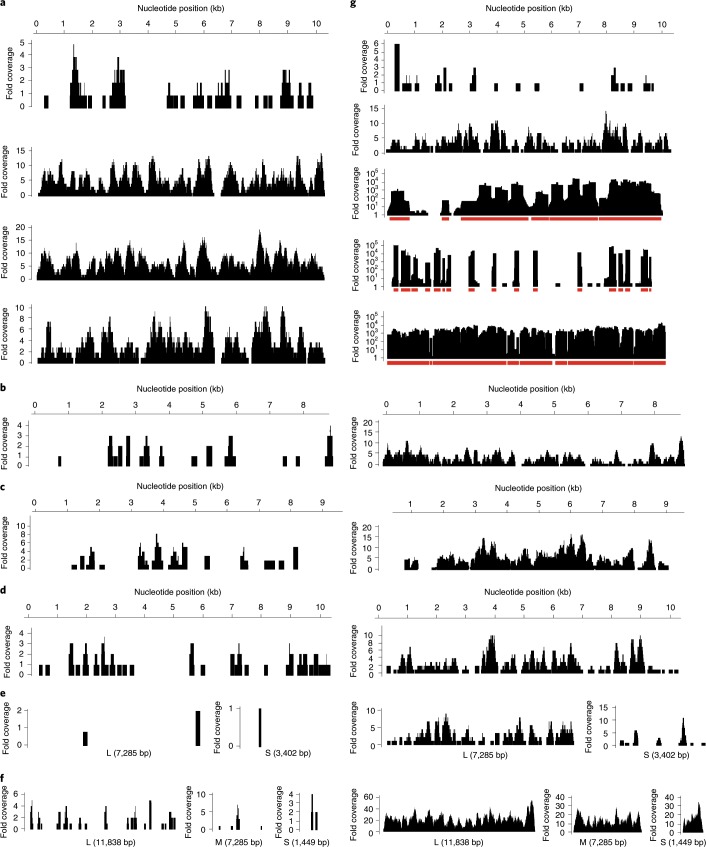
a, Genome coverage of the ZIKV MRC766 (Uganda) strain (mapped to accession no. LC002520) at 1,000 cp ml−1 with no enrichment (top) or MSSPE enrichment using ZIKV SP (second from top), an ArboV SP panel (third from top) or a CombV SP panel (bottom). With no enrichment, there were 50 reads and 45% coverage; with ZIKV SP, there were 456 reads and 97.6% coverage; with ArboV SP, 528 reads and 100% coverage; with CombV SP, there were 254 reads and 93.9% coverage. b, Genome coverage of an HIV-1 Group M, CRF01 strain (mapped to accession no. KY580709) at 1,000 cp ml−1 with no enrichment (left) or using HIV-1 SP (right). With no enrichment, there were 35 reads and 23.2% coverage; with HIV-1 SP, there were 289 reads and 92.8% coverage. c, Genome coverage of an HCV genotype 4 strain (mapped to accession no. KM587625) at 10,000 cp ml−1 with no enrichment (left) or using HCV SP (right). With no enrichment, there were 63 reads and 31.5% coverage; with HCV SP, there were 686 reads and 80% coverage. d, Genome coverage of a POWV strain identified in CSF from an infected patient with tick-borne meningoencephalitis (mapped to accession no. NC_003687) at <1,000 cp ml−1 with no enrichment (left) or using the ArboV SP panel (right). With no enrichment, there were 48 reads and 37.1% coverage; with ArboV SP, there were 209 reads and 88.0% coverage. e, Genome coverage of a contrived sample of LASV (Josiah strain) spiked into donor plasma matrix at a titre of 10 cp ml−1 (mapped to accession nos. AY628202 and NC_004296) with no enrichment (left) or using the HFV SP panel (right). With no enrichment, there were 4 reads and 3.8% coverage; with HFV SP, there were 154 reads and 67.9% coverage. f, Genome coverage of a contrived sample of CCHFV (mapped to accession nos. AY389508, U39455 and U88410) spiked into donor plasma matrix at a titre of 2,500 cp ml−1 with no enrichment (left) or using the HFV SP panel (right). With no enrichment, there were 69 reads and 23.3% coverage; with HFV SP, there were 2,636 reads and 100% coverage. g, Genome coverage of a strain from a patient from Mexico with acute ZIKV infection during the 2013–2016 outbreak (ZIKV/Homo sapiens/MEX/2016/mex30; mapped to accession no. KX879603) at ~2,000 cp ml−1 with no enrichment (top) or enrichment using MSSPE with ZIKV SP (second from top), tiling multiplex PCR (third from top), capture probes (fourth from top, using random primers alone) or MSSPE with ZIKV SP followed by capture probes (bottom). With no enrichment, there were 33 reads and 26.5% coverage; with ZIKV SP, there were 260 reads and 87.5% coverage; with tiling multiplex PCR, there were 158,243 reads and 88.2% coverage (75.0% ≥10× coverage); with capture probes, there were 49,927 reads and 49.1% coverage (29.6% ≥10× coverage); and with ZIKV SP plus capture probes, there were 275,105 reads and 99.8% coverage (95.6% ≥10× coverage). The red bars below the coverage plots show nucleotide regions with coverage of ≥10×, at a threshold to minimize the inclusion of cross-contaminating reads. For each graph in ag, the number of reads is normalized to the total number of viral reads obtained with no enrichment. bp, base pairs; L, large segment; M, medium segment, S, small segment.

References

    1. Bloom DE, Black S, Rappuoli R. Emerging infectious diseases: a proactive approach. Proc. Natl Acad. Sci. USA. 2017;114:4055–4059. - PMC - PubMed
    1. Reperant LA, Osterhaus A. AIDS, Avian flu, SARS, MERS, Ebola, Zika… what next? Vaccine. 2017;35:4470–4474. - PMC - PubMed
    1. Shorten RJ, et al. Diagnostics in Ebola virus disease in resource-rich and resource-limited settings. PLoS Negl. Trop. Dis. 2016;10:e0004948. - PMC - PubMed
    1. Rasmussen AL, Katze MG. Genomic signatures of emerging viruses: a new era of systems epidemiology. Cell Host Microbe. 2016;19:611–618. - PMC - PubMed
    1. Sozhamannan S, et al. Evaluation of signature erosion in Ebola virus due to genomic drift and its impact on the performance of diagnostic assays. Viruses. 2015;7:3130–3154. - PMC - PubMed

Publication types

MeSH terms