Evidence for Mycobacterium leprae Drug Resistance in a Large Cohort of Leprous Neuropathy Patients from India
- PMID: 31933458
- PMCID: PMC7056437
- DOI: 10.4269/ajtmh.19-0390
Evidence for Mycobacterium leprae Drug Resistance in a Large Cohort of Leprous Neuropathy Patients from India
Abstract
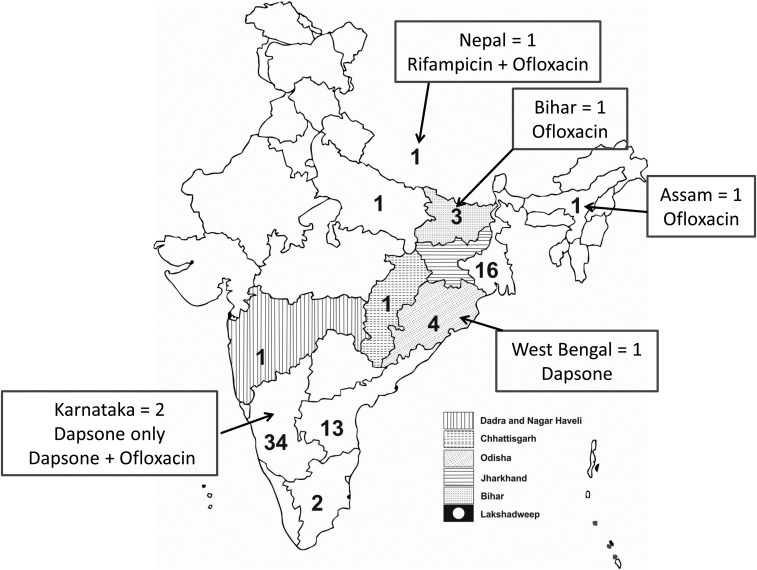
Resistance to anti-leprosy drugs is on the rise. Several studies have documented resistance to rifampicin, dapsone, and ofloxacin in patients with leprosy. We looked for point mutations within the folP1, rpoB, and gyrA gene regions of the Mycobacterium leprae genome predominantly in the neural form of leprosy. DNA samples from 77 nerve tissue samples were polymerase chain reaction (PCR)-amplified for M leprae DNA and sequenced for drug resistance-determining regions of genes rpoB, folP1, and gyrA. The mean age at presentation and onset was 38.2 ± 13.4 (range 14-71) years and 34.9 ± 12.6 years (range 10-63) years, respectively. The majority had borderline tuberculoid leprosy (53 [68.8%]). Mutations associated with resistance were identified in 6/77 (7.8%) specimens. Mutations seen were those associated with resistance to rifampicin, ofloxacin, and dapsone. All the six patients were drug-naive. The clinical and pathological manifestations in this group did not differ from the drug-sensitive group. This study highlights the occurrence of resistance to the standard multidrug therapy and ofloxacin in leprosy. Among the entire cohort, 1/77 (1.3%) showed resistance to rifampicin, 2/77 (2.6%) to dapsone, and 5/77 (6.4%) to ofloxacin. Six new patients showing infection by mutant strains indicated the emergence of primary resistance. Resistance to ofloxacin could be due to frequent use of quinolones for many bacterial infections. The results of the study indicate the need for development of a robust and strict surveillance system for detecting drug resistance in leprosy in India.
Figures
References
-
- Croft RP, Nicholls PG, Richardus JH, Smith WC, 2000. Incidence rates of acute nerve function impairment in leprosy: a prospective cohort analysis after 24 months (The Bangladesh Acute Nerve Damage Study). Lepr Rev 71: 18–33. - PubMed
-
- Saunderson P, Gebre S, Desta K, Byass P, Lockwood DN, 2000. The pattern of leprosy-related neuropathy in the AMFES patients in Ethiopia: definitions, incidence, risk factors and outcome. Lepr Rev 71: 285–308. - PubMed
-
- van Brakel WH, Nicholls PG, Das L, Barkataki P, Suneetha SK, Jadhav RS, Maddali P, Lockwood DNJ, Wilder-Smith E, Desikan KV, 2005. The INFIR cohort study: investigating prediction, detection and pathogenesis of neuropathy and reactions in leprosy. Methods and baseline results of a cohort of multibacillary leprosy patients in north India. Lepr Rev 76: 14–34. - PubMed
-
- WHO Study Group on Chemotherapy of Leprosy for Control Programmes, WHO , 1982. Chemotherapy of Leprosy for Control Programmes: Report of a WHO Study Group. Meeting, October12–16, 1981. Geneva, Switzerland: World Health Organization, Available at: http://apps.who.int/iris/handle/10665/38984. Accessed January 6, 2019.
-
- Cambau E, Perani E, Guillemin I, Jamet P, Ji B, 1997. Multidrug-resistance to dapsone, rifampicin, and ofloxacin in Mycobacterium leprae. Lancet Lond Engl 349: 103–104. - PubMed
Publication types
MeSH terms
Substances
LinkOut - more resources
Full Text Sources
Medical