Review
. 2020 Jan 9;10(1):110.
doi: 10.3390/ani10010110.

Cellular and Molecular Adaptation of Bovine Granulosa Cells and Oocytes under Heat Stress

Affiliations
Review

Cellular and Molecular Adaptation of Bovine Granulosa Cells and Oocytes under Heat Stress

Adnan Khan et al. Animals (Basel). .

Abstract

Heat stress has long been recognized as a challenging issue that severely influences the reproductive functions of dairy cattle, disrupting oocyte development during fetal growth. These detrimental effects of heat stress are the result of either the hyperthermia associated with heat stress or the physiological adjustments made by the heat-stressed animal to regulate body temperature. In addition, elevated temperatures have been implicated in increasing the production of reactive oxygen species. Thus, understanding the impact of heat stress on reproductive functions, from a cellular to molecular level, might help in selecting heat-resilient dairy cattle and developing heat stress mitigation strategies. In the present paper, we have attempted to describe the changes in the reproductive system and function of dairy cattle in response to heat stress by reviewing the latest literature in this area. The review provides useful knowledge on the cellular and genetic basis of oocyte and granulosa cells in heat-stressed dairy cattle, which could be helpful for future research in this area.

Keywords: cellular and molecular level; dairy cattle; granulosa cell; heat stress; oocyte.


Conflict of interest statement

The authors declare no conflicts of interest. The funders had no role in study design, decision to publish, and preparation of the manuscript.

Figures
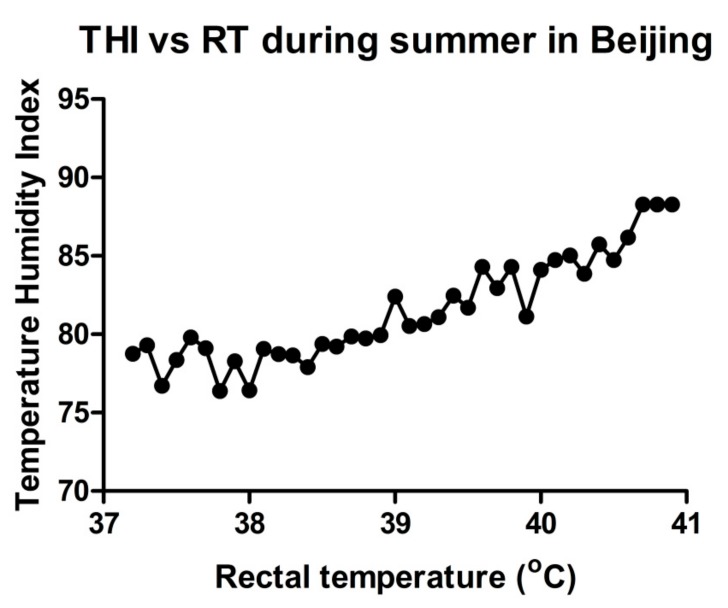
Figure 1
Figure 1
The temperature humidity index can affect rectal temperature (RT): Evaluation of change in RT with an increase in percent temperature humidity index (% THI).
Figure 2
Figure 2
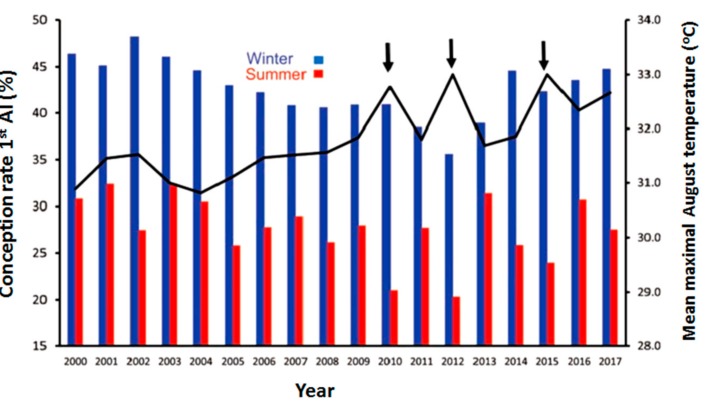
Conception rates of cows in dairy farms after the first insemination during the months of January–March (winter) or July–September (summer) of 2000–2017. The black curve represents the average environmental temperatures during August for each year. A noticeable decline in conception rates was observed during the intense conditions of summer in the years of 2010, 2012, and 2015.
Figure 3
Figure 3
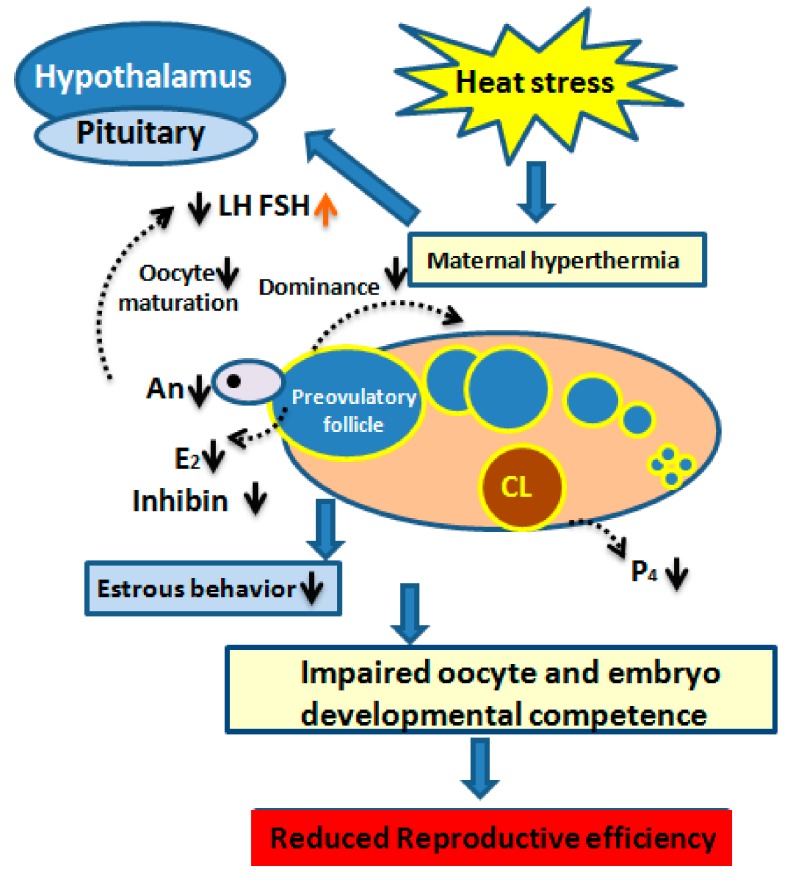
Diagram elucidating the interaction between the impact of seasonal heat stress and the hypothalamus–pituitary–ovarian axis and its mechanism of affecting dairy cow fertility. The lower luteinizing hormone (LH) surge is related to a decreased secretion of follicular estradiol (E2). Lower levels of androstenedione (An) and E2 levels are responsible for decreasing the dominance of preovulatory follicle and is related to poor estrous behavior. Likewise, impaired concentrations of follicle-stimulating hormone (FSH) and inhibin are related to the increased number of medium-sized follicles. Impaired competence of maturing oocyte and developing embryo is due to the disturbed nuclear and cytoplasmic maturation. Reduced reproductive efficiency in dairy cows is the ultimate outcome of heat stress.
Figure 4
Figure 4
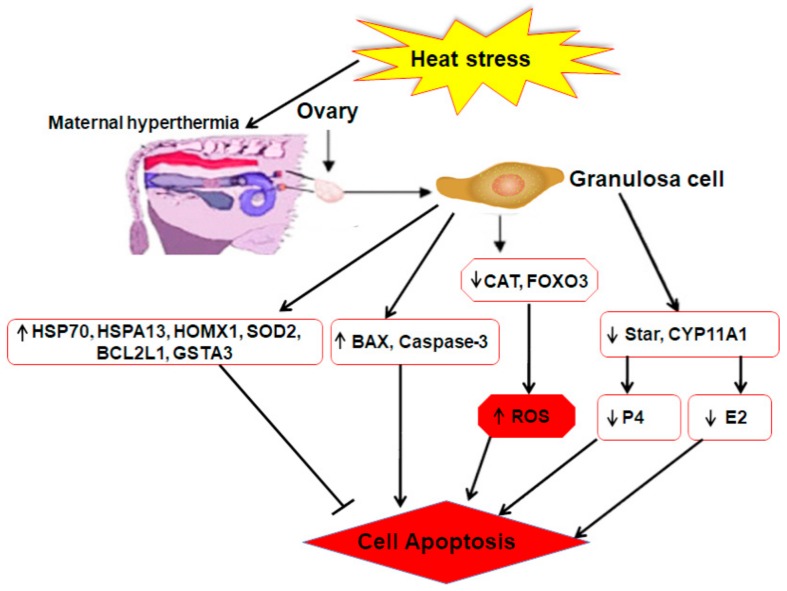
Mechanisms of regulating heat stress response related to follicular function within bovine ovary. Upregulated genes caspase-3, superoxide dismutase (SOD), BCL-2, and BAX, and heat shock proteins (HSPs) (HSP70, HSPA13, HMOX1) are involved in the regulating mechanism of bovine GCs via induced or inhibited cell apoptosis. Under heat stress, downregulated genes CAT and fork head box O3 (FOXO3) were involved in the production of reactive oxygen species (ROS). Likewise, downregulation of steroidogenic acute regulatory protein (STAR) and cytochrome P450, family 11, subfamily A, polypeptide 1 (CYP11A1) were involved in the secretion of E2 and progesterone (P4). Moreover, the decline of E2 and the enhancement of ROS might, in turn, enhance the possibility of GC apoptosis and follicle function.

References

    1. Hansen P.J. Effects of heat stress on mammalian reproduction. Philos. Trans. R. Soc. B Biol. Sci. 2009;364:3341–3350. doi: 10.1098/rstb.2009.0131. - DOI - PMC - PubMed
    1. Torres-Júnior J.R.d.S., Pires M.d.F.A., de Sá W.F., Ferreira A.d.M., Viana J.H.M., Camargo L.S.A., Ramos A.A., Folhadella I.M., Polisseni J., de Freitas C., et al. Effect of maternal heat-stress on follicular growth and oocyte competence in Bos indicus cattle. Theriogenology. 2008;69:155–166. doi: 10.1016/j.theriogenology.2007.06.023. - DOI - PubMed
    1. Kobayashi Y., Wakamiya K., Kohka M., Yamamoto Y., Okuda K. Summer heat stress affects prostaglandin synthesis in the bovine oviduct. Reproduction. 2013;146:103–110. doi: 10.1530/REP-12-0479. - DOI - PubMed
    1. Shehab-El-Deen M.A.M.M., Leroy J.L.M.R., Fadel M.S., Saleh S.Y.A., Maes D., Van Soom A. Biochemical changes in the follicular fluid of the dominant follicle of high producing dairy cows exposed to heat stress early post-partum. Anim. Reprod. Sci. 2010;117:189–200. doi: 10.1016/j.anireprosci.2009.04.013. - DOI - PubMed
    1. Heldmaier G., Ortmann S., Elvert R. Natural hypometabolism during hibernation and daily torpor in mammals. Respir. Physiol. Neurobiol. 2004;141:317–329. doi: 10.1016/j.resp.2004.03.014. - DOI - PubMed

LinkOut - more resources