


Effect of Ten Weeks of Creatine Monohydrate Plus HMB Supplementation on Athletic Performance Tests in Elite Male Endurance Athletes
- PMID: 31936727
- PMCID: PMC7019716
- DOI: 10.3390/nu12010193
Effect of Ten Weeks of Creatine Monohydrate Plus HMB Supplementation on Athletic Performance Tests in Elite Male Endurance Athletes
Abstract
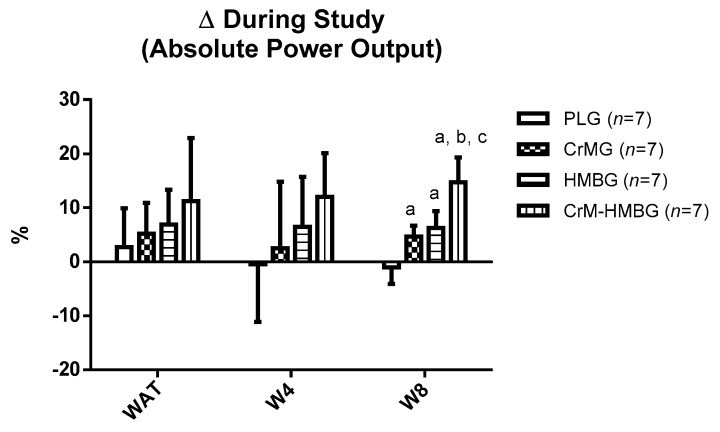
Creatine monohydrate (CrM) and β-hydroxy β-methylbutyrate (HMB) are common ergogenic aids in the field of sports and are frequently used in an isolated way. However, there are a few studies that have investigated the effect of combining both supplements on different variables related to performance, with controversial results. Therefore, the main purpose of this study was to determine the efficacy and the degree of potentiation of 10 weeks of CrM plus HMB supplementation on sports performance, which was measured by an incremental test to exhaustion in elite male traditional rowers. In this placebo-controlled, double-blind trial, 10-week study, participants (n = 28) were randomized to a placebo group (PLG; n = 7), CrM group (0.04 g/kg/day of CrM; n = 7), HMB group (3 g/day of HMB; n = 7) and CrM-HMB group (0.04 g/kg/day of CrM plus 3 g/day of HMB; n = 7). Before and after 10 weeks of different treatments, an incremental test was performed on a rowing ergometer to calculate the power that each rower obtained at the anaerobic threshold (WAT), and at 4 mmol (W4) and 8 mmol (W8) of blood lactate concentration. There were no significant differences in WAT and W4 among groups or in body composition. However, it was observed that the aerobic power achieved at W8 was significantly higher in the CrM-HMB group than in the PLG, CrM and HMB groups (p < 0.001; η2p = 0.766). Likewise, a synergistic effect of combined supplementation was found for the sum of the two supplements separately at WAT (CrM-HMBG = 403.19% vs. CrMG+HMBG = 337.52%), W4 (CrM-HMBG = 2736.17% vs. CrMG+HMBG = 1705.32%) and W8 (CrM-HMBG = 1293.4% vs. CrMG+HMBG = 877.56%). In summary, CrM plus HMB supplementation over 10 weeks showed a synergistic effect on aerobic power (measured as WAT, W4, and W8) during an incremental test but had no influence muscle mass.
Keywords: aerobic power; body composition; lactate threshold; muscle mass; muscle recovery; sport nutrition; supplementation.
Conflict of interest statement
The authors declare no conflict of interest.
Figures
References
-
- Thomas D.T., Erdman K.A., Burke L.M. American College of Sports Medicine Joint Position Statement. Nutrition and Athletic Performance. Med. Sci. Sports Exerc. 2016;48:543–568. - PubMed
-
- Calleja-González J., Mielgo-Ayuso J., Sampaio J., Delextrat A., Ostojic S.M., Marques-Jiménez D., Arratibel I., Sánchez-Ureña B., Dupont G., Schelling X., et al. Brief ideas about evidence-based recovery in team sports. J. Exerc. Rehabil. 2018;14:545–550. doi: 10.12965/jer.1836244.122. - DOI - PMC - PubMed
-
- Rodriguez N.R., DiMarco N.M., Langley S. Position of the American Dietetic Association, Dietitians of Canada, and the American College of Sports Medicine: Nutrition and athletic performance. J. Am. Diet. Assoc. 2013;109:509–527. - PubMed
-
- Terrados N., Mielgo-Ayuso J., Delextrat A., Ostojic S.M., Calleja-Gonzalez J. Dietetic-nutritional, physical and physiological recovery methods post-competition in team sports. A review. J. Sports Med. Phys. Fit. 2018 epub ahead of print. - PubMed
Publication types
MeSH terms
Substances
LinkOut - more resources
Full Text Sources
Medical
Miscellaneous
