Comparative Study
. 2020 Jan 14;10(1):205.
doi: 10.1038/s41598-019-57083-6.

Early Recognition of Burn- and Trauma-Related Acute Kidney Injury: A Pilot Comparison of Machine Learning Techniques

Affiliations
Comparative Study

Early Recognition of Burn- and Trauma-Related Acute Kidney Injury: A Pilot Comparison of Machine Learning Techniques

Hooman H Rashidi et al. Sci Rep. .

Abstract

Severely burned and non-burned trauma patients are at risk for acute kidney injury (AKI). The study objective was to assess the theoretical performance of artificial intelligence (AI)/machine learning (ML) algorithms to augment AKI recognition using the novel biomarker, neutrophil gelatinase associated lipocalin (NGAL), combined with contemporary biomarkers such as N-terminal pro B-type natriuretic peptide (NT-proBNP), urine output (UOP), and plasma creatinine. Machine learning approaches including logistic regression (LR), k-nearest neighbor (k-NN), support vector machine (SVM), random forest (RF), and deep neural networks (DNN) were used in this study. The AI/ML algorithm helped predict AKI 61.8 (32.5) hours faster than the Kidney Disease and Improving Global Disease Outcomes (KDIGO) criteria for burn and non-burned trauma patients. NGAL was analytically superior to traditional AKI biomarkers such as creatinine and UOP. With ML, the AKI predictive capability of NGAL was further enhanced when combined with NT-proBNP or creatinine. The use of AI/ML could be employed with NGAL to accelerate detection of AKI in at-risk burn and non-burned trauma patients.


Conflict of interest statement

The authors declare no competing interests.

Figures
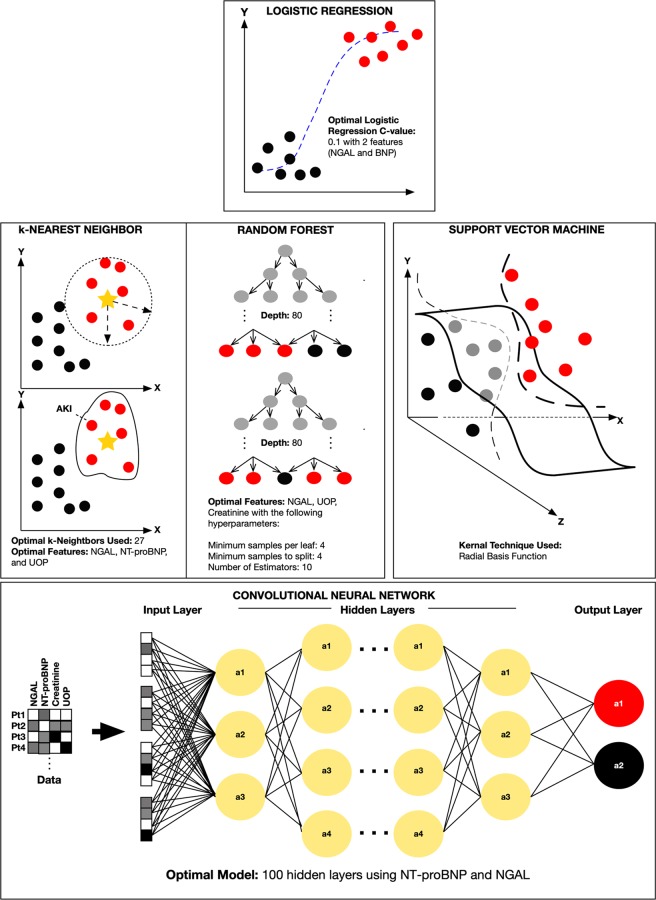
Figure 1
Figure 1
Comparison of DNN, LR, k-NN, RF, and SVM: The figure compares the five ML techniques used in the study and illustrated as conceptual drawings with optimal parameters used in the study serving as examples. Red circles indicate acute kidney injury (AKI) patients, black circles indicate non-AKI patients, and grey circles indicate unclassified patients. At the top, is LR. Middle row from left to right is k-NN, RF, and SVM respectively. The bottom row illustrates a DNN where each patient (Pt#) data matrix containing various combinations of biomarkers and their respective levels (white: none, grey: low, black: high) are processed by hidden layers for classification as having AKI or no AKI.
Figure 2
Figure 2
Accuracy of Cohort B Data Used for Generalization oF DNN, LR, k-NN, SVM and RF Algorithms: Bar graphs illustrate the accuracy for each of the five AI/ML techniques with differing combinations of NGAL, UOP, plasma creatinine, and NT-proBNP. Data was based on Cohort B (n = 51) severely burned or non-burned trauma patients. Notably, the accuracy and sensitivity of best performing models with NGAL alone was 92% and 73%, with an AUC of 85 respectively in 4 out of the five algorithms while the accuracy and sensitivity of the best performing model (seen with LR and DNN) with NGAL in combination with NT-pro-BNP was 92% and 91% with an AUC of 92, respectively. Standard deviations are shown as error bars.
Figure 3
Figure 3
ROC Curve Analysis for Optimized DNN, LR, SVM, k-NN, and RF Models with NGAL and/or NT-proBNP: The Figure compares the ROC curves for the best performing models within each AI/ML technique with differing combinations that include NT-proBNP and/or NGAL. False positive rate (1 – specificity) and true positive rates (sensitivity) are reported on the x- and y-axis respectively. Panel A is for NGAL, NT-proBNP, plasma creatinine only. Panel B is for NGAL and UOP only. Panel C is for plasma creatinine, UOP, and NT-proBNP only. Panel D is for NT-proBNP, and UOP only.
Figure 4
Figure 4
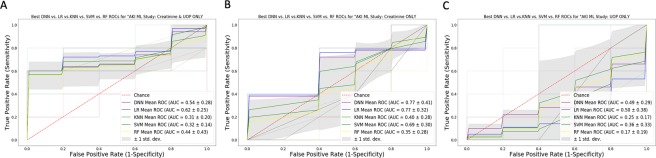
ROC Curve Analysis for Optimized DNN, LR, k-NN, SVM, and RF Models with Traditional AKI Biomarkers: The Figure compares the average ROC curves for the best performing models within each ML method with differing combinations that include UOP and/or creatinine. False positive rate (1 – specificity) and true positive rates (sensitivity) are reported on the x- and y-axis respectively. Panel A is for plasma creatinine and UOP only. Panel B is for plasma creatinine only, and Panel C shows UOP only. Area under the ROC curve values are reported in the bottom right of each Panel.
Figure 5
Figure 5
Potential Role of AI/ML for AKI Prediction in Pre-Hospital Setting: Combining point-of-care (POC) testing with AI/ML could be used to enhance diagnostic power in pre-hospital settings. The figure illustrates a conceptual diagram where POC creatinine and NT-proBNP testing is used at a pre-hospital admission time (t−n) point and augmented by AI/ML (green pathways). Point-of-care testing data may be then transmitted to an AI/ML algorithm to predict AKI prior to hospital admission. Alternately, AI/ML may also be employed as early as the first day of admission denoted as t1. In contrast, traditional workflows (red pathways) relying on urine output and creatinine delay recognition of AKI.

References

    1. Harrois A, Libert N, Duranteau J. Acute kidney in trauma patients. Curr. Opin. Crit. Care. 2017;23:447–456. doi: 10.1097/MCC.0000000000000463. - DOI - PubMed
    1. Harrois A, et al. Prevalence and risk factors for acute kidney injury among trauma patients: a multicenter cohort study. Crit. Care. 2018;22:344. doi: 10.1186/s13054-018-2265-9. - DOI - PMC - PubMed
    1. Palmieri T, Lavrentieva A, Greenhalgh DG. Acute kidney injury in critically ill burn patients. Risk factors, progression and impact on mortality. Burns. 2010;36:205–11. doi: 10.1016/j.burns.2009.08.012. - DOI - PubMed
    1. Palmieri T, Lavrentieva A, Greenhalgh D. An assessment of acute kidney injury with modified RIFLE criteria in pediatric patients with severe burns. Intensive Care Med. 2009;35:2125–9. doi: 10.1007/s00134-009-1638-6. - DOI - PMC - PubMed
    1. Clark A, et al. Acute kidney injury after burn. Burns. 2017;43:898–908. doi: 10.1016/j.burns.2017.01.023. - DOI - PubMed

Publication types

MeSH terms