. 2019 Jun:234:165-171.
doi: 10.1016/j.biocon.2019.03.032. Epub 2019 Mar 28.

Population trends for two Malagasy fruit bats

Affiliations

Population trends for two Malagasy fruit bats

Cara E Brook et al. Biol Conserv. 2019 Jun.

Abstract

Madagascar is home to three endemic species of Old World Fruit Bat, which are important pollinators and seed dispersers. We aimed to quantitatively assess population trajectories for the two largest of these species, the IUCN-listed 'Vulnerable' Eidolon dupreanum and Pteropus rufus. To this end, we conducted a longitudinal field study, in which we live-captured E. dupreanum and P. rufus, estimated species-specific fecundity rates, and generated age-frequency data via histological analysis of cementum annuli layering in tooth samples extracted from a subset of individuals. We fit exponential models to resulting data to estimate annual survival probabilities for adult bats (s A = .794 for E. dupreanum; s A = .511 for P. rufus), then applied Lefkovitch modeling techniques to infer the minimum required juvenile survival rate needed to permit longterm population persistence. Given estimated adult survival, population persistence was only possible for E. dupreanum when field-based fecundity estimates were replaced by higher values reported in the literature for related species. For P. rufus, tooth-derived estimates of adult survival were so low that even assumptions of perfect (100%) juvenile annual survival would not permit stable population trajectories. Age-based survival analyses were further supported by longitudinal exit counts carried out from 2013-2018 at three local P. rufus roost sites, which demonstrated a statistically significant, faintly negative time trend, indicative of subtle regional population declines. These results suggest that Malagasy fruit bat species face significant threats to population viability, with P. rufus particularly imperiled. Immediate conservation interventions, including habitat restoration and cessation of legally sanctioned bat hunting, are needed to protect Madagascar's fruit bats into the future.

Keywords: Lefkovitch matrix modeling; Madagascar; Old World Fruit Bat; Population Viability Analysis (PVA); Pteropodidae.


Figures
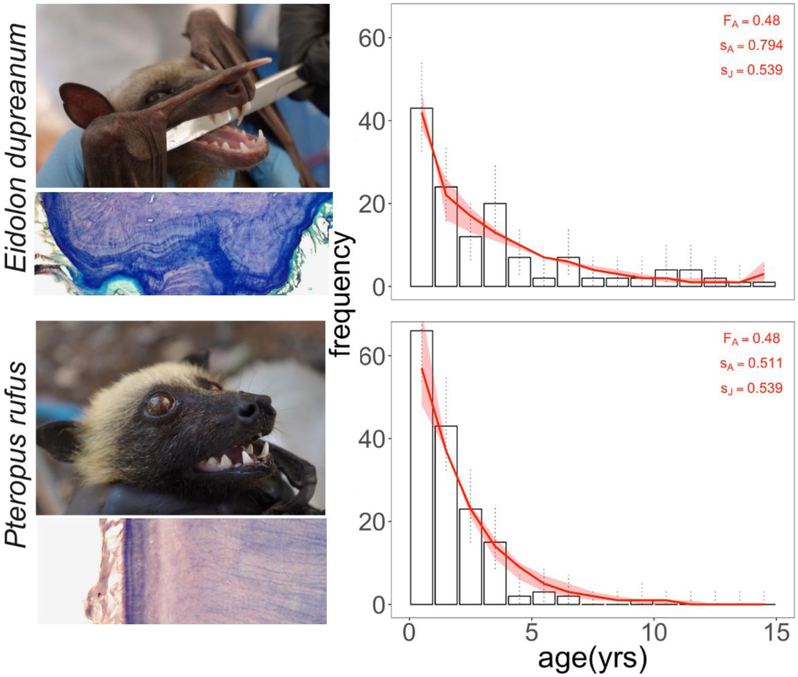
Figure 1.
Figure 1.. Age-frequency data and fitted survival models for Madagascar’s fruit bats.
Left-hand panels show images of Eidolon dupreanum (top) and Pteropus rufus (bottom), paired with cross-sectional images of cementum annuli layering in teeth for, respectively, a 14-year-old E. dupreanum and a 2-year-old P. rufus. Right-hand panels show age-frequency histograms from age analysis of tooth data for E. dupreanum (top) and P. rufus (bottom) with exponential survival model overlain as a solid line. Survival and fecundity parameters used for the demonstrated model are printed in the top righthand corner of each plot; note that juvenile survival rates for P. rufus were adopted from ‘best’ case scenarios for E. dupreanum (Table 2), since no biologically plausible values for P. rufus could maintain a constant population size (λ = 1). Shading is derived from 95% confidence intervals on sA and sJ survival terms – see Table 2 for raw values).
Figure 2.
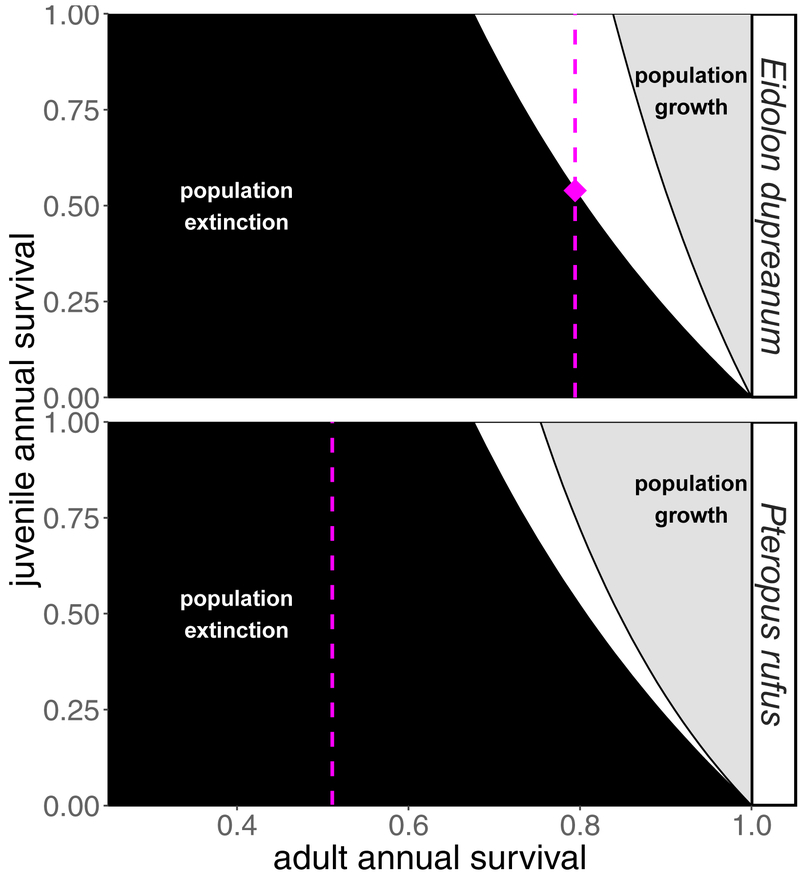
Figure 2.. Zero-growth isoclines for Madagascar’s fruit bats.
Species-specific zero-growth isoclines are here plotted in units of annual survival (adult annual survival = sA; juvenile annual survival = sJ; Supplementary Information). Each species is represented by two isoclines: the bottom (left) isocline is generated by fecundity parameters most favorable to demographic growth (scenario ‘best’; Table 2) and the top (right) isocline by fecundity parameters least favorable to growth (scenario ‘worst’; Table 2). Regions shaded in gray correspond to survival parameter combinations yielding population growth (λ > 1), while regions shaded in black correspond to survival parameter combinations yielding population extinction (λ < 1). The white-shaded regions correspond to survival parameter combinations which result in uncertain population trajectories, dependent on the species-specific annual fecundity rate. The vertical dashed lines give the estimated rate of adult annual survival from analysis of cementum annuli layers in fruit bat teeth; the intersecting diamond in the E. dupreanum plot corresponds to the minimum juvenile annual survival needed to maintain a constant population size (λ = 1) at adult annual survival = .794 and fecundity = .48. The adult annual survival estimate from tooth data (.511) was too low for P. rufus to recover a stable population size, even at juvenile annual survival of 100%.
Figure 3.
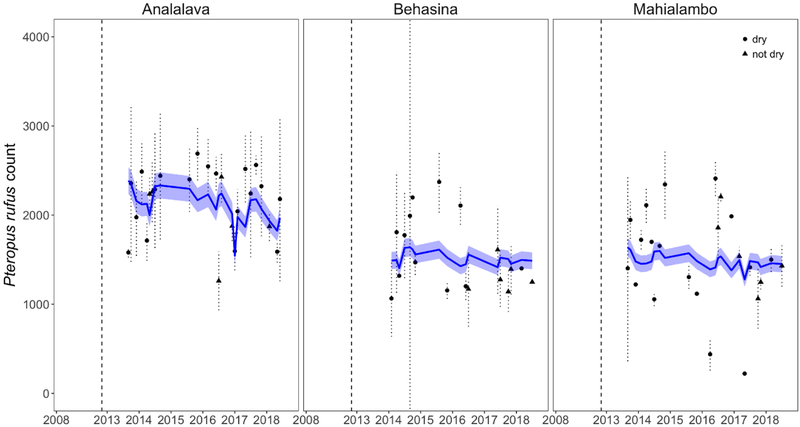
Figure 3.. Longitudinal exit counts for three Pteropus rufus roosts in the District of Amabatondrajaka, Madagascar.
Longitudinal raw exit counts for Pteropus rufus carried out by the conservation NGO, Madagasikara Voakajy, at three roost sites (Analava, Behasina, Mahialambo) in the District of Ambatondrajaka in 2008 (left of dashed vertical line) and from 2013–2018 (right of dashed vertical line). Points depict raw data, with surveys conducted on “dry” days represented as closed circles and surveys conducted on “shady”, “drizzly”, “overcast”, or “rainy” days (“not dry”) represented as closed triangles (though note that weather was not recorded for 2008 data, shown here as a closed circle). We fit a generalized additive mixed model (GAMM) in the Poisson family to the 2013–2018 count data; model output is shown as a solid blue line atop the raw data (shading=95% confidence interval by standard error), incorporating a response variable of count and a fixed predictor variable of year : site interaction. Predicted counts demonstrated a statistically significant slightly negative trend through time for all sites surveyed (slope = −0.023, se − .0022; site-specific p-values: Analalava = 8.19×10⁻¹⁵, Behasina = 6.17×10⁻¹⁵, Mahialambo = 6.05×10⁻¹⁵). A significant monthly smoothing term (p<2×10⁻¹⁶) and a random effect of weather were also included in the model.

References

    1. Beissinger SR, McCullough DR, 2002. Population viability analysis. University of Chicago Press., Chicago.
    1. Bollen A, Van Elsacker, L., 2002. Feeding ecology of Pteropus rufus (Pteropodidae) in the littoral forest of Sainte Luce, SE Madagascar. Acta Chiropterologica 4, 33–47.
    1. Brook CE, Bai Y, Dobson AP, Osikowicz LM, Ranaivoson HC, Zhu Q, Kosoy MY, 2015. Bartonella spp. in fruit bats and blood-feeding ectoparasites in Madagascar. PLoS Negl. Trop. Dis 10, e0003532 10.1371/journal.pntd.0003532 - DOI - PMC - PubMed
    1. Brook CE, Herrera JP, Borgerson C, Fuller E, Andriamahazoarivosoa P, Rasolofoniaina BJR, Randrianasolo JLRR, Rakotondrafarasata ZRE, Randriamady HJ, Dobson AP, Golden CD, 2018. Population viability and harvest sustainability for Madagascar lemurs. Conserv. Biol 0, 1–13. 10.1111/cobi.13151 - DOI - PubMed
    1. Chan LM, Goodman SM, Nowak MD, Weisrock DW, Yoder AD, 2011. Increased population sampling confirms low genetic divergence among Pteropus (Chiroptera: Pteropodidae) fruit bats of Madagascar and other western Indian Ocean islands. PloS Curr. 1, 1–15. 10.1371/currents.RRN1226.Abstract - DOI - PMC - PubMed

LinkOut - more resources