


Clinical Approach to Manage Gastrointestinal Bleeding with a Left Ventricular Assist Device (LVAD)
- PMID: 31938629
- PMCID: PMC6952049
- DOI: 10.7759/cureus.6341
Clinical Approach to Manage Gastrointestinal Bleeding with a Left Ventricular Assist Device (LVAD)
Abstract
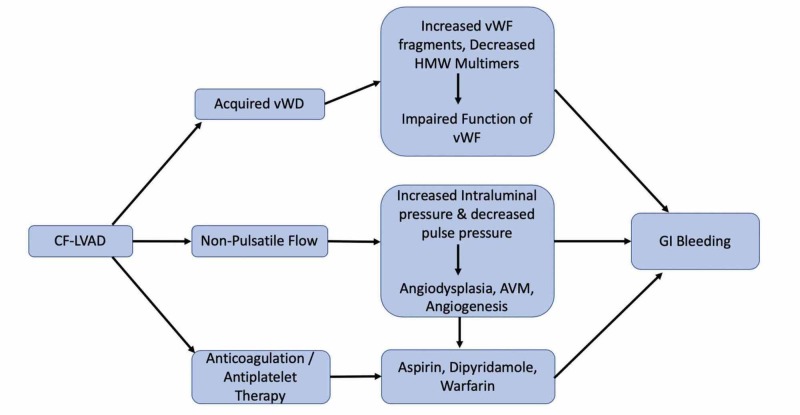
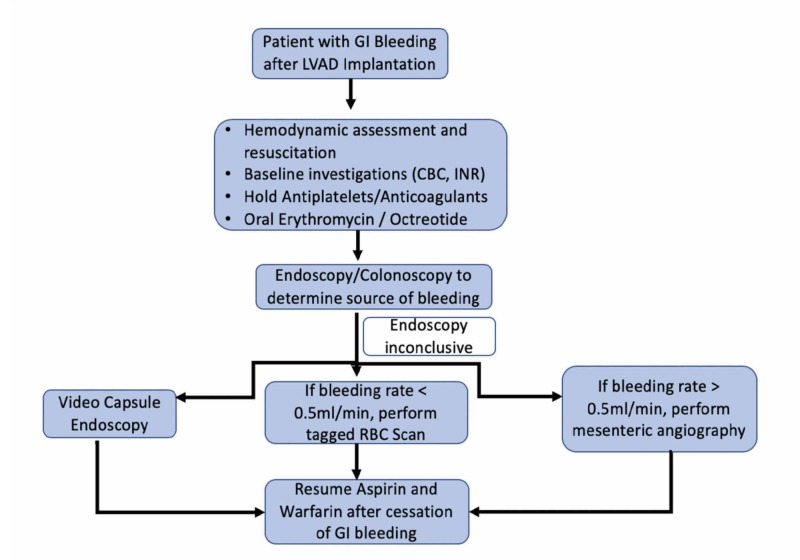
Left ventricular assist devices (LVADs) are an exceedingly important form of mechanical support for patients with end-stage heart failure. LVADs can be utilized both as a bridge to cardiac transplant and also as a definitive treatment. However, a few complications are associated with LVAD placement, the most common and cumbersome of which is gastrointestinal (GI) bleeding with an incidence of about 30%. These bleeding events often require transfusion therapy, but they are rarely fatal. The etiologies of GI bleeding following LVAD are multifactorial and include unstable hemodynamics, an acquired von Willebrand factor (vWf) deficiency, impaired platelet aggregation, and activation of fibrinolytic systems. The treatment of choice in LVAD implantation-associated GI bleeding is endoscopy, which plays a vital role in both its diagnosis and management. Even so, its effectiveness in controlling post-LVAD implantation GI bleeding is still poorly ascertained. In this article, we will review the use of medication and alterations in the LVAD setting to prevent the occurrence of GI bleeding, as well as the findings of previously reported literature on LVAD implantation-associated GI bleeding.
Keywords: end-stage heart failure; gastrointestinal bleeding; left ventricular assist device (lvad).
Copyright © 2019, Ahsan et al.
Conflict of interest statement
The authors have declared that no competing interests exist.
Figures
References
-
- Long-term survival after heart failure: a contemporary population-based perspective. Goldberg RJ, Ciampa J, Lessard D, Meyer TE, Spencer FA. Arch Intern Med. 2007;167:490–496. - PubMed
Publication types
LinkOut - more resources
Full Text Sources
Miscellaneous