Risk of Subjection to Violence and Perpetration of Violence in Persons With Psychiatric Disorders in Sweden
- PMID: 31940015
- PMCID: PMC6990843
- DOI: 10.1001/jamapsychiatry.2019.4275
Risk of Subjection to Violence and Perpetration of Violence in Persons With Psychiatric Disorders in Sweden
Erratum in
-
Error in Abstract, Figure 3, and in Captions to Figures 1, 2, and 4.JAMA Psychiatry. 2020 Apr 1;77(4):438. doi: 10.1001/jamapsychiatry.2020.0092. JAMA Psychiatry. 2020. PMID: 32074259 Free PMC article. No abstract available.
Abstract
Importance: Key outcomes for persons with psychiatric disorders include subjection to violence and perpetration of violence. The occurrence of these outcomes and their associations with psychiatric disorders need to be clarified.
Objective: To estimate the associations of a wide range of psychiatric disorders with the risks of subjection to violence and perpetration of violence.
Design, setting, and participants: A total of 250 419 individuals born between January 1, 1973, and December 31, 1993, were identified to have psychiatric disorders using Swedish nationwide registers. Premorbid subjection to violence was measured since birth. The patients were matched by age and sex to individuals in the general population (n = 2 504 190) and to their full biological siblings without psychiatric disorders (n = 194 788). The start date for the patients and control groups was defined as the discharge date of the first psychiatric episode. The participants were censored either when they migrated, died, experienced the outcome of interest, or reached the end of the study period on December 31, 2013. Data were analyzed from January 15 to September 14, 2019.
Exposures: Patients with common psychiatric disorders (eg, schizophrenia, bipolar disorder, depression, and anxiety) were differentiated using a hierarchical approach. Patients with personality disorders and substance use disorders were also included.
Main outcomes and measures: Subjection to violence was defined as an outpatient visit (excluding a primary care visit), inpatient episode, or death associated with any diagnosis of an injury that was purposefully inflicted by other persons. Perpetration of violence was defined as a violent crime conviction. Stratified Cox regression models were fitted to account for the time at risk, a range of sociodemographic factors, a history of violence, and unmeasured familial confounders (via sibling comparisons).
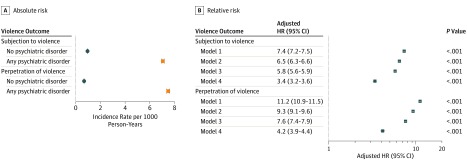
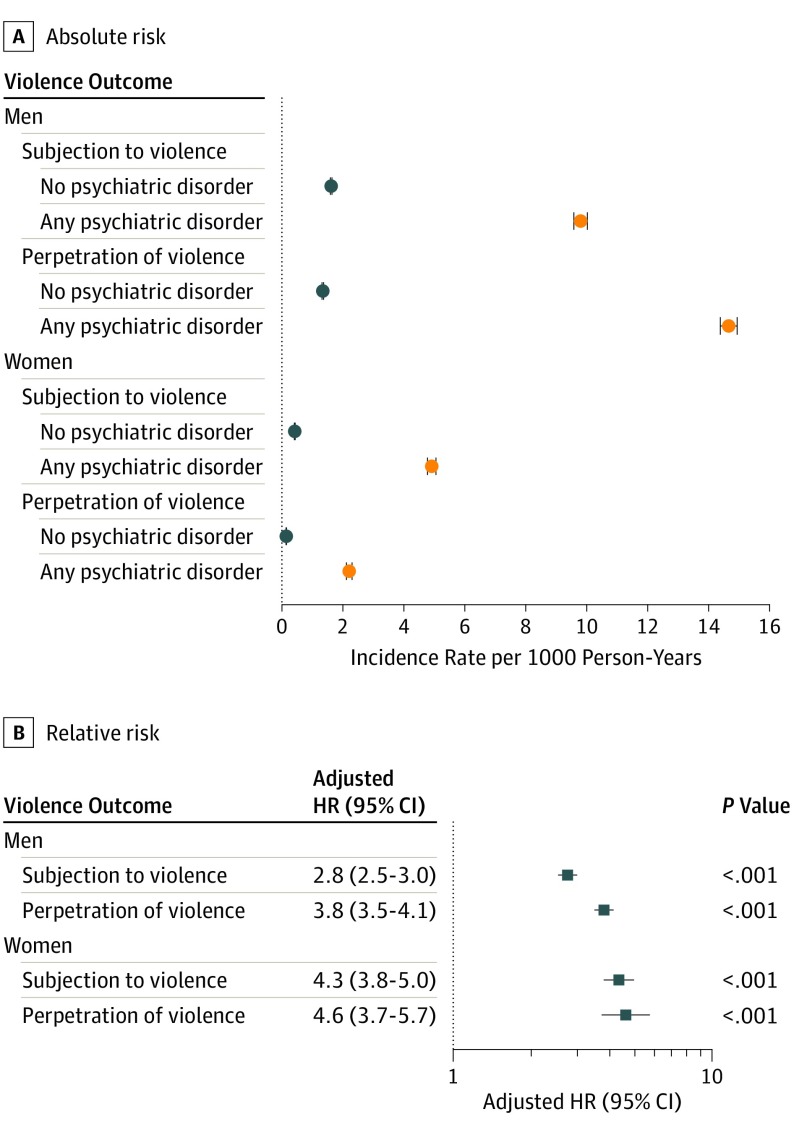
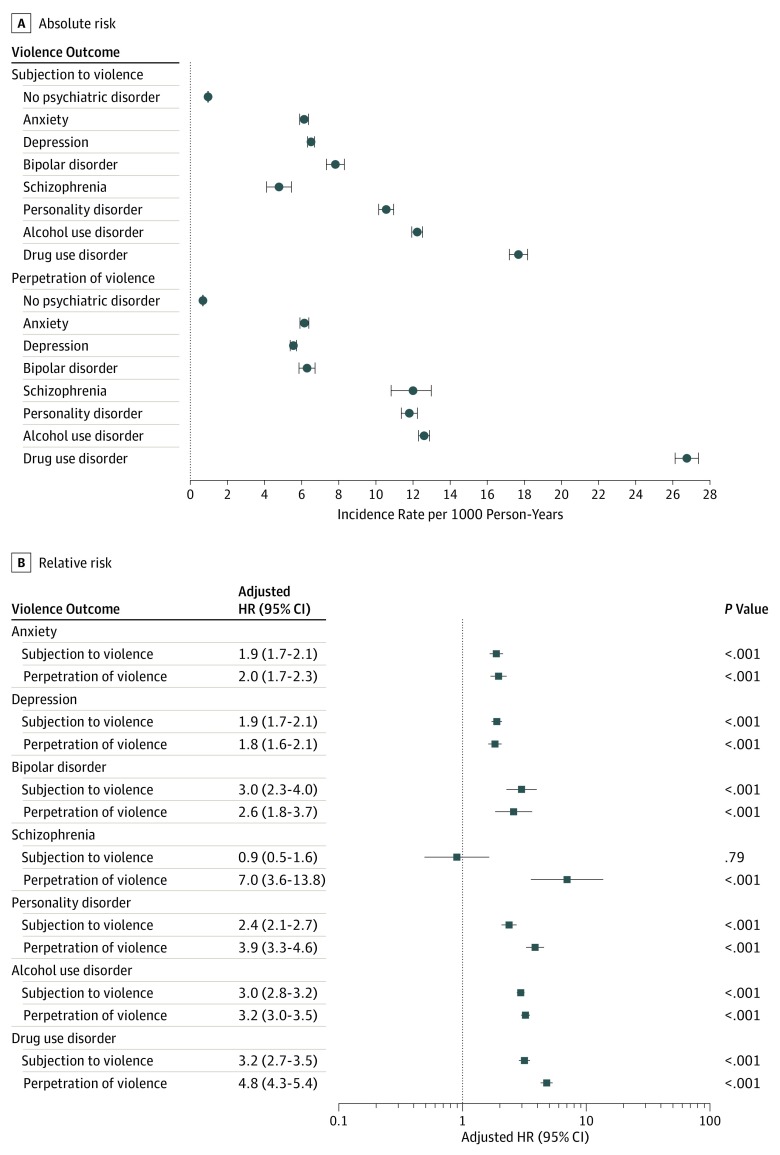
Results: Among 250 419 patients (55.4% women), the median (interquartile range) age at first diagnosis ranged from 20.0 (17.4-24.0) years for alcohol use disorder to 23.7 (19.9-28.8) years for anxiety disorder. Compared with 2 504 190 matched individuals without psychiatric disorders from the general population, patients with psychiatric disorders were more likely to be subjected to violence (7.1 [95% CI, 6.9-7.2] vs 1.0 [95% CI, 0.9-1.0] per 1000 person-years) and to perpetrate violence (7.5 [95% CI, 7.4-7.6] vs 0.7 [95% CI, 0.7-0.7] per 1000 person-years). In the fully adjusted models, patients with psychiatric disorders were 3 to 4 times more likely than their siblings without psychiatric disorders to be either subjected to violence (adjusted hazard ratio [aHR], 3.4 [95% CI, 3.2-3.6]) or to perpetrate violence (aHR, 4.2 [95% CI, 3.9-4.4]). Diagnosis with any of the specific disorders was associated with higher rates of violent outcomes, with the sole exception of schizophrenia, which was not associated with the risk of subjection to violence.
Conclusions and relevance: In this study, persons with psychiatric disorders were 3 to 4 times more likely than their siblings without psychiatric disorders to have been subjected to violence or to have perpetrated violence after the onset of their conditions. The risks of both outcomes varied by specific psychiatric diagnosis, history of violence, and familial risks. Clinical interventions may benefit from targeted approaches for the assessment and management of risk of violence in people with psychiatric disorders.
Conflict of interest statement
Figures
Comment in
-
Violent Acts and Being the Target of Violence Among People With Mental Illness-The Data and Their Limits.JAMA Psychiatry. 2020 Apr 1;77(4):345-346. doi: 10.1001/jamapsychiatry.2019.4266. JAMA Psychiatry. 2020. PMID: 31940025 No abstract available.
-
Limitations of Case Register Studies for Violence and Psychiatric Disorders.JAMA Psychiatry. 2020 Aug 1;77(8):875. doi: 10.1001/jamapsychiatry.2020.0830. JAMA Psychiatry. 2020. PMID: 32374353 No abstract available.
-
Limitations of Case Register Studies for Violence and Psychiatric Disorders-Reply.JAMA Psychiatry. 2020 Aug 1;77(8):875-876. doi: 10.1001/jamapsychiatry.2020.0835. JAMA Psychiatry. 2020. PMID: 32374355 No abstract available.
References
Publication types
MeSH terms
Grants and funding
LinkOut - more resources
Full Text Sources
Medical