. 2020 Apr:141:103976.
doi: 10.1016/j.micpath.2020.103976. Epub 2020 Jan 12.

Nipah shell disorder, modes of infection, and virulence

Affiliations

Nipah shell disorder, modes of infection, and virulence

Gerard Kian-Meng Goh et al. Microb Pathog. 2020 Apr.

Abstract

The Nipah Virus (NiV) was first isolated during a 1998-9 outbreak in Malaysia. The outbreak initially infected farm pigs and then moved to humans from pigs with a case-fatality rate (CFR) of about 40%. After 2001, regular outbreaks occurred with higher CFRs (~71%, 2001-5, ~93%, 2008-12). The spread arose from drinking virus-laden palm date sap and human-to-human transmission. Intrinsic disorder analysis revealed strong correlation between the percentage of disorder in the N protein and CFR (Regression: r2 = 0.93, p < 0.01, ANOVA: p < 0.01). Distinct disorder and, therefore, genetic differences can be found in all three group of strains. The fact that the transmission modes of the Malaysia strain are different from those of the Bangladesh strains suggests that the correlations may also be linked to the modes of viral transmission. Analysis of the NiV and related viruses suggests links between modes of transmission and disorder of not just the N protein but, also, of M shell protein. The links among shell disorder, transmission modes, and virulence suggest mechanisms by which viruses are attenuated as they passed through different cell hosts from different animal species. These have implications for development of vaccines and epidemiological molecular analytical tools to contain outbreaks.

Keywords: Intrinsically disordered protein; Nipah; Nucleocapsid; Protein function; Protein structure; Shell; Viral protein; Virulence.


Conflict of interest statement

Declaration of competing interest GKMG is an independent researcher, and the owner of Goh's BioComputing, Singapore. GKMG has also written a book on a related subject. The authors have no other potential conflict of interests.

Figures

Fig. 1
Fig. 1
An illustrated organization of the NiV genome (Acheson 2007).
Fig. 2
Fig. 2
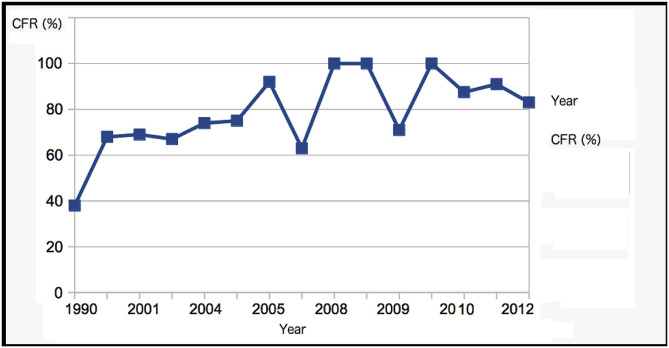
A CFR (Case-Fatality Ratio) as shown by outbreaks by year. The calculations and data shown have been adjusted for “noise” especially involving samples with the number of cases in the outbreaks that are too small to be reliable. Regression analysis (p < 0.01, F = 44.1, r2 = 0.81) shows correlation between the CFR and year of infection. One-Way ANOVA analysis based on dividing three groups, 1998–9, 2001–6, and 2008–12, has yielded a statistically significant result (One-Way ANOVA: F = 49, p < 0.01). Average CFRs (~40% in 1998–9, ~75% in 2001–5, and ~85% in 2007–12).
Fig. 3
Fig. 3
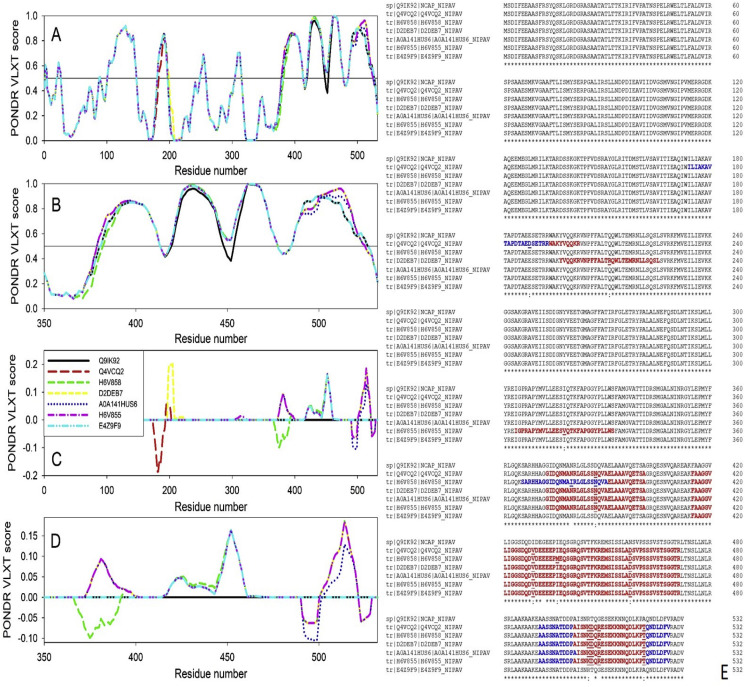
Differences in nucleocapid disorder of various Nipah virus strains. A. PONDR® VLXT plots of the nucleocapsid proteins of various NiV strains listed in Table 1. B. Zoomed-in PONDR® VLXT plots of the C-terminal regions of the nucleocapsid proteins of various NiV strains. C. Disorder “difference spectra” representing differences between the various NiV strains in relation to the Malaysia-Singapore 1998-9 strain. D. Zoomed-in disorder “difference spectra” representing differences between the various NiV strains in relation to the Malaysia-Singapore 1998-9 strain with the focus on the C-terminal regions of the nucleocapsid proteins. In these plots, the corresponding disorder “difference spectra” were calculated by subtracting the PONDR® VLXT profile of the Malaysia-Singapore 1998-9 strain from the PONDR® VLXT profiles of other NiV strain. Positive peaks here correspond to the region of newer strains that are more disordered than the corresponding regions in the Malaysia-Singapore 1998-9 strain, whereas negative peaks show regions with higher disorder in the Malaysia-Singapore 1998-9 strain relative to the newer NiV strains. E. Multiple sequence alignments of N proteins from different NiV strains listed in Table 1. Alignment was conducted by Clustal Omega (https://www.ebi.ac.uk/Tools/msa/clustalo/) using the default parameters. Residues, which are predicted to be more disordered in the Malaysia-Singapore 1998-9 strain relative to the newer NiV strains are shown by bold blue font, whereas bold red font is used to show residues predicted to be more disordered in the more recent NiV strains relative to the Malaysia-Singapore 1998-9 strain.
Fig. 4
Fig. 4
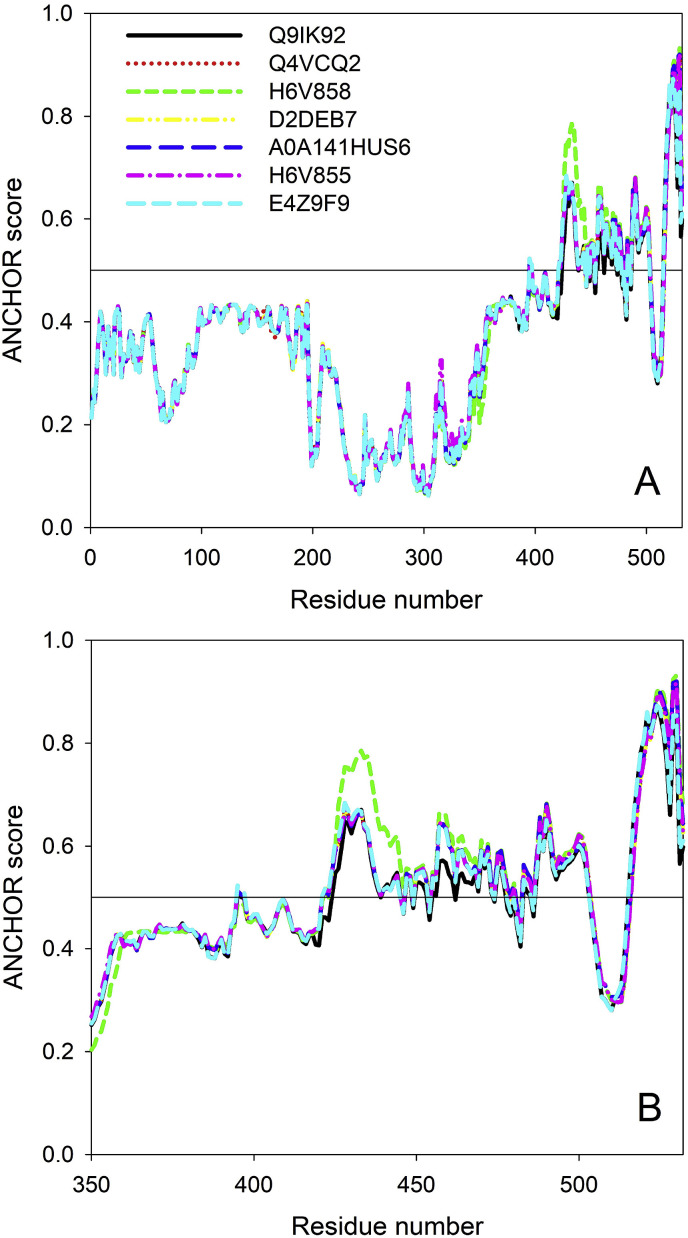
ANCHOR-based analysis of the potential intrinsic disorder-based interactivity of N proteins from different NiV strains. A. ANCHOR plot for the full-length proteins. B. Zoomed-in ANCHOR plot showing C-terminal regions of the N-proteins that are most affected by the strain-specific variability.
Fig. 5
Fig. 5
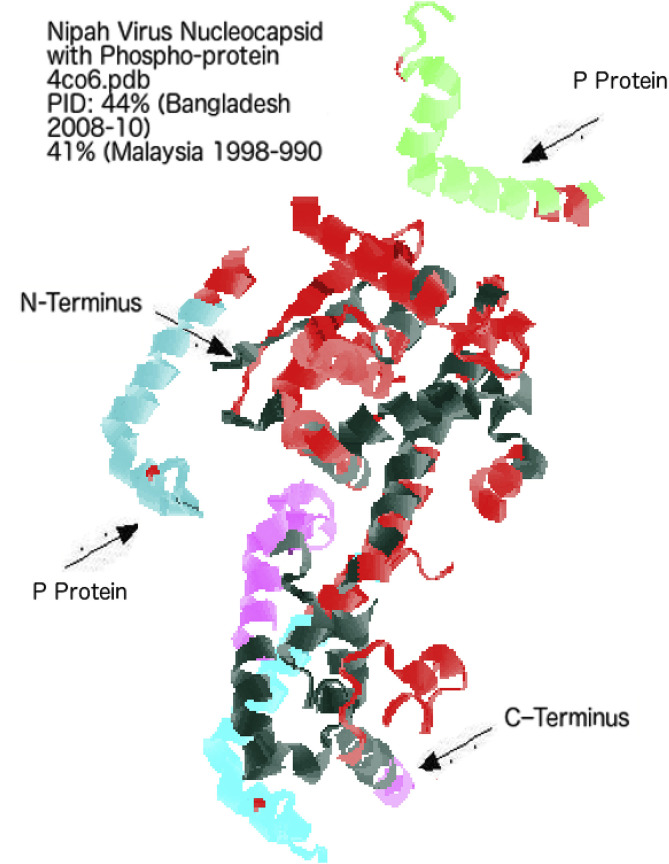
3D Crystal Structure Representation of Nipah Nucleocapsid with Disorder Annotated in Red. The region in pink (around location 315) represents the area that have larger predicted disorder residues in Bangladesh-India 2007-12 strains when compared to that of Malaysia-Singapore 1998–9.
Fig. 6
Fig. 6
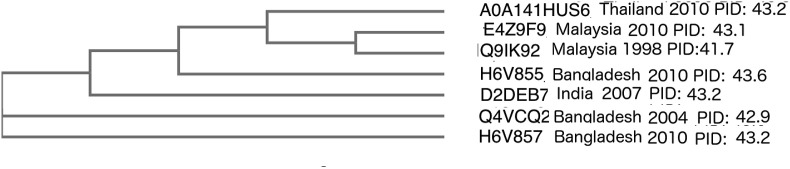
Phylogenetic tree based on N protein of selected NiV strains with disorder. accession code, location, year and PID (disorder level) denoted.
Fig. 7
Fig. 7
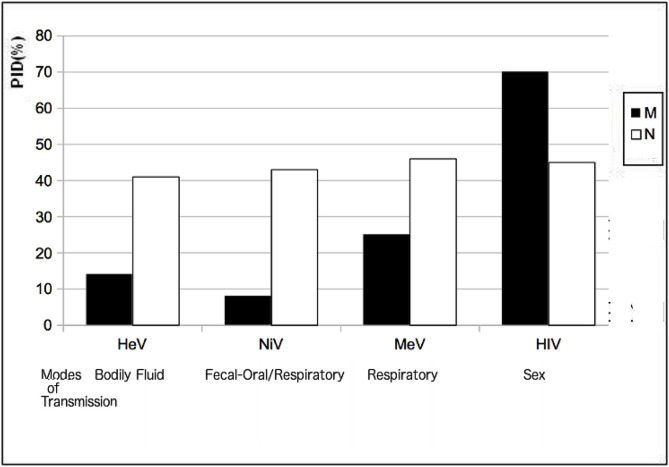
Relationship Between Shell Disorder and Modes of Transmission. The level of disorder (PID) rises as the fecal-oral component decreases. It should be noted that HeV is known to spread by contact with bodily fluid and therefore has a higher fecal-oral component. Depending of the strain, NiV can spread via respiratory and fecal-oral routes including close contacts with bodily fluids. MeV and HIV are spread mainly by respiratory and sexual modes respectively. For comparative purposes, only maximal PIDs found for a virus and protein are used.

References

    1. Angeletti S., Lo Presti A., Cella E., Ciccozzi M. Molecular epidemiology and phylogeny of nipah virus infection: a mini review. Asian Pac J Trop Med. 2016;9:630–634. - PMC - PubMed
    1. Ang B.S.P., Lim T.C.C., Wang L. Nipah virus infection. J. Clin. Microbiol. 2018;56 e1875-17. - PMC - PubMed
    1. Mire C.E., Satterfield B.A., Geisbert J.B., Agans K.N., Borisevich V., Yan L., Chan Y.P., Cross R.W., Fenton K.A., Broder C.C. Pathogenic differences between nipah virus Bangladesh and Malaysia strains in primates: implications for antibody therapy. Sci. Rep. 2016;6:30916. Mire et al. 2018) - PMC - PubMed
    1. Lo Presti A., Cella E., Giovanetti M., Lai A., Angeletti S., Zehender G., Ciccozzi M. Origin and evolution of nipah virus. J. Med. Virol. 2016;88:380–388. - PubMed
    1. Sun B., Jia L., Liang B., Chen Q., Liu D. Phylogeography, transmission, and viral proteins of Nipah virus. Virol. Sin. 2018;33:385–393. - PMC - PubMed

MeSH terms

LinkOut - more resources