Case Reports
. 2020 Jan 15;20(1):38.
doi: 10.1186/s12885-020-6516-1.

Early relapse on adjuvant gemcitabine associated with an exceptional response to 2nd line capecitabine chemotherapy in a patient with pancreatic adenosquamous carcinoma with strong intra-tumoural expression of cytidine deaminase: a case report

Affiliations
Case Reports

Early relapse on adjuvant gemcitabine associated with an exceptional response to 2nd line capecitabine chemotherapy in a patient with pancreatic adenosquamous carcinoma with strong intra-tumoural expression of cytidine deaminase: a case report

Claire M Connell et al. BMC Cancer. .

Abstract

Background: Pancreatic adenosquamous carcinoma has a poor prognosis, with limited prospective trial data to guide optimal treatment. The potential impact of drug metabolism on the treatment response of patients with pancreatic adenosquamous carcinoma is largely unknown.

Case presentation: We describe the case of a 51 year old woman with pancreatic adenosquamous carcinoma who, following surgical resection, experienced early disease relapse during adjuvant gemcitabine therapy. Paradoxically, this was followed by an exceptional response to capecitabine therapy lasting 34.6 months. Strong expression of cytidine deaminase was detected within the tumour.

Conclusions: This case study demonstrates that early relapse during adjuvant chemotherapy for pancreatic adenosquamous carcinoma may be compatible with a subsequent exceptional response to second line chemotherapy, an important observation given the poor overall prognosis of patients with adenosquamous carcinoma. Cytidine deaminase is predicted to inactivate gemcitabine and, conversely, catalyze capecitabine activation. We discuss strong intra-tumoural expression of cytidine deaminase as a potential mechanism to explain this patient's disparate responses to gemcitabine and capecitabine therapy, and highlight the benefit that may be gained from considering similar determinants of response to chemotherapy in clinical practice.

Keywords: Cytidine deaminase; Drug metabolism; Gemcitabine; Pancreatic adenosquamous carcinoma.


Conflict of interest statement

The authors declare that they have no competing interests.

Figures
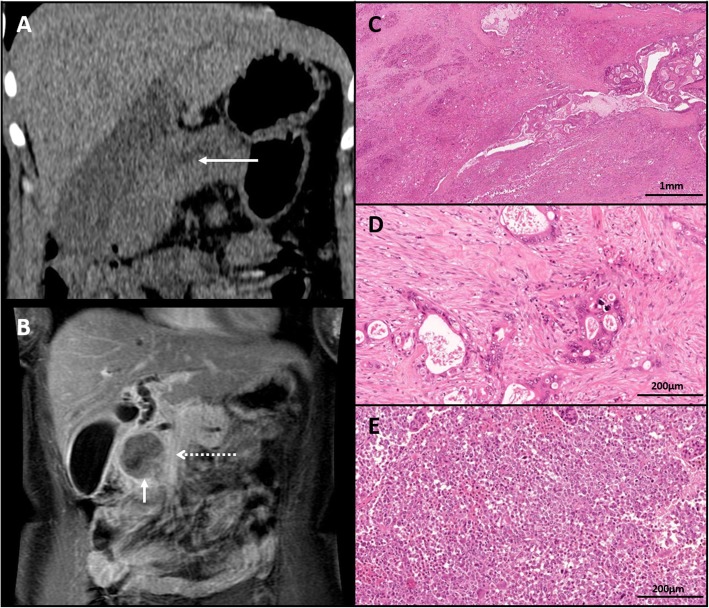
Fig. 1
Fig. 1
Head of pancreas carcinoma with adenosquamous and undifferentiated components; (a) unenhanced CT demonstrating a mass at the head of the pancreas with marked pancreatic duct dilatation (solid arrow); (b) Coronal MRI (with gadolinium contrast) demonstrating head of pancreas mass (solid arrow) abutting the adjacent SMV (dashed arrow); (c) hematoxylin and eosin stain of head of pancreas tumour from Whipple’s resection demonstrating a biphasic carcinoma with adenosquamous (magnified in (d)) and undifferentiated (magnified in (e)) components
Fig. 2
Fig. 2
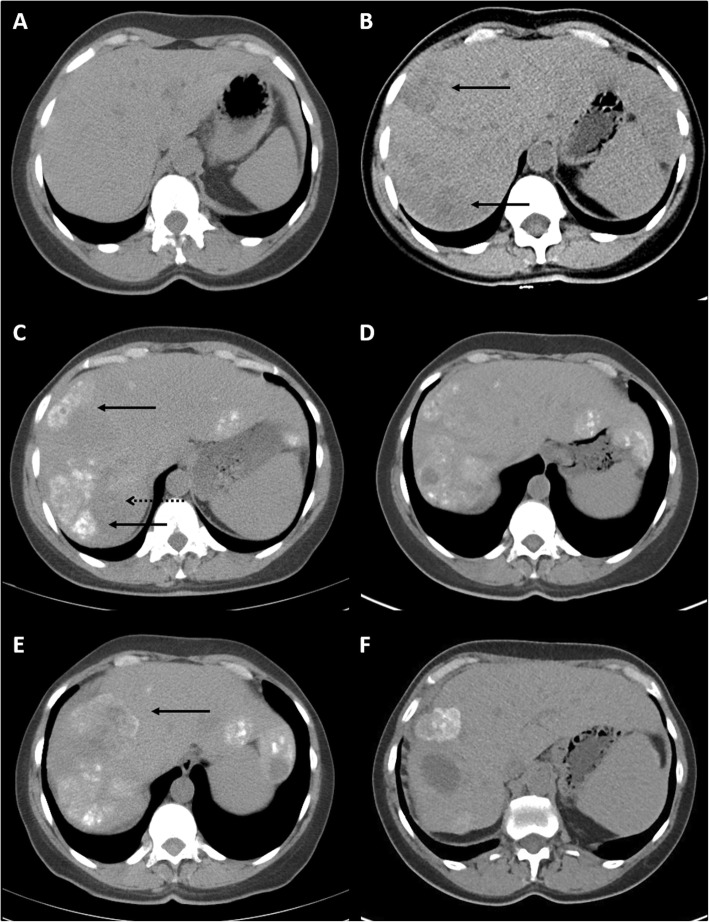
Radiological progression of liver metastases, by unenhanced CT. a baseline liver free of metastatic disease; b new liver lesions in segments 7 and 8 (solid arrows) 1.8 months into gemcitabine therapy; c high attenuation calcification of pre-existing liver lesions (solid arrows) and further low attenuation cystic components (dashed arrow) 13.8 months into capecitabine therapy; d stable liver disease 32.3 months into capecitabine therapy; e increase in size of segment 8 liver lesion (solid arrow) 34.6 months into capecitabine therapy; f stable liver disease 13.3 months into modified FOLFIRINOX therapy
Fig. 3
Fig. 3
CDA protein expression within adenosquamous and undifferentiated tumour components. Formalin-fixed paraffin-embedded sections of adenosquamous (a) and undifferentiated (b) tumour components were stained with a polyclonal rabbit anti-CDA antibody (Epitomics) on a Leica BOND-MAX Autostainer (Leica Biosystems, UK), with heat-induced epitope retrieval with pH 6.0 citrate-based solution (ER1, Leica Biosystems, UK)

References

    1. Borazanci E, Millis S, Korn R, Han H, Whatcott C, Gatalica Z, et al. Adenosquamous carcinoma of the pancreas: molecular characterization of 23 patients along with a literature review. World J Gastrointest Oncol. 2015;7(9):132–140. doi: 10.4251/wjgo.v7.i9.132. - DOI - PMC - PubMed
    1. Katz MHG, Taylor TH, Al-Refaie WB, Hanna MH, Imagawa DK, Anton-Culver H, et al. Adenosquamous versus adenocarcinoma of the pancreas: a population-based outcomes analysis. J Gastrointest Surg. 2011;15:165–174. doi: 10.1007/s11605-010-1378-5. - DOI - PMC - PubMed
    1. Wild AT, Dholakia AS, Fan KY, Kumar R, Moningi S, Rosati LM, et al. Efficacy of platinum chemotherapy agents in the adjuvant setting for adenosquamous carcinoma of the pancreas. J Gastrointest Oncol. 2015;6:115–125. - PMC - PubMed
    1. De Souza AL, Saif MW. Platinum-based therapy in adenosquamous pancreatic cancer: experience at two institutions. JOP. 2014;15:144–146. - PubMed
    1. Khorana AA, Mangu PB, Berlin J, Engebretson A, Hong TS, Maitra A, et al. Potentially curable pancreatic Cancer: American Society of Clinical Oncology clinical practice guideline. J Clin Oncol. 2016;34:2541–2556. doi: 10.1200/JCO.2016.67.5553. - DOI - PubMed

Publication types

MeSH terms