


A Risk Stratification for Patients with Cervical Cancer in Stage IIIC1 of the 2018 FIGO Staging System
- PMID: 31941966
- PMCID: PMC6962323
- DOI: 10.1038/s41598-019-57202-3
A Risk Stratification for Patients with Cervical Cancer in Stage IIIC1 of the 2018 FIGO Staging System
Abstract
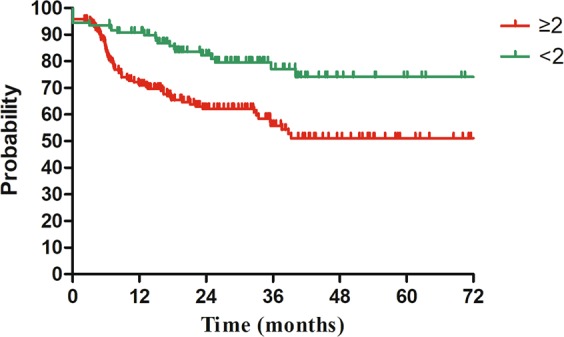
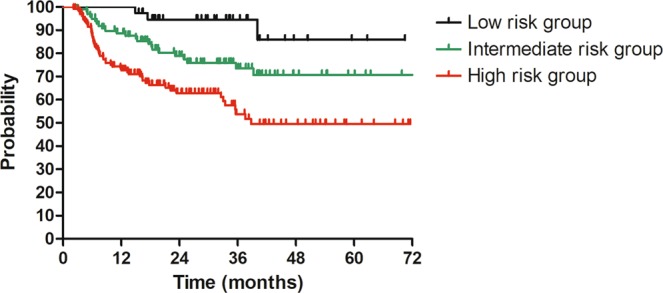
This retrospective study was designed to investigate the heterogeneity of patients with cervical cancer in stage IIIC1 (the 2018 International Federation of Gynecology and Obstetrics staging system, FIGO) and conduct a risk stratification for this group of patients. We reviewed clinical records of 325 patients with stage IIIC1 treated with definitive concurrent chemoradiotherapy in our institute between January 2008 and December 2014. The median follow-up duration was 28.4 months (range: 1.9-114.2 months). The 3-year DFS for the 325 eligible patients was 66.3%. Tumor size of ≥4 cm and number of pelvic lymph node metastasis ≥2 were identified as adverse prognostic factors for disease free survival (DFS) in cervical cancer patients with stage IIIC1 (2018). A risk stratification based on the number of identified prognostic factors for DFS was performed. The 3-year DFS for patients in low-risk (without prognostic factor), intermediate-risk (with one prognostic factor) and high-risk group (with two prognostic factors) was 92.1%, 70.0%, and 51.1%, respectively (P < 0.001). Our study confirms the heterogeneity of patients with cervical cancer in FIGO stage IIIC1 (the 2018 FIGO staging system). Tumor size and number of pelvic lymph node metastasis (PLNM) are significant prognostic factors for DFS in patients with FIGO stage IIIC1. The next revision of FIGO staging system for cervical cancer, especially for stage IIIC1, should focus on tumor size and number of pelvic lymph node metastasis.
Conflict of interest statement
The authors declare no competing interests.
Figures


References
-
- Narayan K, Fisher RJ, Bernshaw D, Shakher R, Hicks RJ. Patterns of failure and prognostic factor analyses in locally advanced cervical cancer patients staged by positron emission tomography and treated with curative intent. Int. J. Gynecol. Cancer. 2009;19:912–918. doi: 10.1111/IGC.0b013e3181a58d3f. - DOI - PubMed
