. 2020 Jan 15;10(1):310.
doi: 10.1038/s41598-019-57272-3.

Rumor Propagation is Amplified by Echo Chambers in Social Media

Affiliations

Rumor Propagation is Amplified by Echo Chambers in Social Media

Daejin Choi et al. Sci Rep. .

Abstract

Spreading rumors on the Internet has become increasingly pervasive due to the proliferation of online social media. This paper investigates how rumors are amplified by a group of users who share similar interests or views, dubbed as an echo chamber. To this end, we identify and analyze 'rumor' echo chambers, each of which is a group of users who have participated in propagating common rumors. By collecting and analyzing 125 recent rumors from six popular fact-checking sites, and their associated 289,202 tweets/retweets generated by 176,362 users, we find that the rumors that are spread by rumor echo chamber members tend to be more viral and quickly propagated than those that are not spread by echo chamber members. We propose the notion of an echo chamber network that represents relations among rumor echo chambers. By identifying the hub rumor echo chambers (in terms of connectivity to other rumor echo chambers) in the echo chamber network, we show that the top 10% of hub rumor echo chambers contribute to propagation of 24% rumors by eliciting more than 36% of retweets, implying that core rumor echo chambers significantly contribute to rumor spreads.


Conflict of interest statement

The authors declare no competing interests.

Figures
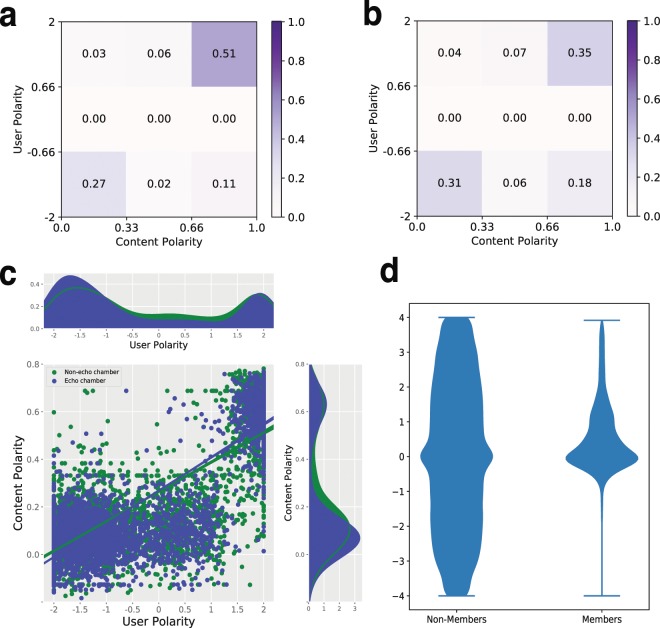
Figure 1
Figure 1
Measuring selective exposure and political homophily in rumor echo chambers. The portions of members (a) and non-members (b) of rumor echo chambers in terms of content and user polarity are plotted. In both figures, the portions of the users in the left-bottom and right-top cells tend to be higher than others, meaning that users participating in rumor spreads tend to show the selective exposure in general. Comparing (a,b), the sum of the portions of user in the left-bottom and right-top cells of echo chamber and non-echo chamber are 0.78 and 0.68, respectively, meaning that echo chamber members show the relatively stronger selective exposure than non-members. As a case study, (c) shows the user and content polarities of each user for the rumor “YETI cut ties with the NRA”. The scatter plot shows the user and content polarities of each user, and one-dimensional plots along the axes reveal the distributions of the user and content polarities. The content polarities of echo chamber members show the stronger bimodal distribution than those of non-members. These results imply that echo chambers tend to exhibit stronger selective exposure. (d) shows the distribution of user homogeneity scores of the users who belong to the same echo chamber. For the comparison purpose, we randomly select 100 K pairs of users who do not belong to the same echo chamber, and compute their user homogeneity scores. The result reveals that echo chamber members tend to share similar political views.
Figure 2
Figure 2
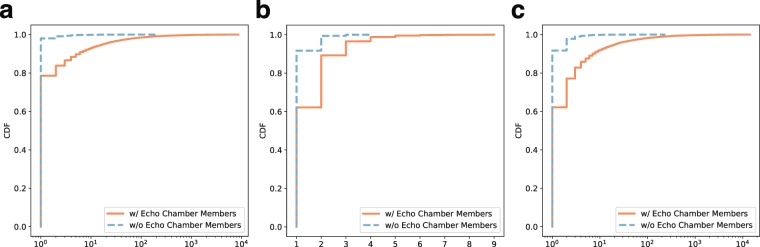
Structural properties of tweet rumor cascades. Rumor cascades where echo chamber members and non-members participate are compared in terms of size (a), height (b), and width (c). The rumor cascades with echo chamber members tend to be propagated to more audiences, deeper, and wider than the ones without members.
Figure 3
Figure 3
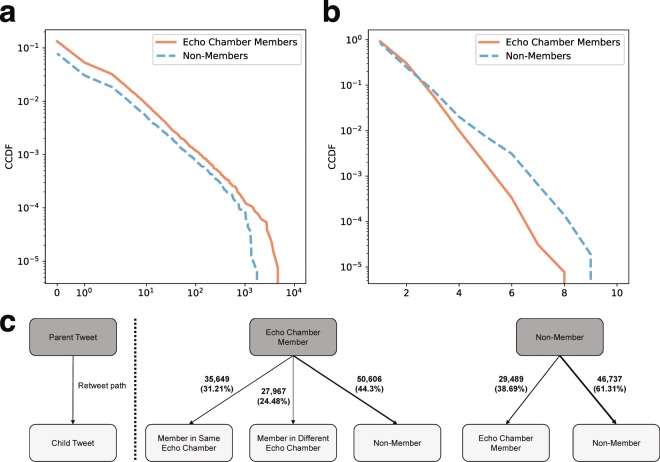
Roles of echo chambers in rumor cascades. Distributions of depth and number of retweets elicited by echo chamber members and by non-members are shown in (a,b), respectively. Most echo chamber members tend to be located at close to the roots of rumor cascades, and are likely to generate more retweets than non-members. The numbers (and portions) of retweets from members/non-members to members/non-members are described in (c). Overall, rumors tend more to be propagated to non-members while the portions of retweet paths from both members and non-members to non-members are different (44% and 61%, respectively). The portion of retweet paths between the members in the same echo chamber is higher than the ones in different echo chambers, meaning that rumors written by an echo chamber member tend to be more propagated among non-members or members in a same echo chamber.
Figure 4
Figure 4
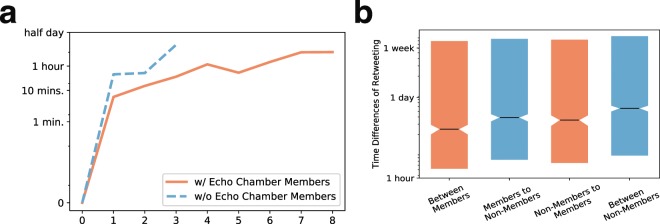
Speed of rumor propagation. We plot the depth increment times of rumor cascades with and without echo chamber members (a), and the distribution of the propagation times (b). Rumor cascades with echo chamber members are spread more quickly than those without members. The propagation times toward echo chamber members (orange boxes) are shorter than the ones in the case of retweet-paths toward non-members. In addition, the time differences from members are shorter than those from non-members. These results imply that echo chamber members contribute to propagate rumors quickly, by not only retweeting the rumor quickly but also eliciting other users’ quick responses.
Figure 5
Figure 5
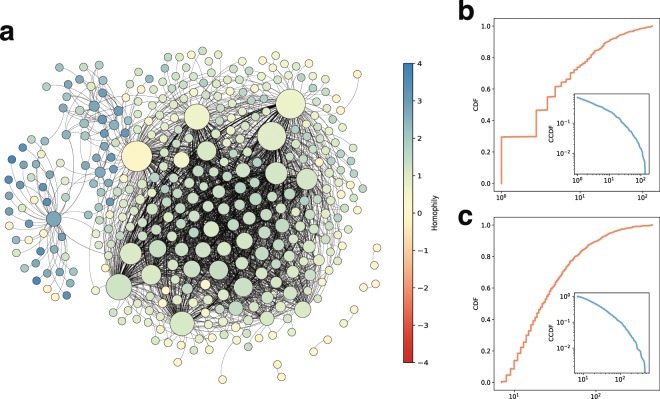
The echo chamber network. We depict the echo chamber network (a). The size and color of nodes indicates degree and member homophily, respectively. A node is close to blue or red if the homophily score is close to 4 or −4, respectively. The yellow nodes represent that the homophily score is close to 0. Distributions of degrees and weights of the echo chamber network are plotted at (b,c). Both distributions follow a heavy-tail distribution, which spans up to several orders of magnitudes.
Figure 6
Figure 6
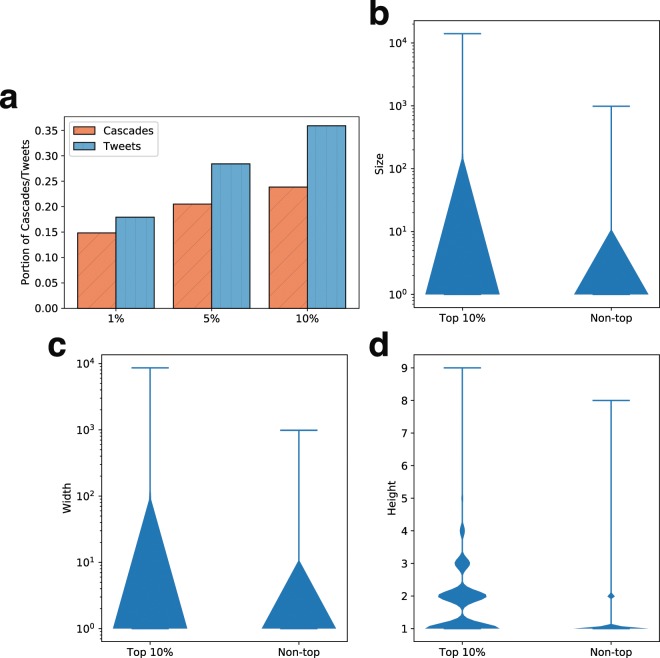
Contributions by hub echo chambers in rumor propagation. The top echo members in terms of degree tend to actively participate in rumor propagation and the rumor cascades where the members in these echo chambers are involved tend to be larger, wider, and deeper, which implies that participation from these members can be an signal to find viral rumor propagation.
Figure 7
Figure 7
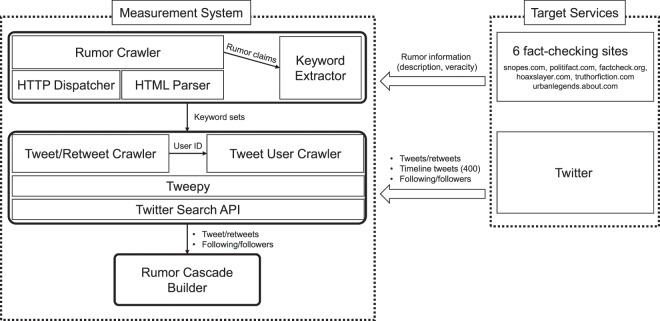
Rumor cascades measurement system. Our measurement system that crawls rumors, their associated tweets/retweets, and user information is depicted. We build each rumor cascade based on the collected tweets/retweets and their associated users’ following information.
Figure 8
Figure 8
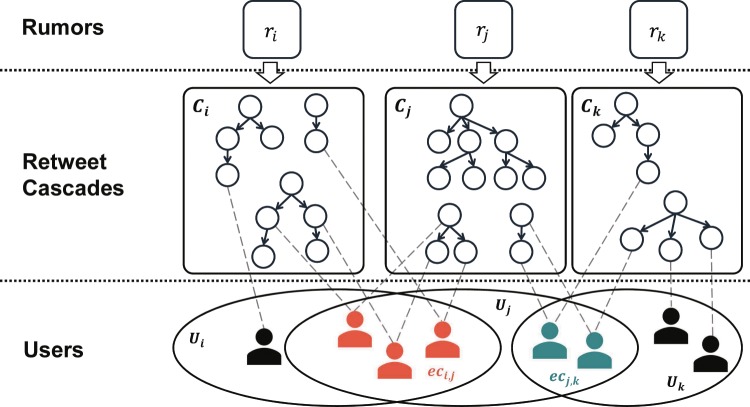
Identifying a rumor echo chamber. We first consider a set of the cascades (Ci) for a given rumor ri, where the cascades are built from the tweets written by a set of users Ui. We then compute a set of echo chambers EC whose element eci,j is the intersection of Ui and Uj, corresponding a given pair of rumors ri and rj, respectively.

References

    1. Bakshy, E., Rosenn, I., Marlow, C. & Adamic, L. The role of social networks in information diffusion. In Proceedings of the 21st International World Wide Web Conference (2012).
    1. Cha, M., Mislove, A. & Gummadi, K. P. A measurement-driven analysis of information propagation in the flickr social network. In Proceedings of the 18th International World Wide Web Conference (2009).
    1. Han, J. et al. Collecting, organizing, and sharing pins in pinterest: Interest-driven or social-driven? In Proceedings of the 2014 ACM International Conference on Measurement and Modeling of Computer Systems (2014).
    1. Zhao, Z., Resnick, P. & Mei, Q. Enquiring minds: Early detection of rumors in social media from enquiry posts. In Proceedings of the 24th International Conference on World Wide Web (2015).
    1. Vosoughi S, Roy D, Aral S. The spread of true and false news online. Sci. 2018;359:1146–1151. doi: 10.1126/science.aap9559. - DOI - PubMed

Publication types