


BAD sensitizes breast cancer cells to docetaxel with increased mitotic arrest and necroptosis
- PMID: 31942016
- PMCID: PMC6962214
- DOI: 10.1038/s41598-019-57282-1
BAD sensitizes breast cancer cells to docetaxel with increased mitotic arrest and necroptosis
Abstract
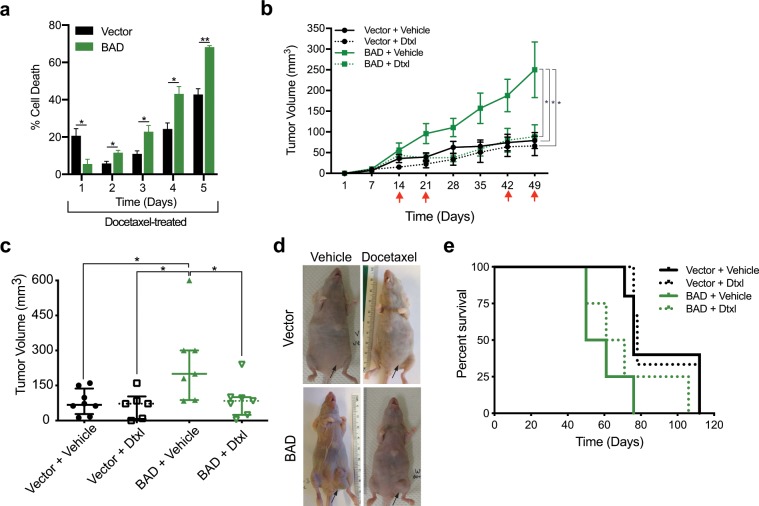
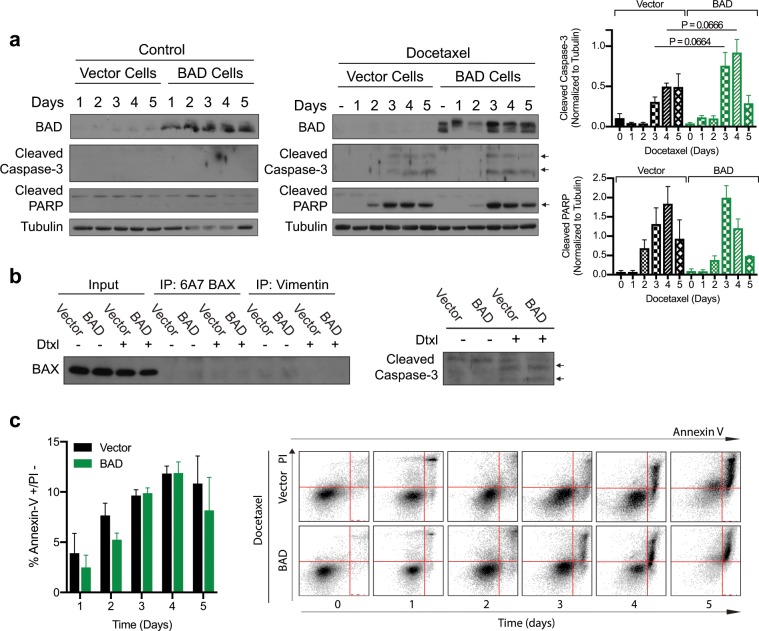
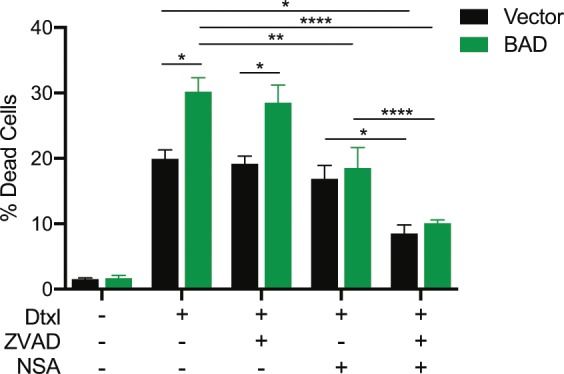
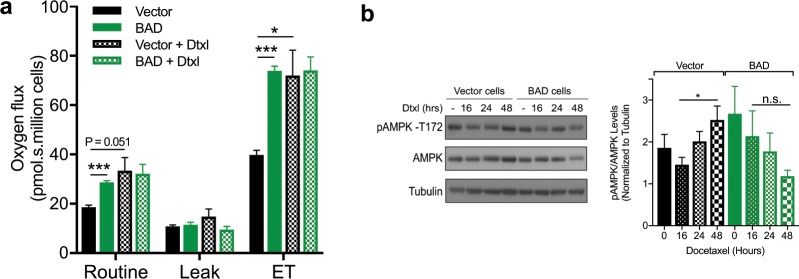
Breast cancer patients are commonly treated with taxane (e.g. docetaxel) chemotherapy, despite poor outcomes and eventual disease relapse. We previously identified the Bcl-2-associated death promoter (BAD) as a prognostic indicator of good outcome in taxane-treated breast cancer patients. We also demonstrated that BAD expression in human breast carcinoma cells generated larger tumors in mouse xenograft models. These paradoxical results suggest that BAD-expressing tumors are differentially sensitive to taxane treatment. We validated this here and show that docetaxel therapy preferentially reduced growth of BAD-expressing xenograft tumors. We next explored the cellular mechanism whereby BAD sensitizes cells to docetaxel. Taxanes are microtubule inhibiting agents that cause cell cycle arrest in mitosis whereupon the cells either die in mitosis or aberrantly exit (mitotic slippage) and survive as polyploid cells. In response to docetaxel, BAD-expressing cells had lengthened mitotic arrest with a higher proportion of cells undergoing death in mitosis with decreased mitotic slippage. Death in mitosis was non-apoptotic and not dependent on Bcl-XL interaction or caspase activation. Instead, cell death was necroptotic, and dependent on ROS. These results suggest that BAD is prognostic for favourable outcome in response to taxane chemotherapy by enhancing necroptotic cell death and inhibiting the production of potentially chemoresistant polyploid cells.
Conflict of interest statement
The authors declare no competing interests.
Figures



References
-
- Yu K.-D., Zhu R., Zhan M., Rodriguez A. A., Yang W., Wong S., Makris A., Lehmann B. D., Chen X., Mayer I., Pietenpol J. A., Shao Z.-M., Symmans W. F., Chang J. C. Identification of Prognosis-Relevant Subgroups in Patients with Chemoresistant Triple-Negative Breast Cancer. Clinical Cancer Research. 2013;19(10):2723–2733. doi: 10.1158/1078-0432.CCR-12-2986. - DOI - PMC - PubMed
-
- Bonnefoi Hervé, Piccart Martine, Bogaerts Jan, Mauriac Louis, Fumoleau Pierre, Brain Etienne, Petit Thierry, Rouanet Philippe, Jassem Jacek, Blot Emmanuel, Zaman Khalil, Cufer Tanja, Lortholary Alain, Lidbrink Elisabet, André Sylvie, Litière Saskia, Lago Lissandra Dal, Becette Véronique, Cameron David A, Bergh Jonas, Iggo Richard. TP53 status for prediction of sensitivity to taxane versus non-taxane neoadjuvant chemotherapy in breast cancer (EORTC 10994/BIG 1-00): a randomised phase 3 trial. The Lancet Oncology. 2011;12(6):527–539. doi: 10.1016/S1470-2045(11)70094-8. - DOI - PMC - PubMed
-
- Harris Lyndsay N., Ismaila Nofisat, McShane Lisa M., Andre Fabrice, Collyar Deborah E., Gonzalez-Angulo Ana M., Hammond Elizabeth H., Kuderer Nicole M., Liu Minetta C., Mennel Robert G., Van Poznak Catherine, Bast Robert C., Hayes Daniel F. Use of Biomarkers to Guide Decisions on Adjuvant Systemic Therapy for Women With Early-Stage Invasive Breast Cancer: American Society of Clinical Oncology Clinical Practice Guideline. Journal of Clinical Oncology. 2016;34(10):1134–1150. doi: 10.1200/JCO.2015.65.2289. - DOI - PMC - PubMed
-
- Craik A C, Veldhoen R A, Czernick M, Buckland T W, Kyselytzia K, Ghosh S, Lai R, Damaraju S, Underhill D A, Mackey J R, Goping I S. The BH3-only protein Bad confers breast cancer taxane sensitivity through a nonapoptotic mechanism. Oncogene. 2010;29(39):5381–5391. doi: 10.1038/onc.2010.272. - DOI - PubMed
Publication types
MeSH terms
Substances
LinkOut - more resources
Full Text Sources
Other Literature Sources
Medical
Molecular Biology Databases
Research Materials
