. 2019 Sep 25;2(4):252-258.
doi: 10.1002/ame2.12084. eCollection 2019 Dec.

Characterization of inflammation and insulin resistance in high-fat diet-induced male C57BL/6J mouse model of obesity

Affiliations

Characterization of inflammation and insulin resistance in high-fat diet-induced male C57BL/6J mouse model of obesity

Dimiter Avtanski et al. Animal Model Exp Med. .

Abstract

Background: Animal models of diet-induced obesity (DIO) are commonly used in medical research for mimicking human diseases. There is no universal animal model, and careful evaluation of variety of factors needs to be considered when designing new experiments. Here, we investigated the effect of 9 weeks high-fat diet (HFD) intervention, providing 60% energy from fat, on parameters of inflammation and insulin resistance in male C57BL/6J mice.

Methods: Six weeks old mice were initiated on regular diet (RD) or HFD providing 60 kcal energy from fat for 9 weeks. Fasting blood glucose levels were measured by glucometer, and fasting plasma levels of insulin and proinflammatory cytokines by Luminex assay. Insulin sensitivity was evaluated by using QUICKI and HOMA2 indexes.

Results: HFD mice showed ~ 40% higher body weight and ~ 20% larger abdominal circumference, due to an increase in the white adipose tissue mass. Liver examination revealed increased size and higher hepatic lipid accumulation in livers from HFD mice compared to their RD counterparts. Animals from the HFD group were characterized with significantly higher presence of crown-like structures (CLS) in WAT and higher plasma levels of proinflammatory cytokines (TNF-α, IL-6, leptin, MCP-1, PAI-1, and resistin). HFD-fed mice also demonstrated impaired insulin sensitivity (lower QUICKI, higher HOMA-insulin resistance (HOMA-IR), and lower HOMA-percent sensitivity (HOMA-%S)) index values.

Conclusion: Male C57BL/6J mice on 9 weeks HFD providing 60 kcal energy from fat display impaired insulin sensitivity and chronic inflammation, thus making this DIO mouse model appropriate for studies of early stages of obesity-related pathology.

Keywords: diet; high‐fat; insulin resistance; mouse model.


Conflict of interest statement

None.

Figures
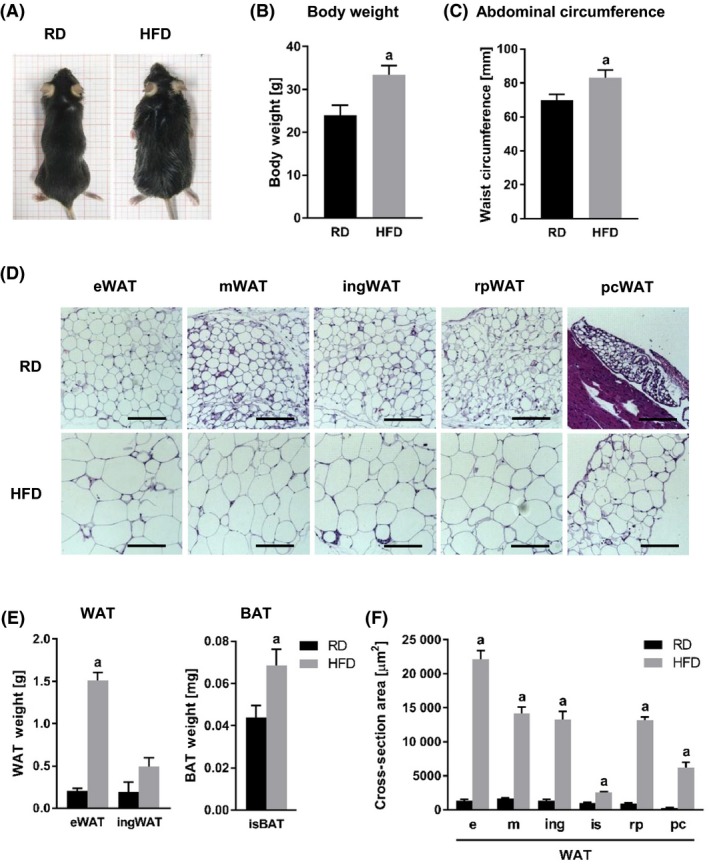
Figure 1
Figure 1
Effect of HFD on body weight and adipose tissue. A, Comparisons between RD and HFD mice in body habitus (A), body weight (B), and abdominal circumference (C). D, Cross sections of various WAT tissue depots from RD and HFD mice stained with H&E. E, Comparisons between RD and HFD mice in adipose tissue weight from different depots. F, Comparisons of adipocyte size in various WAT depots, measured as cross‐section area [µm2]. a, P < .0001. Abbreviations: RD, regular diet; HFD, high‐fat diet; WAT, white adipose tissue; BAT, brown adipose tissue; eWAT, epididymal WAT; ingWAT, inguinal WAT; mWAT, mesenteric WAT; isWAT, interscapular WAT; rpWAT, retroperitoneal WAT; pcWAT, pericardial WAT; isBAT, interscapular BAT; H&E, hematoxylin and eosin
Figure 2
Figure 2
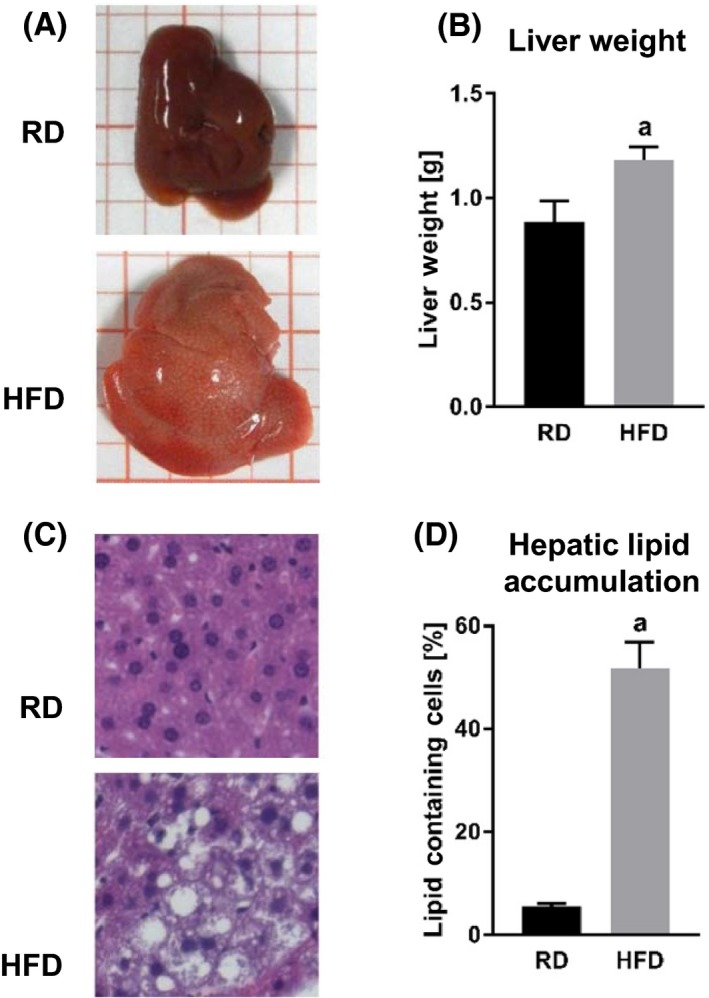
Effect of HFD on liver. Comparisons between livers from RD and HFD mice. A, Liver size and appearance. B, Liver weight. a, P = .0494. C, Liver cross sections stained with H&E. D, Hepatic lipid accumulation measured as percentage of hepatocytes containing lipids. a, P < .0001. Abbreviations: RD, regular diet; HFD, high‐fat diet
Figure 3
Figure 3
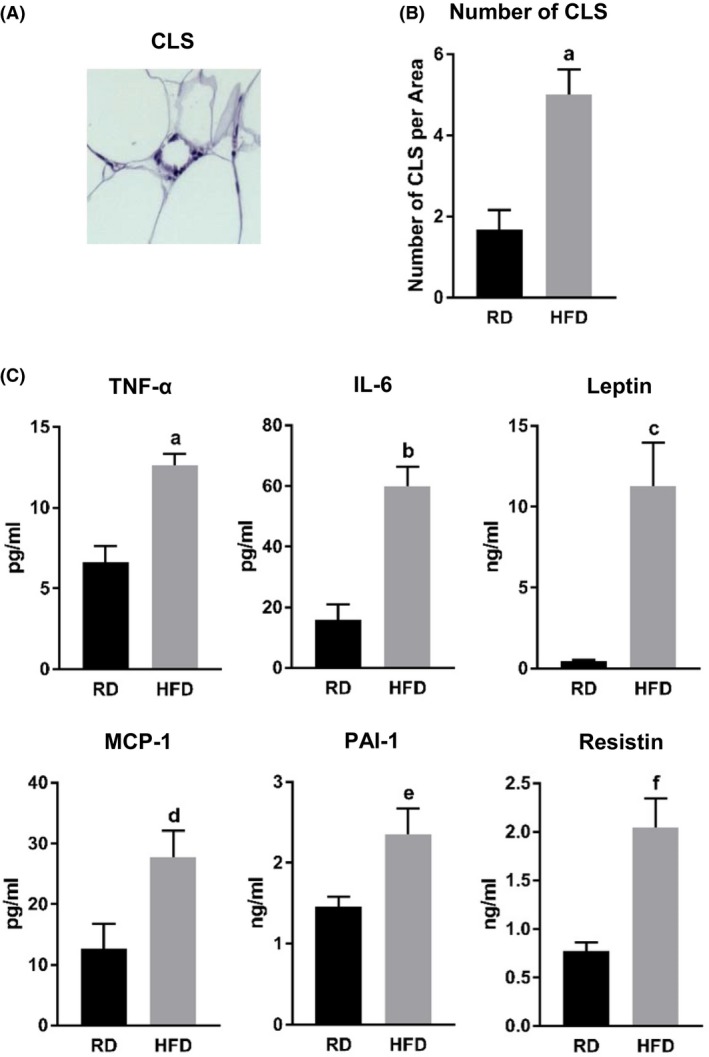
Effect of HFD on chronic inflammation. A, CLS. B, Comparisons between RD and HFD mice in number of CLS. Data are presented as number of CLS per visual microscope area. a, P = .0020. C, Fasting plasma levels of proinflammatory cytokines (TNF‐α, IL‐6, leptin, MCP‐1, PAI‐1, and resistin) measured by Luminex assay. a, P = .0209; b, P = .0002; c, P = .0024; d, P = .0328; e, P = .0151; f, P = .0008. Abbreviations: RD, regular diet; HFD, high‐fat diet; CLS, crown‐like structure; (TNF‐α), tumor necrosis factor‐alpha; IL‐6, interleukin‐6; MCP‐1, monocyte chemoattractant protein‐1; PAI‐1, plasminogen activator inhibitor‐1
Figure 4
Figure 4
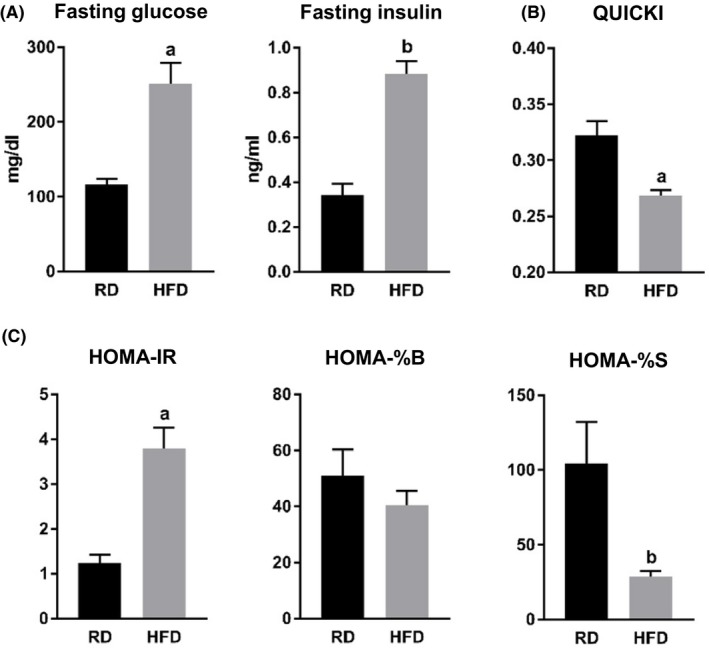
Effect of HFD on insulin sensitivity. A, Fasting blood glucose levels measured with glucometer, and fasting plasma levels of insulin measured by Luminex assay. a, P = .0015; b, P < .0001. B, QUICKI index values. a, P = .0022. C, HOMA2 index values: insulin resistance (HOMA‐IR), β‐cell function (HOMA‐%B), and insulin sensitivity (HOMA‐%S). a, P = .0003; b, P = .0189. Abbreviations: RD, regular diet; HFD, high‐fat diet; QUICKI, quantitative insulin sensitivity check index; HOMA, homeostatic model assessment; IR, insulin resistance; %B, percent β‐cells; %S, percent sensitivity

References

    1. Reilly SM, Saltiel AR. Adapting to obesity with adipose tissue inflammation. Nat Rev Endocrinol. 2017;13:633‐643. - PubMed
    1. Hariri N, Thibault L. High‐fat diet‐induced obesity in animal models. Nutr Res Rev. 2010;23:270‐299. - PubMed
    1. Heydemann A. An overview of murine high fat diet as a model for type 2 diabetes mellitus. J Diabetes Res. 2016;2016:2902351. - PMC - PubMed
    1. Blüher M. Importance of estrogen receptors in adipose tissue function. Mol Metab. 2013;2:130‐132. - PMC - PubMed
    1. Varlamov O, Bethea CL, Roberts CT Jr. Sex‐specific differences in lipid and glucose metabolism. Front Endocrinol (Lausanne). 2015;5:241. - PMC - PubMed