


Review
doi: 10.1002/1873-3468.13731.
Epub 2020 Feb 3.
Retargeting adenoviruses for therapeutic applications and vaccines
Affiliations
- PMID: 31944286
- PMCID: PMC7311308
- DOI: 10.1002/1873-3468.13731
Item in Clipboard
Review
Retargeting adenoviruses for therapeutic applications and vaccines
FEBS Lett.
2020 Jun.
Abstract
Adenoviruses (Ads) are robust vectors for therapeutic applications and vaccines, but their use can be limited by differences in their in vitro and in vivo pharmacologies. This review emphasizes that there is not just one Ad, but a whole virome of diverse viruses that can be used as therapeutics. It discusses that true vector targeting involves not only retargeting viruses, but importantly also detargeting the viruses from off-target cells.
Keywords: Ad serotypes; detargeting; gain of function; liver; retargeting; sequestration; serotypes.
© 2020 Federation of European Biochemical Societies.
Figures
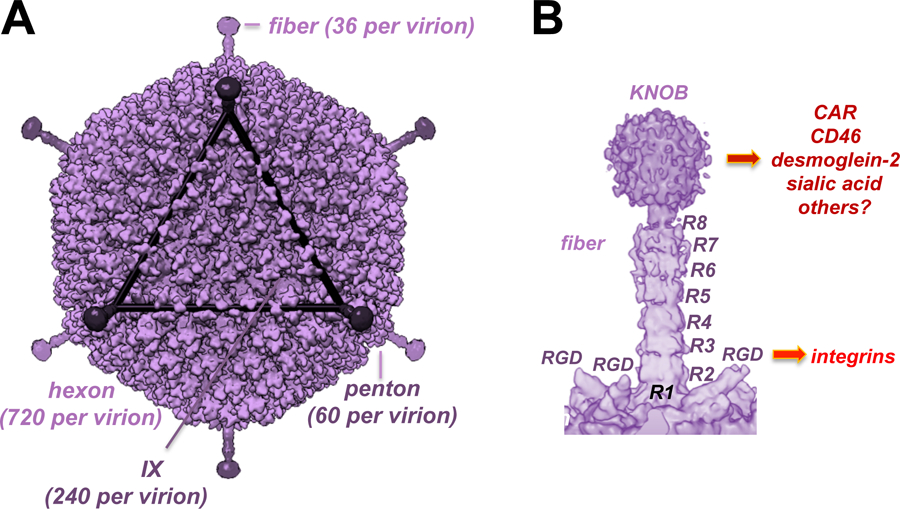
A) Full virion structure B) Fiber and penton base. R indicated fiber shaft repeats. RGD indicates arginine-glycine-aspartic acid integrin binding motifs in the penton base. Knob indicates the receptor binding portion of the Ad26 fiber trimer. Receptors bound by these capsomers are shown on the right. Adapted from [33].
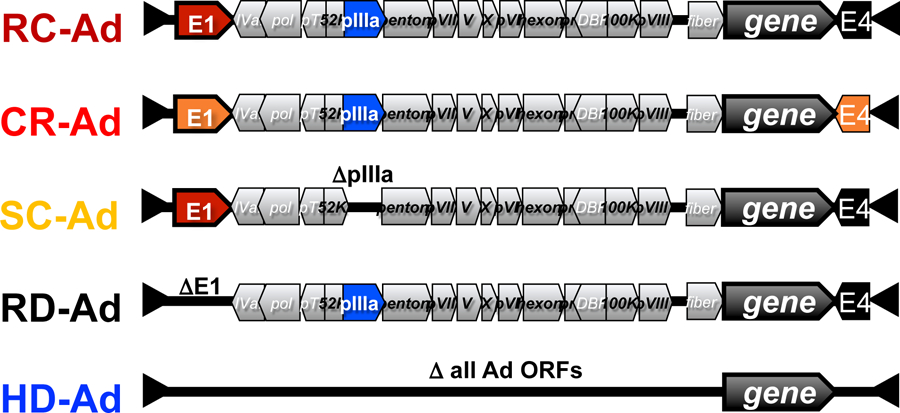
RC-Ad = replication-competent Ad. SC-Ad = single-cycle Ad. RD-Ad = replication-defective, E1-deleted Ad. HD-Ad = helper-dependent Ad.
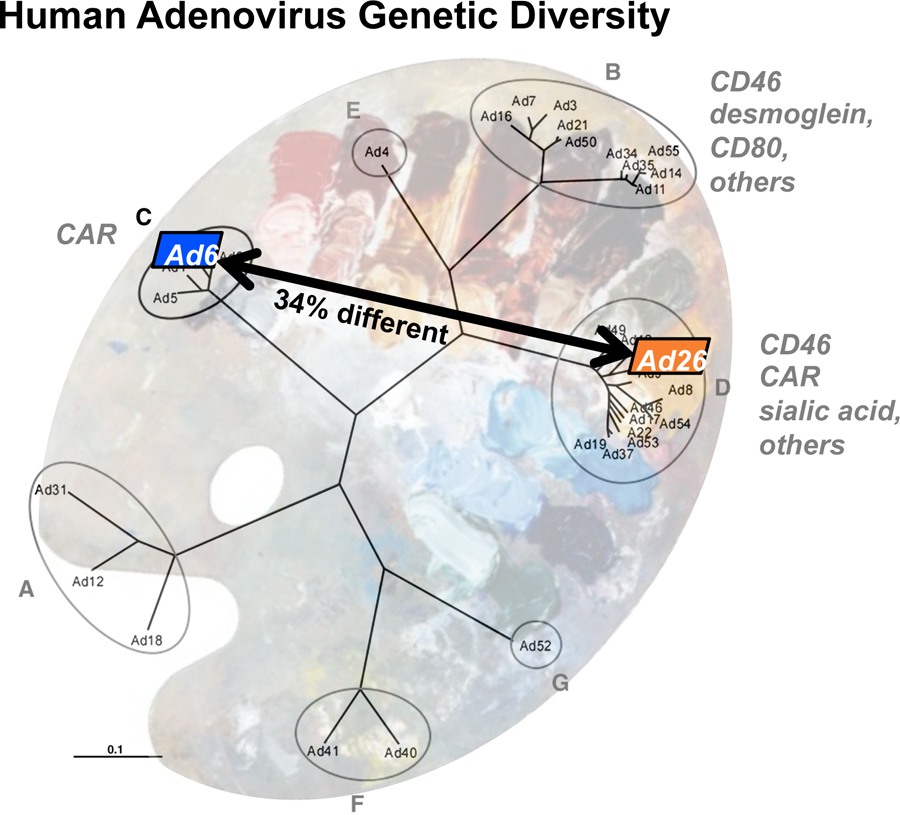
Adapted from [100] and showing whole genome difference between species C Ad6 and species D Ad26 described in [107].

See main text for further information. Adapted from [107].
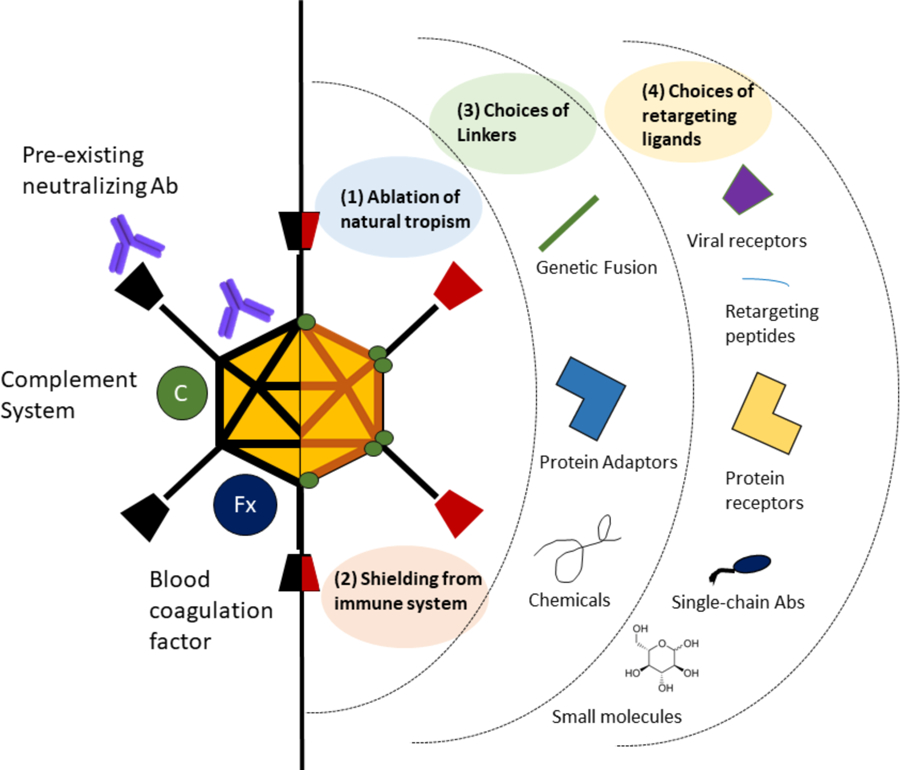
See main text for further information.
References
-
- Couch RB, Chanock RM, Cate TR, Lang DJ, Knight V and Huebner RJ (1963). Immunization with types 4 and 7 adenovirus by selective infection of the intestinal tract. Am Rev Respir Dis 88, SUPPL 394–403. - PubMed
-
- Top FH Jr., Buescher EL, Bancroft WH and Russell PK (1971). Immunization with live types 7 and 4 adenovirus vaccines. II. Antibody response and protective effect against acute respiratory disease due to adenovirus type 7. J Infect Dis 124, 155–60. - PubMed
-
- Croyle MA, Cheng X, Sandhu A and Wilson JM (2001). Development of novel formulations that enhance adenoviral-mediated gene expression in the lung in vitro and in vivo. Mol Ther 4, 22–8. - PubMed
-
- Croyle MA, Cheng X and Wilson JM (2001). Development of formulations that enhance physical stability of viral vectors for gene therapy. Gene Ther 8, 1281–90. - PubMed
Publication types
MeSH terms
Substances
Grants and funding
LinkOut - more resources
Full Text Sources
Other Literature Sources
