Overuse of short-acting β2-agonists in asthma is associated with increased risk of exacerbation and mortality: a nationwide cohort study of the global SABINA programme
- PMID: 31949111
- PMCID: PMC7160635
- DOI: 10.1183/13993003.01872-2019
Overuse of short-acting β2-agonists in asthma is associated with increased risk of exacerbation and mortality: a nationwide cohort study of the global SABINA programme
Abstract
Background: Overuse of short-acting β2-agonists (SABA) may indicate poor asthma control and adverse health outcomes. Contemporary population-based data on use, risk factors and impact of SABA (over)use on asthma exacerbations and mortality are scarce, prompting initiation of the global SABINA (SABA use IN Asthma) programme.
Methods: By linking data from Swedish national registries, asthma patients aged 12-45 years with two or more collections of drugs for obstructive lung disease during 2006-2014 were included. SABA overuse was defined as collection of more than two SABA canisters in a 1-year baseline period following inclusion. SABA use was grouped into 3-5, 6-10 and ≥11 canisters per baseline-year. Cox regression was used to examine associations between SABA use and exacerbation (hospitalisations and/or oral corticosteroid claims) and mortality.
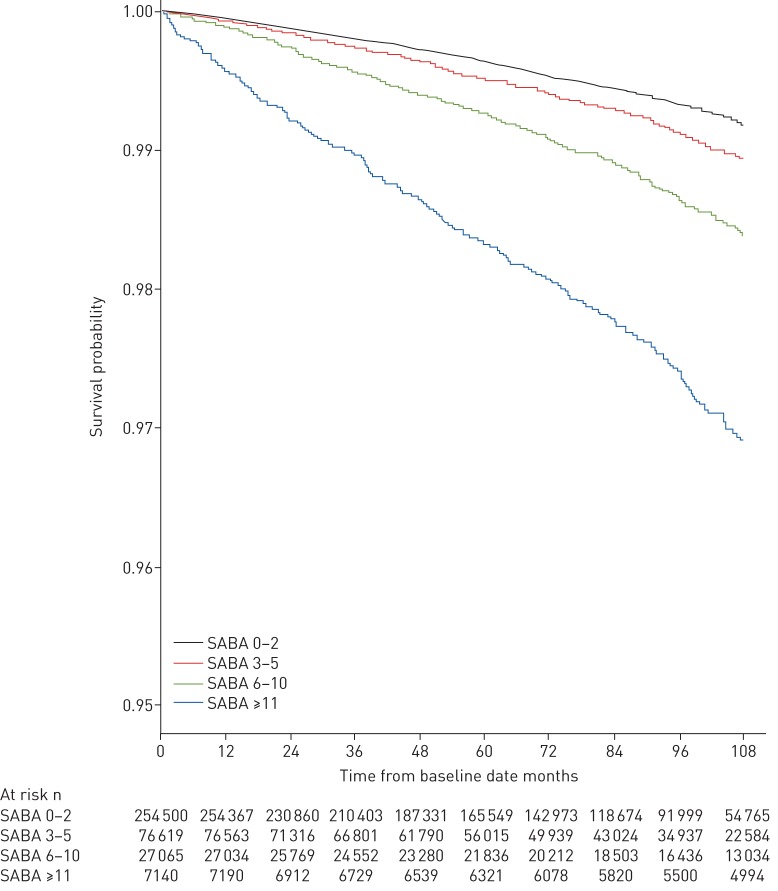
Results: The analysis included 365 324 asthma patients (mean age 27.6 years; 55% female); average follow-up was 85.4 months. 30% overused SABA, with 21% collecting 3-5 canisters per year, 7% collecting 6-10 canisters per year and 2% collecting ≥11 canisters per year. Increasing number of collected SABA canisters was associated with increased risk of exacerbation, as follows. 3-5 canisters: hazard ratio (HR) 1.26 (95% CI 1.24-1.28); 6-10 canisters: 1.44 (1.41-1.46); and ≥11 canisters: 1.77 (1.72-1.83), compared to two or fewer canisters per year. Higher SABA use was associated with incrementally increased mortality risk (2564 deaths observed), as follows. 3-5 canisters: HR 1.26 (95% CI 1.14-1.39); 6-10 canisters 1.67 (1.49-1.87); and ≥11 canisters: 2.35 (2.02-2.72) compared to two or fewer canisters per year.
Conclusion: One-third of asthma patients in Sweden collected three or more SABA canisters annually. SABA overuse was associated with increased risks of exacerbation and mortality. These findings emphasise that monitoring of SABA usage should be key in improving asthma management.
Copyright ©ERS 2020.
Conflict of interest statement
Conflict of interest: B.I. Nwaru reports personal fees for advisory board work from AstraZeneca, during the conduct of the study. Conflict of interest: M. Ekström reports personal fees for advisory board work from AstraZeneca, during the conduct of the study. Conflict of interest: P. Hasvold is an employee of AstraZeneca. Conflict of interest: F. Wicklund is an employee of Statisticon, for which AstraZeneca is a client. Conflict of interest: G. Telg is an employee of AstraZeneca. Conflict of interest: C. Janson has received payments for educational activities from AstraZeneca, Boehringer Ingelheim, Chiesi, Novartis, and Teva, and has served on advisory boards arranged by AstraZeneca, Boehringer Ingelheim, Chiesi, GlaxoSmithKline, Novartis, and Teva.
Figures



Comment in
-
Asthma rescue treatments, time to reboot.Eur Respir J. 2020 Apr 16;55(4):2000542. doi: 10.1183/13993003.00542-2020. Print 2020 Apr. Eur Respir J. 2020. PMID: 32300023 No abstract available.
-
Observational studies and "the eye of the beholder".Eur Respir J. 2020 Jul 16;56(1):2001637. doi: 10.1183/13993003.01637-2020. Print 2020 Jul. Eur Respir J. 2020. PMID: 32675295 No abstract available.
References
-
- Gibson GJ, Loddenkemper R, Lundbäck B, et al. . Respiratory health and disease in Europe: the new European Lung White Book. Eur Respir J 2013; 42: 559–622. - PubMed
-
- The Global Asthma Report 2014. www.globalasthmareport.org/burden/mortality.php Date last accessed: April 2, 2019.
Publication types
MeSH terms
Substances
LinkOut - more resources
Full Text Sources
Other Literature Sources
Medical