. 2020 Mar;129(1):83-98.
doi: 10.1007/s00412-020-00732-x. Epub 2020 Jan 16.

Heterochromatin formation in Drosophila requires genome-wide histone deacetylation in cleavage chromatin before mid-blastula transition in early embryogenesis

Affiliations

Heterochromatin formation in Drosophila requires genome-wide histone deacetylation in cleavage chromatin before mid-blastula transition in early embryogenesis

Matthias Walther et al. Chromosoma. 2020 Mar.

Abstract

Su(var) mutations define epigenetic factors controlling heterochromatin formation and gene silencing in Drosophila. Here, we identify SU(VAR)2-1 as a novel chromatin regulator that directs global histone deacetylation during the transition of cleavage chromatin into somatic blastoderm chromatin in early embryogenesis. SU(VAR)2-1 is heterochromatin-associated in blastoderm nuclei but not in later stages of development. In larval polytene chromosomes, SU(VAR)2-1 is a band-specific protein. SU(VAR)2-1 directs global histone deacetylation by recruiting the histone deacetylase RPD3. In Su(var)2-1 mutants H3K9, H3K27, H4K8 and H4K16 acetylation shows elevated levels genome-wide and heterochromatin displays aberrant histone hyper-acetylation. Whereas H3K9me2- and HP1a-binding appears unaltered, the heterochromatin-specific H3K9me2S10ph composite mark is impaired in heterochromatic chromocenters of larval salivary polytene chromosomes. SU(VAR)2-1 contains an NRF1/EWG domain and a C2HC zinc-finger motif. Our study identifies SU(VAR)2-1 as a dosage-dependent, heterochromatin-initiating SU(VAR) factor, where the SU(VAR)2-1-mediated control of genome-wide histone deacetylation after cleavage and before mid-blastula transition (pre-MBT) is required to enable heterochromatin formation.

Keywords: Drosophila melanogaster; Heterochromatin; Histone deacetylation; Mid-blastula transition.


Conflict of interest statement

The authors declare that they have no conflict of interest.

Figures
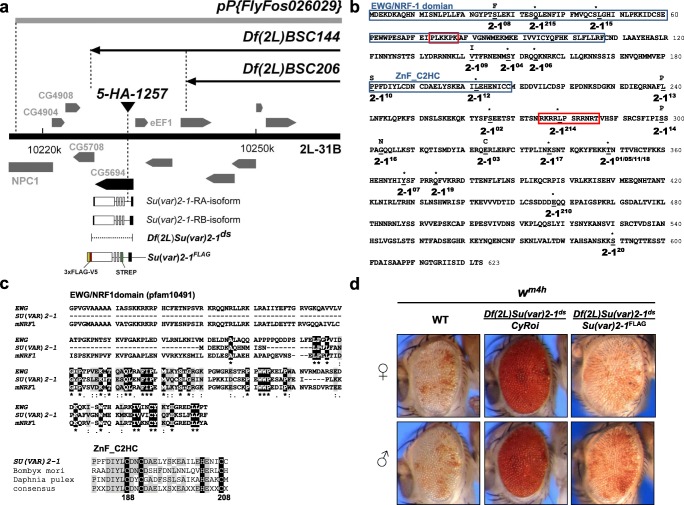
Fig. 1
Fig. 1
Su(var)2-1 encodes a NRF domain protein with a C2HC zinc-finger motif. a Cytogenetic mapping of Su(var)2-1 within region 31B in chromosome arm 2L between the distal breakpoints of Df(2L)BSC144 and Df(2L)BSC206. The pP{RS5}5-HA-1257 element inserted within the first intron of CG5694 and a CRISPR/Cas9 induced deletion of CG5694 {Df(2L)Su(var)2-1ds} are allelic to Su(var)2-1 mutations. The pP{FlyFos026029} and P{UAST-attB Strep-Su(var)2-1-V5-3xFLAG} transgenes rescue Su(var)2-1 mutations. b Molecularly defined Su(var)2-1 mutations including in total 15 stop or frameshift mutations (*) and 7 point mutations. The Su(var)2-1 alleles 2-1210, 2-1214 and 2-1215 were isolated by Sinclair et al. . The SU(VAR)2-1 protein contains two putative nuclear localization signals (red boxes). c In the SU(VAR)2-1N-terminus about 100 amino acids show homology to the C-terminal half of the NRF1/EWG domain of Drosophila ERECT WING (EWG) and mammalian NRF1 proteins. In addition, SU(VAR)2-1 contains a C2HC motif between amino acids 188–208. d Phenotypic rescue of Su(var)2-1 mutants by P{UAST-attB Strep-Su(var)2-1-V5-3xFLAG} expressing a fusion protein with a N-terminal STREP and C-terminal V5-3xFLAG tag under the endogenous Su(var)2-1 promoter (Abbreviated Su(var)2-1FLAG)
Fig. 2
Fig. 2
SU(VAR)2-1 is heterochromatin-associated in blastoderm nuclei but is a band-specific protein in polytene chromosomes. a SU(VAR)2-1 is an abundant chromatin protein in syncytial nuclei. At blastoderm cycles 11 to 14, the SU(VAR)2-1 protein preferentially associates with heterochromatin at the apical pole as shown for the endogenous protein (SU(VAR)2-1-specific polyclonal antibody) and in b for the STREP-SU(VAR)2-1-V5-3xFLAG fusion protein (monoclonal FLAG Antibody). c In contrast to somatic blastoderm cells where SU(VAR)2-1 is preferentially in prospective heterochromatin the protein shows uniform chromatin association in primordial germ line stem cell nuclei (arrow). d In larval salivary gland polytene chromosomes SU(VAR)2-1 is a band-specific protein and not found in chromocenter heterochromatin (arrows)
Fig. 3
Fig. 3
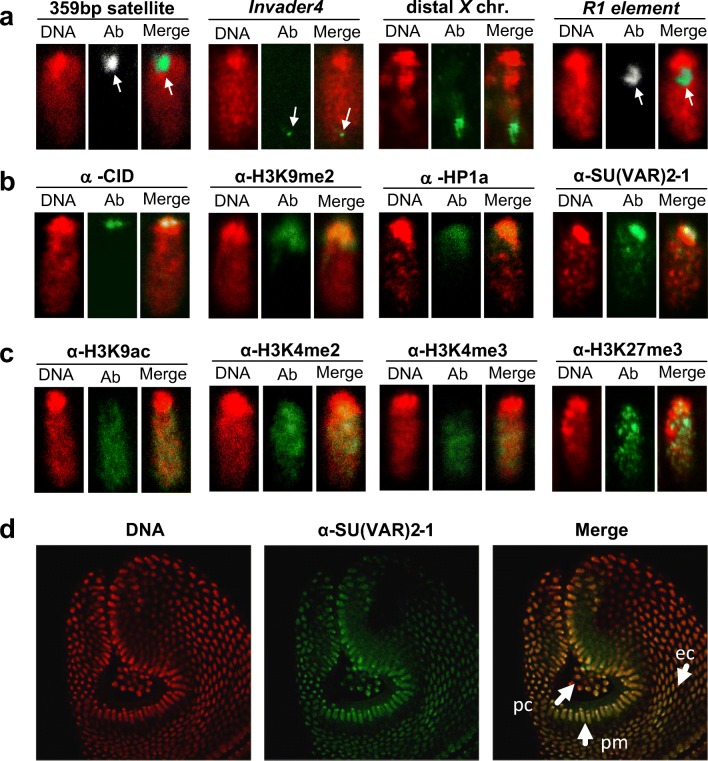
Apico-basal chromosome orientation and heterochromatin association of SU(VAR)2–1 in blastoderm nuclei. a Fluorescence in situ analysis with DIG-labeled DNA probes for the heterochromatic 359 bp satellite repeat, the sub-telomeric 2R and 3R Invader4 repeats, a painting probe for the distal X chromosome and for the R1 retrotransposon repeat distal to the X-chromosomal nucleolus organizer. b Antibody staining for the centromere-specific protein CID, the heterochromatic H3K9me2 histone mark, the heterochromatin protein HP1a and SU(VAR)2-1. All the heterochromatic sequences, the heterochromatic histone marks and the HP1a and SU(VAR)2-1 proteins are apically located. c The euchromatic histone modification marks H3K9ac, H3K4me2, H3K4me3 and H3K27me3 identify euchromatin extending from heterochromatin toward the basal pole of the nuclei. d Embryo at early gastrulation showing the posterior midgut rudiment with internalized germ-line cells (glc). In nuclei of primordial cells in posterior midgut (pmg) SU(VAR)2-1 is rather uniformly distributed, although still more abundant at the apical pole of the nucleus. In nuclei of ectodermal cells (ec) SU(VAR)2-1 shows uniform nuclear distribution. DAPI staining of DNA in red, antibody and fluorescence staining in green
Fig. 4
Fig. 4
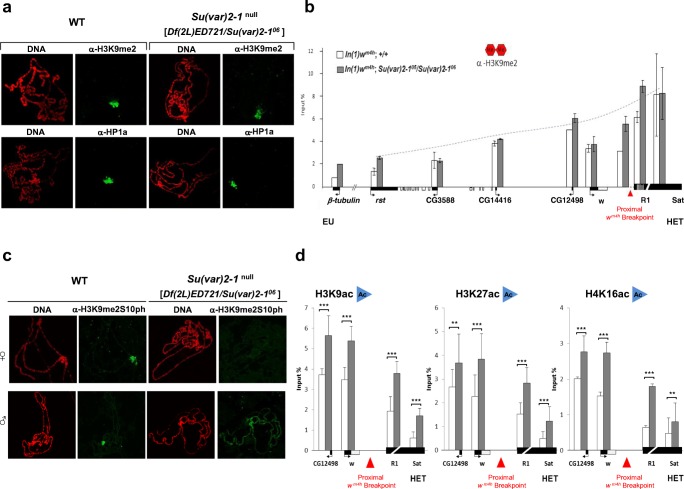
In Su(var)2-1 null mutants heterochromatic H3K9me2- and HP1a-binding are unaffected, whereas H3K9me2S10pho double indexing is impaired. a Chromocenter staining for H3K9me2 and HP1a in larval salivary gland polytene chromosomes is identical between wild-type and a Su(var)2-1 null {Df(2L)ED721/Su(var)2-106} genotype. b ChIP analysis of H3K9me2 spreading along the white-roughest region juxtaposed in In(1)wm4h to pericentric heterochromatin in adult female heads. No difference between wild-type (white bars) and Su(var)2-1 null flies (gray bars) is found. Error bars indicate standard deviation. c Heterochromatin-specific double-indexing by H3K9me2S10pho is impaired in Su(var)2-1 null larval salivary gland polytene chromosomes. In females, H3K9me2S10pho is lost, whereas it is ectopically distributed along euchromatic chromosome arms in the mutant males. d ChIP analysis of H3K9ac, H3K27ac and H4K16ac along the white-roughest region and in heterochromatin of In(1)wm4h adult female heads. In the Su(var)2-1 null genotype (white bars) elevated levels for all acetylation marks are found at euchromatin, at the R1 breakpoint sequences and for the heterochromatic 359 bp satellite sequences. Error bars indicate standard deviation. Statistical significance between the control and the mutant genotype with *P < 0.05, **P < 0.01 and ***P < 0.001. In B and C, the red triangle indicates the breakpoint of In(1)wm4h in heterochromatin (HET), R1 indicates the retrotransposon cluster distal to the nucleolus organizer region and Sat the 359 bp satellite sequences in X chromosome heterochromatin
Fig. 5
Fig. 5
In Su(var)2-1 null polytene chromosomes the levels of H3K9ac, H3K18ac, H3K27ac, H4K8ac and H4K16ac are strongly increased. a Antibody staining of Su(var)2-106/Df(2L)Su(var)2-1ds {Su(var)2-1 null} larvae shows, when compared with wild-type, significantly higher levels of H3K9ac, H3K18ac, H3K27ac, H4K8ac and H4K16ac along the euchromatic chromosome arms and in chromocenter heterochromatin. White arrows point to chromocenters. b The increase in H4K16 acetylation is most prominent in chromocenter heterochromatin. In males the X-chromosome also shows increased staining for H4K16ac and MOF although no obvious effects on dosage compensation are observed. Compared with wild-type the male X-chromosome frequently appears to be more condensed in Su(var)2-1 null mutant larvae. c The global increase in all the studied histone acetylation marks is supported by Western blot analysis
Fig. 6
Fig. 6
SU(VAR)2-1 recruits the histone deacetylase RPD3 to numerous chromosomal sites. a Immunostaining of Su(var)2-1-null larval salivary glands with a RPD3-specific polyclonal antibody shows significant reduction of RPD3 chromosome association. b Western analysis of Su(var)2-1-null [Df(2L)ED721/Su(var)2-106] suggests global reduction of RPD3 although expression of the Rpd3 gene is unchanged. c Co-immunoprecipitation of SU(VAR)2-1 and RPD3 was studied in extracts derived from transgenic larval salivary glands producing a SU(VAR)2-1-EGFP fusion protein purified with GFP-Trap beads. Precipitated proteins were studied by Western blot analysis using EGFP and RPD3 specific polyclonal antibodies. In Fig. 5c, the blots of two independent immunoprecipitations are shown (indicated with IP1 and IP2)
Fig. 7
Fig. 7
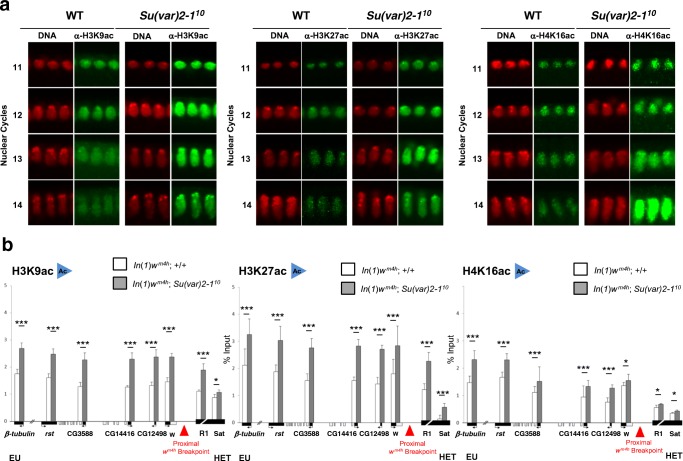
SU(VAR)2-1-controlled global histone deacetylation at pre-MBT is essential for normal heterochromatin formation. a Immunocytology of blastoderm nuclei at cycles 11, 12, 13 and 14 for H3K9ac, H3K27ac and H4K16ac from embryos produced by wild-type and Su(var)2-110 homozygous females. In wild-type, the studied acetylation marks are prominent histone modifications in syncytial nuclei and in blastoderm at cycles 11 and 12 but are strongly reduced at cycles 13 and 14 when establishment of heterochromatin and euchromatin is initiated. Contrary to Su(var)2-1-null females, which are agametic homozygous, Su(var)2-110 females are fertile. Requirement of SU(VAR)2-1 for histone deacetylation at pre-MBT is reflected by strong elevation of all studied acetylation marks in blastoderm nuclei of Su(var)2-110 mutant embryos. b ChIP analysis of H3K9ac, H3K27ac and H4K16ac along the white-roughest region juxtaposed in the inversion wm4h to pericentric heterochromatin (HET) in 0.5 h old wild-type (white bars) and Su(var)2-110 homozygous embryos (gray bars). In Su(var)2-110 mutant embryos the studied acetylation marks are elevated at all euchromatic sites. The heterochromatic R1 retrotransposon repeat cluster (marked by R1) at the proximal breakpoint of In(1)wm4h (indicated by a red triangle) shows elevated levels of H3K9ac and H3K27ac whereas no significant differences are found for the 359 bp repeats (abbreviated Sat). However, all the studied heterochromatic sequences show substantial H3K9, H3K27 and H4K16 acetylation, indicating that the collected embryos include a considerable amount of cycle 11–14 embryos. Statistical significance between the control and the mutant genotype with *P < 0.05, **P < 0.01 and ***P < 0.001
Fig. 8
Fig. 8
Heterochromatin formation depends on global histone deacetylation at the transition of naive syncytial (cleavage) chromatin to somatic blastoderm chromatin. SU(VAR)2-1 is an abundant chromatin protein of syncytial nuclei and in early blastoderm nuclei. At cycles 13–14 in blastoderm nuclei, SU(VAR)2-1 accumulates at heterochromatic regions at the apical pole. During transition of naive cleavage chromatin into somatic and germ-line chromatin, it is essential for global histone deacetylation to occur before mid-blastula transition. SU(VAR)2-1 is required for complete removal of, and protection against, histone acetylation at heterochromatic sequences. SU(VAR)2-1 physically interacts with RPD3 and is required for its normal chromatin association suggesting that RPD3 is the main deacetylase controlling early embryonic chromatin transition through H3K9ac, H3K27ac and H4K16ac deacetylation

References

    1. Alekseyenko AA, Gorchakov AA, Zee BM, Fuchs SM, Kharchenko PV, Kuroda MI. Heterochromatin-associated interactions of Drosophila HP1a with dADD1, HIPP1, and repetitive RNAs. Genes Dev. 2014;28:1445–1460. doi: 10.1101/gad.241950.114. - DOI - PMC - PubMed
    1. Allshire RC, Madhani HD. Ten principles of heterochromatin formation and function. Nat Rev Mol Cell Biol. 2017;19:229–244. doi: 10.1038/nrm.2017.119. - DOI - PMC - PubMed
    1. Aufsatz W, Mette MF, van der Winden J, Matzke M, Matzke AJ. HDA6, a putative histone deacetylase needed to enhance DNA methylation induced by double-stranded RNA. EMBO J. 2002;21:6832–6841. doi: 10.1093/emboj/cdf663. - DOI - PMC - PubMed
    1. Aygün O, Mehta S, Grewal SIS. HDAC mediated suppression of histone turnover promotes epigenetic stability of heterochromatin. Nat Struct Mol Biol. 2013;20:547–554. doi: 10.1038/nsmb.2565. - DOI - PMC - PubMed
    1. Baksa K, Morawietz H, Dombradi V, Axton M, Taubert H, Szabo G, Török I, Gyurkovics H, Szöör B, Gloover D, et al. Mutations in the phosphatase 1 gene at 87B can differentially affect suppression of position-effect variegation and mitosis in Drosophila melanogaster. Genetics. 1993;135:117–125. - PMC - PubMed

Publication types

MeSH terms

LinkOut - more resources