. 2020 Jan 15;12(1):104.
doi: 10.3390/v12010104.

An RNA Thermometer Activity of the West Nile Virus Genomic 3'-Terminal Stem-Loop Element Modulates Viral Replication Efficiency during Host Switching

Affiliations

An RNA Thermometer Activity of the West Nile Virus Genomic 3'-Terminal Stem-Loop Element Modulates Viral Replication Efficiency during Host Switching

Alexandra Meyer et al. Viruses. .

Abstract

The 3'-terminal stem-loop (3'SL) of the RNA genome of the flavivirus West Nile (WNV) harbors, in its stem, one of the sequence elements that are required for genome cyclization. As cyclization is a prerequisite for the initiation of viral replication, the 3'SL was proposed to act as a replication silencer. The lower part of the 3'SL is metastable and confers a structural flexibility that may regulate the switch from the linear to the circular conformation of the viral RNA. In the human system, we previously demonstrated that a cellular RNA-binding protein, AUF1 p45, destabilizes the 3'SL, exposes the cyclization sequence, and thus promotes flaviviral genome cyclization and RNA replication. By investigating mutant RNAs with increased 3'SL stabilities, we showed the specific conformation of the metastable element to be a critical determinant of the helix-destabilizing RNA chaperone activity of AUF1 p45 and of the precision and efficiency of the AUF1 p45-supported initiation of RNA replication. Studies of stability-increasing mutant WNV replicons in human and mosquito cells revealed that the cultivation temperature considerably affected the replication efficiencies of the viral RNA variants and demonstrated the silencing effect of the 3'SL to be temperature dependent. Furthermore, we identified and characterized mosquito proteins displaying similar activities as AUF1 p45. However, as the RNA remodeling activities of the mosquito proteins were found to be considerably lower than those of the human protein, a potential cell protein-mediated destabilization of the 3'SL was suggested to be less efficient in mosquito cells. In summary, our data support a model in which the 3'SL acts as an RNA thermometer that modulates flavivirus replication during host switching.

Keywords: Flavivirus; RNA annealer; RNA chaperone; RNA remodeling; RNA replication; RNA structure; RNA thermometer; West Nile virus; host factor; host switching.


Conflict of interest statement

The funders had no role in the design of the study; in the collection, analyses, or interpretation of data; in the writing of the manuscript, or in the decision to publish the results.

Figures
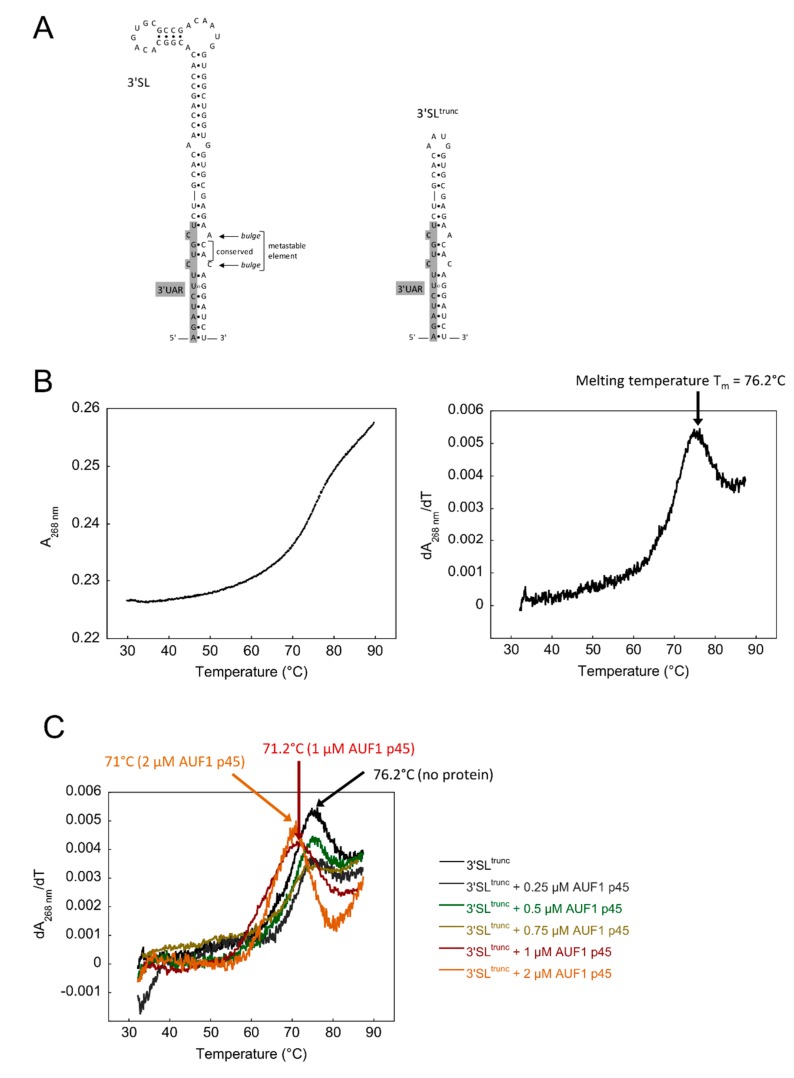
Figure 1
Figure 1
AUF1 p45 increases the flexibility of the WNV 3′SL. (A) Sequence and secondary structure of the full-length WNV 3′SL (left) and a truncated 3′SL (3′SLtrunc) that was used for the thermal denaturation experiments (right). The 3′UAR cyclization sequence is shown in grey. The metastable element within the bottom part of the 3′SL consists of two conserved base pairs and is flanked by two bulges. (B) (left) Thermal denaturation of the 3′SLtrunc RNA. The denaturation was recorded in the temperature range from 30 to 90 °C. (right) First derivative of the trace shown on the left to determine the melting temperature TM (arrow). (C) First derivatives of thermal denaturation experiments of the 3′SLtrunc RNA in the absence and presence of increasing concentrations of AUF1 p45. Melting temperatures are indicated with arrows.
Figure 2
Figure 2
Increasing stability of the WNV 3′SL correlates with decreasing RNA chaperone activity of AUF1 p45. (A) Sequence and secondary structure of the bottom part of the WNV 3′SL and mutants. Introduced mutations are shown in red. The 3′UAR cyclization sequence is shown in grey. (B) First derivatives of thermal denaturation experiments of the 3′SLtrunc wild-type and mutant RNAs. Melting temperatures are indicated with arrows. (C) Change of melting temperatures of thermal denaturation experiments of the 3′SLtrunc wild-type and mutant RNAs in the presence of AUF1 p45. n.d., not definable. Average results and standard deviations (n = 3) are shown. (D) Schematic drawing of the WNV sgRNA and experimental outline of the replicase assay. The RNA consists of the 5′- and 3′UTR and a part of the core coding sequence. It contains the 5′SLA, the 3′SL, all cyclization elements, and the AU-rich element in the upstream portion of the 3′UTR (left). WNV sgRNAs that contained the wild-type or mutant 3′SL were tested in the replicase assay in the absence or presence of AUF1 p45. The products were analyzed by denaturing PAGE and phosphor imaging. One representative experiment is shown (right). Levels of stimulation of full-length de novo product relative to the control (absence of AUF1 p45) are given below. n.a., not applicable.
Figure 3
Figure 3
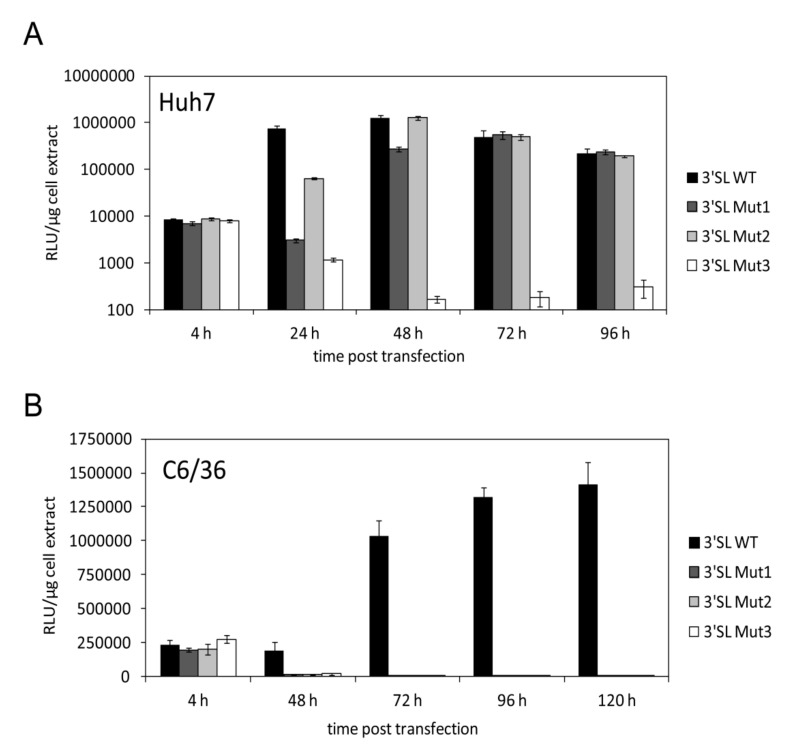
Altering the stability of the WNV 3′SL affects RNA replication differently in human and mosquito cells. (A) Huh7 cells were transfected with wild-type and mutant WNVRluc replicon RNAs, cultivated at 37 °C and analyzed for luciferase reporter activity at the indicated time points post transfection. Results from one representative experiment performed in triplicate are shown and error bars reflect standard deviations. (B) Same as in (A) except that C6/36 cells were used and cultivated at 28 °C.
Figure 4
Figure 4
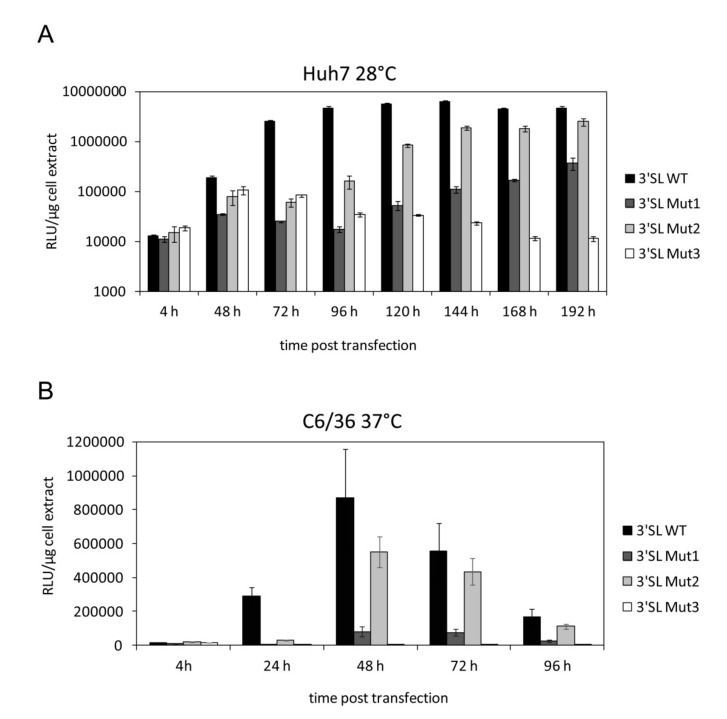
The cultivation temperature determines the replication rates of WNVRluc replicons. (A) Huh7 cells were transfected with wild-type and mutant WNVRluc replicon RNAs, subsequently cultivated at 28 °C and analyzed for luciferase reporter activity at the indicated time points post transfection. Results from one representative experiment performed in triplicate are shown and error bars reflect standard deviations. (B) Same as in (A) except that C6/36 cells were used and cultivated at 37 °C after transfection.
Figure 5
Figure 5
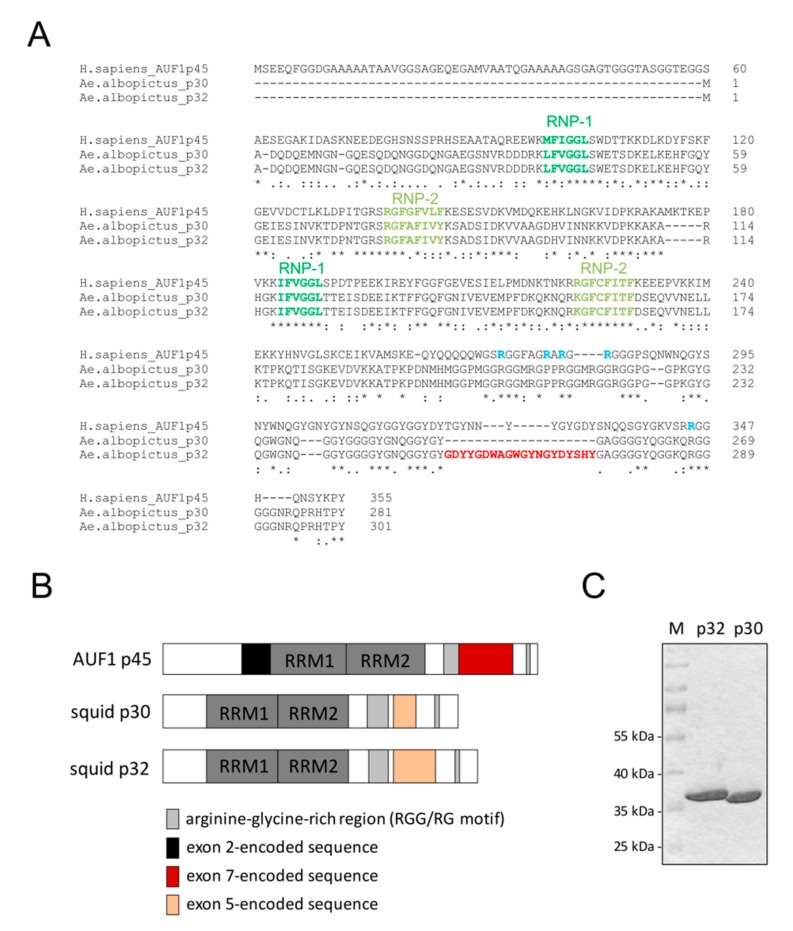
Mosquito cells encode two AUF1-homologous proteins. (A) Alignment of human AUF1 p45 and A. albopictus proteins p30 and p32. Conserved RNP-1 (light green) and RNP-2 (green) sequences of the RNA recognition motifs (RRM) are highlighted. The arginine residues of the RGG/RG motif of AUF1 p45 that were found to be dimethylated in human cells are highlighted in blue. The alternatively spliced sequence that is absent in p30 but present in p32 is shown in red. (B) Domain organization of human AUF1 p45 and mosquito squid proteins p30 and p32. (C) AUF1-homologous proteins p30 and p32 were produced in, and purified from, E. coli. About 4 μg of protein were analyzed on a Coomassie-stained SDS-gel in parallel with a molecular weight marker (M).
Figure 6
Figure 6
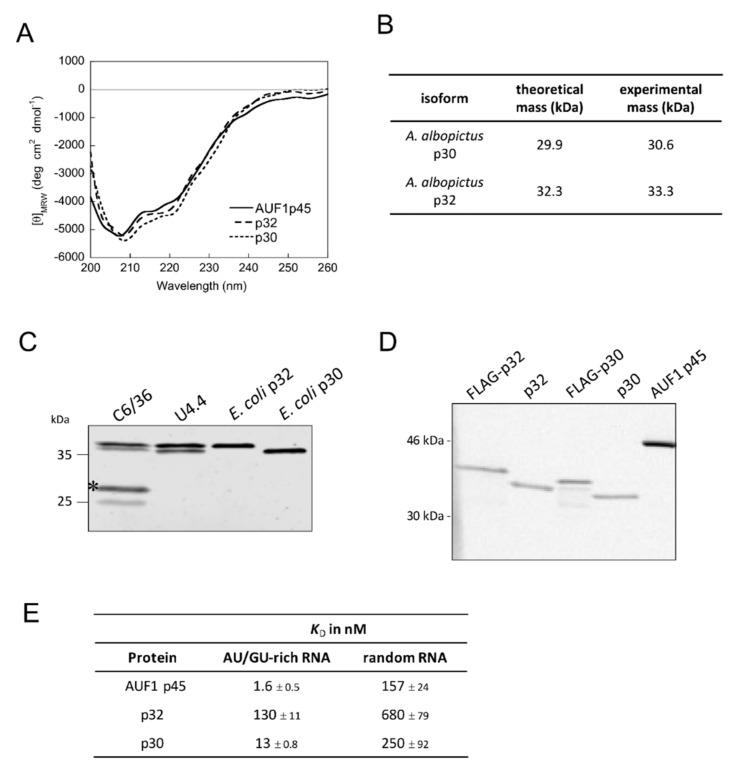
Characterization of mosquito proteins p30 and p32. (A) Far-UV circular dichroism (CD) spectra of AUF1 p45 and mosquito p30 and p32 were recorded. The acquired data were normalized to mean residue weight (MRW) ellipticities. The CD data for AUF1 p45 were taken from [16]. (B) Summary of the analytical ultracentrifugation experiments demonstrating that mosquito proteins p30 and p32 are monomeric proteins (see Supplementary Figure S3). (C) Detection of squid isoforms p30 and p32 in cell extracts of mosquito cell lines C6/36 and U4.4. An antibody that was raised against the full-length p32 protein (purified from E. coli) was applied. The asterisk indicates bands that most likely correspond to degradation products of p30. (D) In vitro methylation assay with PRMT1 and different protein preparations. Equal amounts (1 pmol) of mosquito proteins p30 and p32 that were purified from E. coli, as well as FLAG-p30 and FLAG-p32 proteins that were purified from C6/36 cells, were methylated by PRMT1. AUF1 p45 (13 pmol) that was purified from E. coli served as a positive control. The samples were taken after 2 h and analyzed by SDS–PAGE and phosphor imaging. (E) RNA binding affinities of human AUF1 p45 and mosquito proteins p30 and p32 to an AU/GU-rich RNA and a randomly composed RNA. Dissociation constants and standard deviations derived from at least three measurements. The binding data for AUF1 p45 were taken from [16].
Figure 7
Figure 7
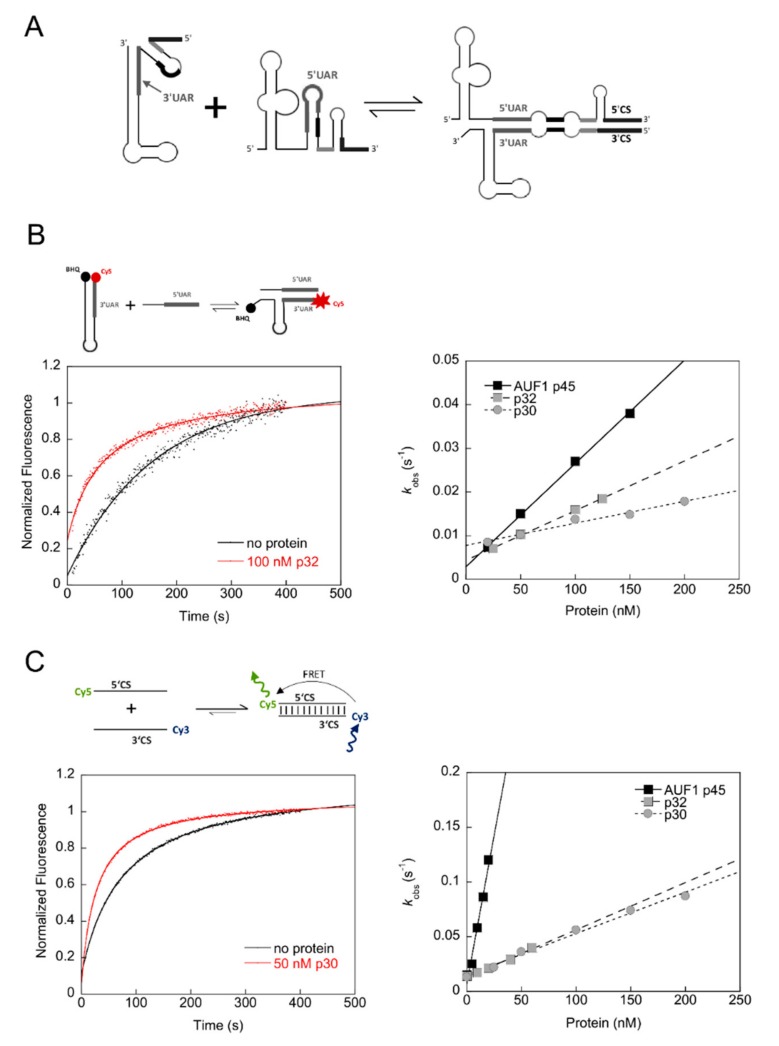
Mosquito proteins p30 and p32 exhibit RNA chaperone and RNA annealing activities. (A) Scheme of the structural rearrangement of the 5ʹ and 3ʹ termini, specifically of the 5ʹUAR and 3ʹUAR, as well as 5′CS and 3′CS elements, during cyclization of the WNV RNA genome. (B) (Top) Scheme of the fluorescence-based 3′SLtrunc-5ʹUAR chaperone assay to detect protein-mediated conformational rearrangement of WNV RNA by dequenching of Cy5. (Bottom) Exemplary kinetic traces with Cy5 and BHQ (black hole quencher) labeled 3′SLtrunc incubated with or without 100 nM of p32. Following the addition of 5ʹUAR RNA the fluorescence signals were measured, plotted as a function of time, and fitted according to a first-order reaction (no protein, Equation (2)) or second-order reaction (in the presence of protein, Equation (3)). (Right) The observed rate constants kobs (s−1) that were measured for the RNA chaperoning reaction in the presence of AUF1 p45, p30, or p32 were plotted as a function of the protein concentration. (C) (Top) Scheme of the fluorescence-based 5ʹCS-3ʹCS RNA annealing assay to analyze the hybridization of the CS cyclization sequences. Annealing of the complementary 5′- and 3′CS RNAs that are fluorescently labeled with Cy5 and Cy3, respectively, leads to a detectable FRET signal. (Bottom) Exemplary kinetic traces of the RNA–RNA interaction in the absence or presence of 50 nM p30. The fluorescence signals were analyzed according to a second-order reaction (Equation (3)). (Right) The observed rate constants kobs (s−1) that were measured for the RNA annealing reaction in the presence of AUF1 p45, p30, or p32 were plotted as a function of the protein concentration.
Figure 8
Figure 8
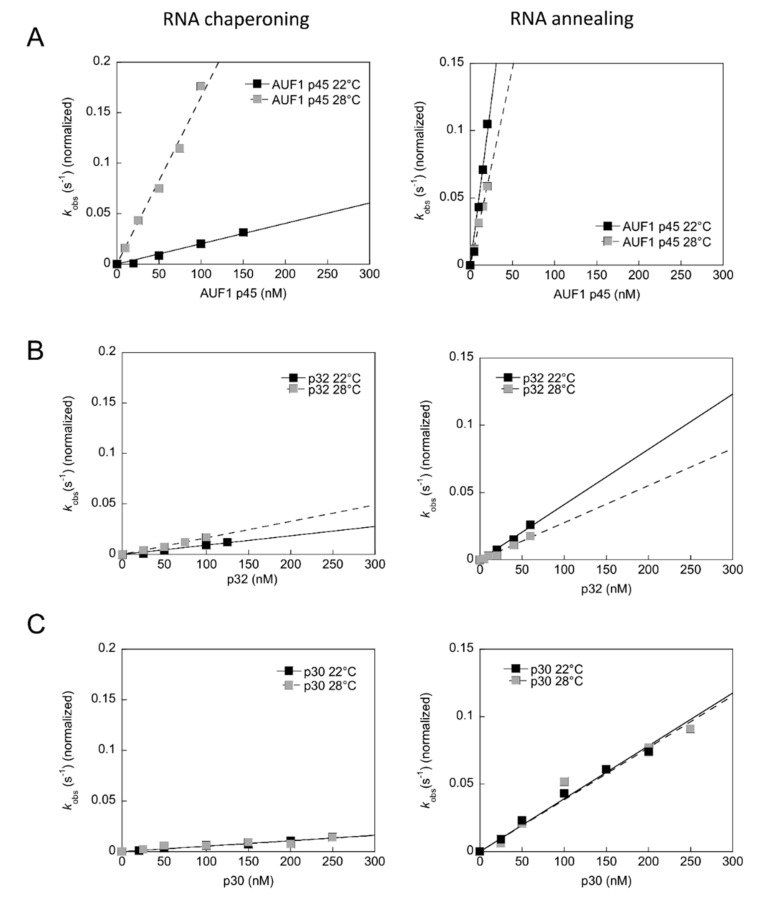
The effect of temperature on rates of RNA chaperoning and RNA annealing reactions. The RNA chaperoning (left) and RNA annealing (right) reactions in the presence of AUF1 p45 (A), p32 (B), or p30 (C) were performed at 22 °C and 28 °C. The rate constants were normalized by subtracting the non-enzymatic rate from the total rate and plotted as a function of the protein concentration.
Figure 9
Figure 9
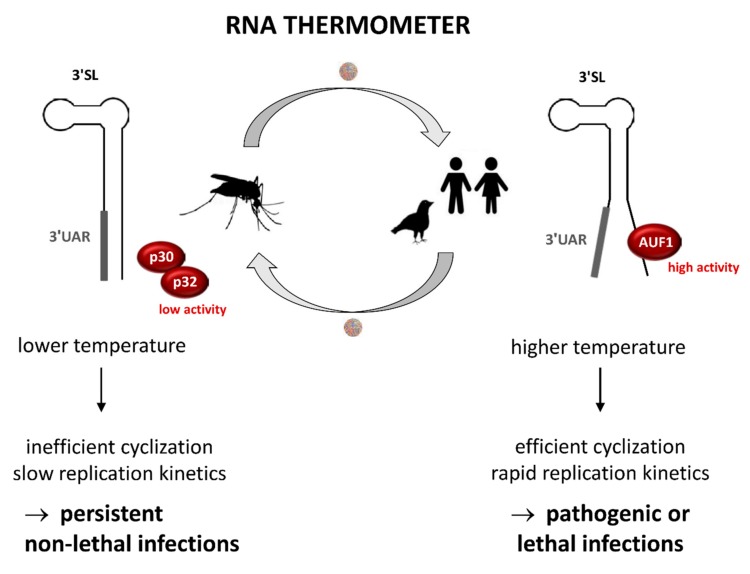
A model of the WNV 3′SL acting as an RNA thermometer during host switching. Due to the lower body temperature and low activities of p30/p32 in the mosquito host, the 3′SL exhibits a higher stability, which leads to inefficient cyclization and slow replication kinetics. In this way, persistent non-lethal infections in mosquitos can be established. In vertebrate hosts the higher body temperature and the strong activity of AUF1 renders the 3′SL more flexible. Consequently, cyclization is efficient, replication is fast, and high viral titers are produced, which can lead to pathogenic or lethal infections.

References

    1. Ciota A.T., Kramer L.D. Vector-vir us interactions and transmission dynamics of West Nile virus. Viruses. 2013;5:3021–3047. doi: 10.3390/v5123021. - DOI - PMC - PubMed
    1. Kramer L.D. Complexity of virus-vector interactions. Curr. Opin. Virol. 2016;21:81–86. doi: 10.1016/j.coviro.2016.08.008. - DOI - PMC - PubMed
    1. Chambers T.J., Hahn C.S., Galler R., Rice C.M. Flavivirus genome organization, expression, and replication. Annu. Rev. Microbiol. 1990;44:649–688. doi: 10.1146/annurev.mi.44.100190.003245. - DOI - PubMed
    1. Mazeaud C., Freppel W., Chatel-Chaix L. The Multiples Fates of the Flavivirus RNA Genome During Pathogenesis. Front. Genet. 2018;9:595. doi: 10.3389/fgene.2018.00595. - DOI - PMC - PubMed
    1. Filomatori C.V., Lodeiro M.F., Alvarez D.E., Samsa M.M., Pietrasanta L., Gamarnik A.V. A 5’ RNA element promotes dengue virus RNA synthesis on a circular genome. Genes Dev. 2006;20:2238–2249. doi: 10.1101/gad.1444206. - DOI - PMC - PubMed

Publication types

MeSH terms