


Novel targets and strategies to combat borreliosis
- PMID: 31953560
- PMCID: PMC7222997
- DOI: 10.1007/s00253-020-10375-8
Novel targets and strategies to combat borreliosis
Abstract
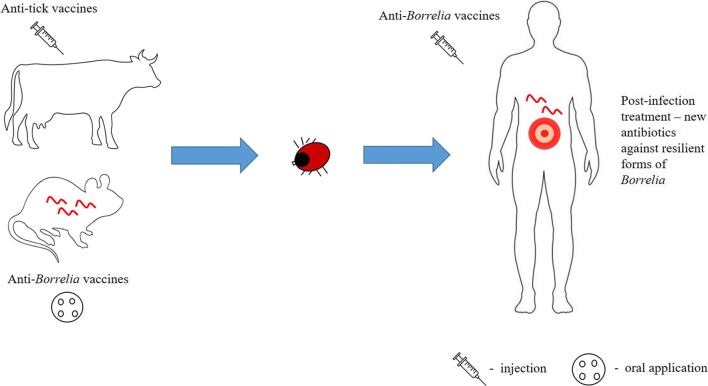
Lyme borreliosis is a bacterial infection that can be spread to humans by infected ticks and may severely affect many organs and tissues. Nearly four decades have elapsed since the discovery of the disease agent called Borrelia burgdorferi. Although there is a plethora of knowledge on the infectious agent and thousands of scientific publications, an effective way on how to combat and prevent Lyme borreliosis has not been found yet. There is no vaccine for humans available, and only one active vaccine program in clinical development is currently running. A spirited search for possible disease interventions is of high public interest as surveillance data indicates that the number of cases of Lyme borreliosis is steadily increasing in Europe and North America. This review provides a condensed digest of the history of vaccine development up to new promising vaccine candidates and strategies that are targeted against Lyme borreliosis, including elements of the tick vector, the reservoir hosts, and the Borrelia pathogen itself.
Keywords: Anti-tick strategies; Human pathogen; Lyme borreliosis; Public health; Vaccine candidates.
Conflict of interest statement
The authors declare that they have no conflict of interest.
Figures
References
Publication types
MeSH terms
Substances
Grants and funding
LinkOut - more resources
Full Text Sources
Medical
