


Associations between age and dyslipidemia are differed by education level: The Cardiovascular and Metabolic Diseases Etiology Research Center (CMERC) cohort
- PMID: 31954396
- PMCID: PMC6969451
- DOI: 10.1186/s12944-020-1189-y
Associations between age and dyslipidemia are differed by education level: The Cardiovascular and Metabolic Diseases Etiology Research Center (CMERC) cohort
Abstract
Background: Dyslipidemia is a multifactorial disorder, which arises from complex interactions among genetic and environmental risk factors. Previous studies have established the deteriorating effect of aging on lipid profiles. However, little is known about the role of education level, a stable marker of socioeconomic status, which reflect modifiability of lifestyle risk factors. Therefore, we examined the association between age and individual dyslipidemia parameter across education level among healthy, middle-aged Korean women.
Methods: From 2049 middle-aged women, education attainment was classified into completion of elementary school or below, middle school, high school, college or above. Dyslipidemia was assessed in adherence to the 2018 Korean Dyslipidemia Treatment Guideline. Multivariable logistic regression and generalized linear model tested for associations between age and dyslipidemia parameter across education level and other known risk factors, including menopause, obesity, and current drinking and smoking.
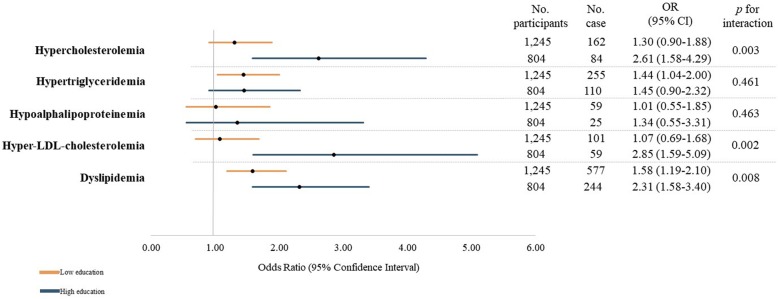
Results: In this cross-sectional analysis, the prevalence of each dyslipidemia parameter was significantly different by age and education level. The odds ratio (OR) for dyslipidemia was higher among participants who were older and had received higher education (OR = 2.31, p for interaction = 0.008) than younger and low education counterpart. The interaction between age and education level remained significant for hypercholesterolemia (p for interaction = 0.003) and hyper-LDL-cholesterolemia (p for interaction = 0.002).
Conclusions: Separate examination of individual dyslipidemia parameter indicated varying degree of interaction with age and education level. Such results imply that each type of lipid abnormality may arise from and be exacerbated by heterogeneous composition of biological and lifestyle risk factors, which may be reflected by education level.
Keywords: Aging; Dyslipidemias; Education; Risk factors.
Conflict of interest statement
The authors have no conflicts of interest to declare for this study.
Figures


References
-
- Sharrett AR, Ballantyne CM, Coady SA, Heiss G, Sorlie PD, Catellier D, et al. Coronary heart disease prediction from lipoprotein cholesterol levels, triglycerides, lipoprotein(a), alpolipoprotein A-I and B and HDL density subfractions: the atherosclerosis risk in communities (ARIC) study. Circ. 2001;104:1108–1113. doi: 10.1161/hc3501.095214. - DOI - PubMed
MeSH terms
Grants and funding
LinkOut - more resources
Full Text Sources
Medical
