


Age-Dependent Association of Occult Hypoperfusion and Outcomes in Trauma
- PMID: 31954820
- PMCID: PMC7719288
- DOI: 10.1016/j.jamcollsurg.2019.12.011
Age-Dependent Association of Occult Hypoperfusion and Outcomes in Trauma
Abstract
Background: Occult hypoperfusion (OH), or global hypoperfusion with normal vital signs, is a risk factor for poor outcomes in elderly trauma patients. We hypothesized that OH is associated with worse outcomes than shock in both young and elderly trauma patients.
Methods: We conducted a single-center cohort study of adult (16 years or older) trauma patients from 2016 to 2018 with base excess measured on arrival. Perfusion states were defined as shock if heart rate was >120 beats/min or systolic blood pressure was <90 mmHg; OH if base excess was < -2 mmol/L, heart rate was <120 beats/min, and systolic blood pressure was >90 mmHg; and normal for all others. Patients were stratified as young (younger than 55 years) or elderly (55 years or older). Bayesian regression was used to assess the relationship between arrival perfusion state and mortality or serious complication.
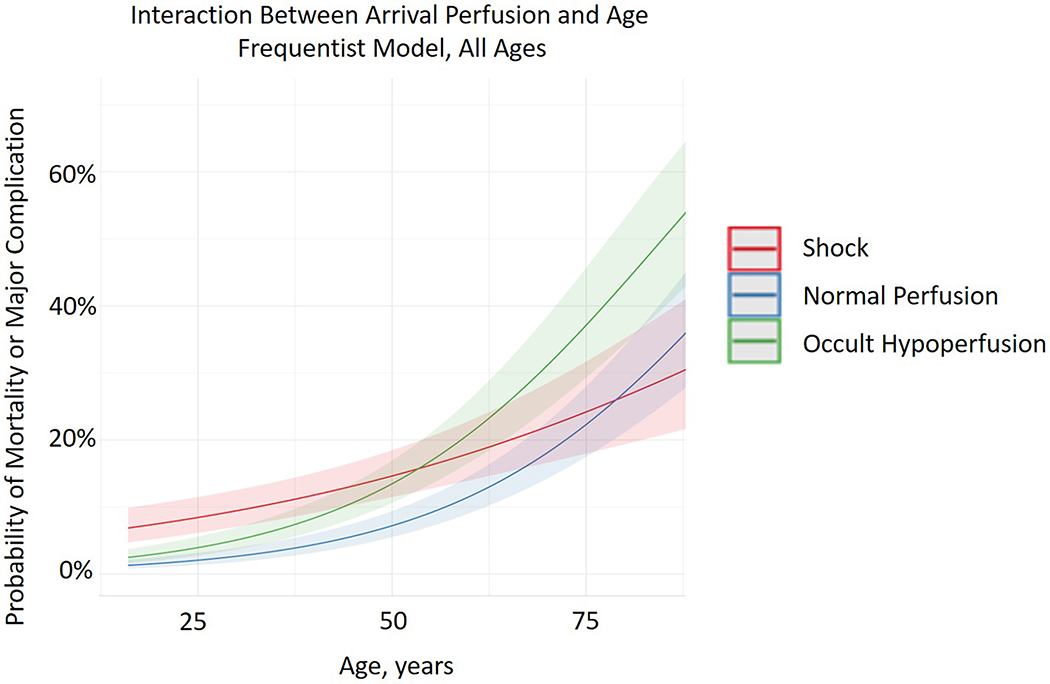
Results: Of 3,126 included patients, 808 were elderly. Rates of shock (33% and 31%) and OH (25% and 23%) were similar in young and elderly patients, respectively. OH on arrival was associated with higher odds of mortality or serious complication than normal perfusion, regardless of age group. Compared with shock, OH was associated with an odds ratio of 1.21 (95% CI, 0.97 to 1.52, posterior probability 96%) for poor outcomes in elderly patients and an odds ratio of 0.52 (95% CI, 0.42 to 0.65, posterior probability <1%) for poor outcomes in younger patients. Findings were similar on sensitivity analysis, excluding shock patients with base excess ≥ -2 mmol/L.
Conclusions: In elderly but not younger patients, OH is associated with worse outcomes than shock. Although shock parameters might need to be redefined in elderly patients, more attention is necessary for the diagnosis and treatment of all hypoperfused states in this age group.
Copyright © 2020 American College of Surgeons. Published by Elsevier Inc. All rights reserved.
Figures
Comment in
-
Discussion.J Am Coll Surg. 2020 Apr;230(4):425-427. doi: 10.1016/j.jamcollsurg.2020.02.012. J Am Coll Surg. 2020. PMID: 32220431 No abstract available.
References
-
- Howden LM, M.J., Age and Sex Composition: 2010. United States Census Bureau, 2011.
-
- Hildebrand F, et al., Impact of age on the clinical outcomes of major trauma. Eur J Trauma Emerg Surg, 2016. 42(3): p. 317–32. - PubMed
-
- Hashmi A, et al., Predictors of mortality in geriatric trauma patients: a systematic review and meta-analysis. J Trauma Acute Care Surg, 2014. 76(3): p. 894–901. - PubMed
-
- Jacobs DG, et al., Practice management guidelines for geriatric trauma: the EAST Practice Management Guidelines Work Group. J Trauma, 2003. 54(2): p. 391–416. - PubMed
-
- Losh J, et al., Multidisciplinary Patient Management Improves Mortality in Geriatric Trauma Patients. Am Surg, 2019. 85(2): p. 230–233. - PubMed
Publication types
MeSH terms
Grants and funding
LinkOut - more resources
Full Text Sources
Medical
