Review
. 2020 Apr:132:110841.
doi: 10.1016/j.exger.2020.110841. Epub 2020 Jan 16.

Kynurenine pathway, NAD+ synthesis, and mitochondrial function: Targeting tryptophan metabolism to promote longevity and healthspan

Affiliations
Review

Kynurenine pathway, NAD+ synthesis, and mitochondrial function: Targeting tryptophan metabolism to promote longevity and healthspan

Raul Castro-Portuguez et al. Exp Gerontol. 2020 Apr.

Abstract

Aging is characterized by a progressive decline in the normal physiological functions of an organism, ultimately leading to mortality. Nicotinamide adenine dinucleotide (NAD+) is an essential cofactor that plays a critical role in mitochondrial energy production as well as many enzymatic redox reactions. Age-associated decline in NAD+ is implicated as a driving factor in several categories of age-associated disease, including metabolic and neurodegenerative disease, as well as deficiency in the mechanisms of cellular defense against oxidative stress. The kynurenine metabolic pathway is the sole de novo NAD+ biosynthetic pathway, generating NAD+ from ingested tryptophan. Altered kynurenine pathway activity is associated with both aging and a variety of age-associated diseases. Kynurenine pathway interventions can extend lifespan in both fruit flies and nematodes, and altered NAD+ metabolism represents one potential mediating mechanism. Recent studies demonstrate that supplementation with NAD+ or NAD+-precursors increase longevity and promote healthy aging in fruit flies, nematodes, and mice. NAD+ levels and the intrinsic relationship to mitochondrial function have been widely studied in the context of aging. Mitochondrial function and dynamics have both been implicated in longevity determination in a range of organisms from yeast to humans, at least in part due to their intimate link to regulating an organism's cellular energy economy and capacity to resist oxidative stress. Recent findings support the idea that complex communication between the mitochondria and the nucleus orchestrates a series of events and stress responses involving mitophagy, mitochondrial number, mitochondrial unfolded protein response (UPRmt), and mitochondria fission and fusion events. In this review, we discuss how mitochondrial morphological changes and dynamics operate during aging, and how altered metabolism of tryptophan to NAD+ through the kynurenine pathway interacts with these processes.

Keywords: Kynurenine pathway; Mitochondria; NAD; Oxidative stress; Tryptophan.


Conflict of interest statement

Declaration of competing interest The authors declare that they have no competing interests.

Figures
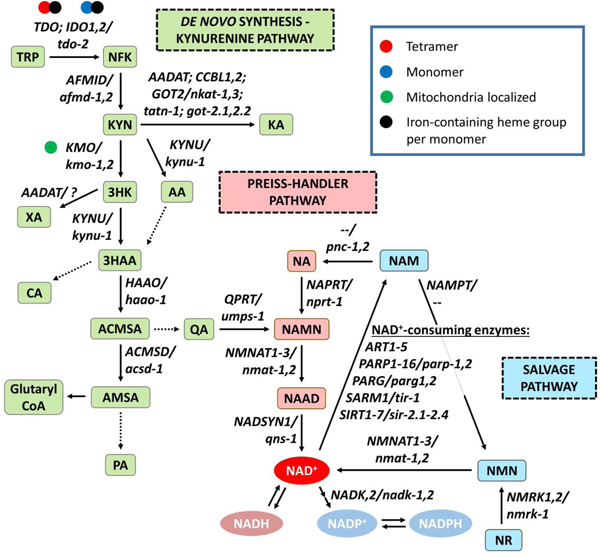
Figure 1.
Figure 1.. The kynurenine pathway represents one of three routes for NAD+ production or recycling.
The enzymatic degradation of the essential amino acid tryptophan (TRP) through the series of reactions catalyzed by rate-limiting enzymes culminates in de novo synthesis of NAD+ constitutes one of the two major branches of the kynurenine pathway. The other major branch converts kynurenine (KYN) to the neuroactive metabolite kynurenic acid (KA). Cells can also generate NAD+ from nicotinic acid (NA) through the Preiss-Handler pathway, or from nicotinamide riboside (NR) through the salvage pathway. Note that mammalian genomes contain the enzyme nicotinamide phosphoribosyltransferase (NAMPT), which converts nicotinamide (NAM) to nicotinamide mononucleotide (NMN), but not the enzyme nicotinamides (NAMase), which converts NAM to NA, while the invertebrate C. elegans and D. melanogaster genomes contain NAMase but not NAMPT. Thus mammals recycle NAM through the salvage pathway, while invertebrates recycle NAM through the Preiss-Handler pathway. Each catalytic step is annotated with the human or C. elegans gene encoding the corresponding enzyme. Enzymes (enzyme symbol: human gene/worm gene): indoleamine 2,3-dioxygenase (IDO: IDO1,2/--); tryptophan 2,3-dioxygenase (TDO: TDO2/tdo-2); arylformamidase (AFMID: AFMID/afmd-1,2); kynurenine aminotransferase (KYAT: AADAT, CCBL1,2/nkat-1,3, tatn-1); glutamic-oxaloacetic transaminase (GOT: GOT2/got-2.1,2.2); kynurenine 3-monooxygenase (KMO: KMO/kmo-1,2); kynureninase (KYNU: KYNU/kynu-1); 3-hydroxyanthranilate 3,4-dioxygenase (HAAO: HAAO/haao-1); and aminocarboxymuconate-semialdehyde decarboxylase (ACMSD: ACMSD/acsd-1), quinolinate phosphoribosyl transferase (QPRT: QPRT/umps-1), nicotinate phosphoribosyltransferase (NAPRT: NAPRT/nprt-1), nicotinamide nucleotide adenylyltransferase (NMNAT: NMNAT1,2,3/nmat-1,2), NAD synthetase (NADSYN: NADSYN1/qns-1), NAD kinase (NADK: NADK,2/nadk-1,2), nicotinamide riboside kinase (NMRK: NMRK1,2/nmrk-1), nicotinamide phosphoribosyltransferase (NAMPT: NAMPT/-), ADP-ribosyltransferase (ART: ART1–5/--), poly(ADP-ribose polymerase 1–16 (PARP: PARP1–16/parp-1,2), poly(ADP-ribose) glycohydrolase (PARG: PARG/parg-1,2), sterile alpha and TIR motif containing (SARM: SARM1/tir-1), sirtuin NAD-dependent protein deacetylase (SIRT: SIRT1-7/sir-2.1,2.2,2.3,2.4). Metabolites: tryptophan (TRP); Nformylkynurenine (NFK); kynurenine (KYN); kynurenic acid (KA); 3-hydroxykynurenine (3HK); 3-hydroxyanthranilic acid (3HAA); anthranilic acid (AA); xanthurenic acid (XA); 2-amino-3-carboxymuconic semialdehyde (ACMSA); 2-aminomuconic semialdehyde (AMSA); and quinolinic acid (QA); glutaryl-coenzyme A (Glutaryl CoA); picolinic acid (PA); nicotinic acid (NA); nicotinic acid mononucleotide (NAMN); nicotinic acid adenine dinucleotide (NAAD); nicotinamide adenine dinucleotide (NAD+/NADH); nicotinamide adenine dinucleotide phosphate (NADP+/NADPH); nicotinamide (NAM); nicotinamide mononucleotide (NMN); nicotinamide riboside (NR).
Figure 2.
Figure 2.. NAD+ synthesis and mitochondrial fitness.
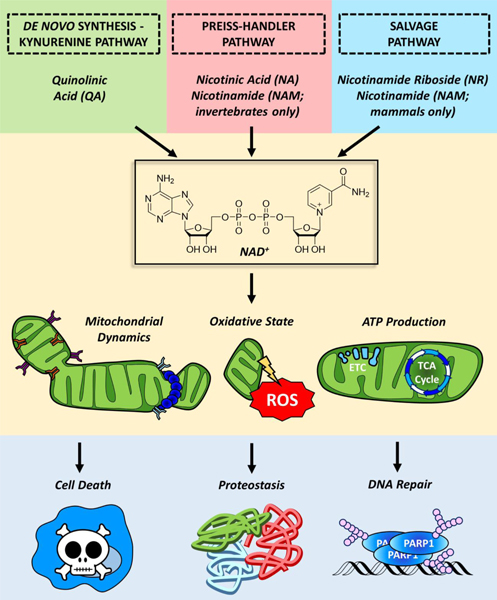
NAD+ is synthesized in the cell through the kynurenine/de novo biosynthetic pathway using quinolinic acid as a primary precursor. Cells also possess additional systems for producing NAD+ from alternative precursors. The Priess-Handler pathway generates NAD+ from nicotinic acid (NA) while the salvage pathway generates NAD+ from nicotinamide riboside (NR). Invertebrates recycle NAM generated from consuming NAD+ through the Priess-Handler pathway, while mammals recycle NAM through the salvage pathway. NAD+ regulates a variety of cellular process that modulates mitochondrial morphology, fitness, and function, which in turn impacts downstream processes including as cell death, proteostasis and DNA repair.
Figure 3.
Figure 3.. Cellular and molecular mechanisms regulated by the kynurenine -NAD+-mitochondria axis.
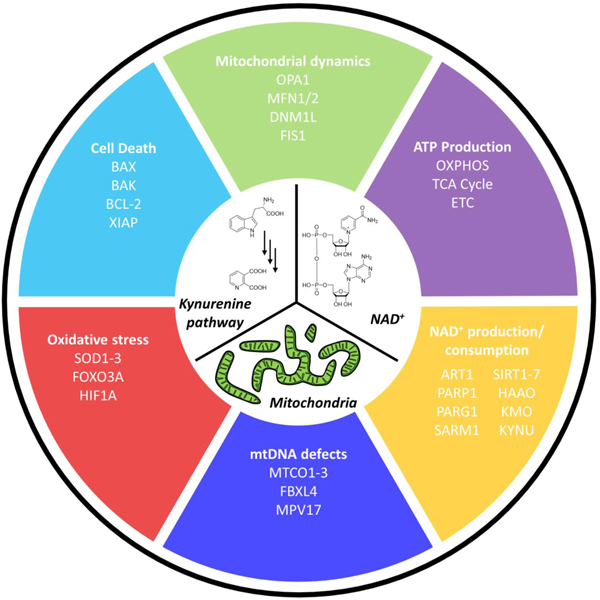
The kynurenine pathway and its interaction with NAD+ metabolism and mitochondrial fitness affect many cellular processes. Highlighted are processes and associated genes and systems with a known function in aging and age-associated disease. Oxidative phosphorylation (OXPHOS), TCA (tricarboxylic acid) cycle, electron transport chain (ETC), optic atrophy 1 (OPA1), mitofusin 1/2 (MFN1/2), dynamin-1 like (DNM1L), mitochondrial fission 1 (FIS1), kynurenine 3-monooxygenase (KMO), kynureninase (KYNU), 3-hydroxyanthranilate 3,4-dioxygenase (HAAO), superoxide dismutase 1–3 (SOD1–3), forkhead box O3 (FOXO3A), cytochrome c oxidase subunit 1–3 (MTCO1–3), F-box and leucine rich repeat 4 (FBXL4), mitochondrial inner membrane protein MPV17 (MPV17), ADP-ribosyltransferase 1 (ART1), Poly [ADP-ribose] polymerase 1 (PARP-1), Poly(ADP-ribose) glycohydrolase (PARG), Sterile Alpha and TIR Motif Containing 1 (SARM1), sirtuin 1–7 (SIRT1–7).

References

    1. Aksoy P, Escande C, White TA, Thompson M, Soares S, Benech JC, Chini EN, 2006. Regulation of SIRT 1 mediated NAD dependent deacetylation: a novel role for the multifunctional enzyme CD38. Biochem. Biophys. Res. Commun. 349, 353–359. 10.1016/j.bbrc.2006.08.066 - DOI - PubMed
    1. Aman Y, Qiu Y, Tao J, Fang EF, 2018. Therapeutic potential of boosting NAD+ in aging and age-related diseases. Transl. Med. Aging 2, 30–37. 10.1016/j.tma.2018.08.003 - DOI
    1. Bai P, Cantó C, Oudart H, Brunyánszki A, Cen Y, Thomas C, Yamamoto H, Huber A, Kiss B, Houtkooper RH, Schoonjans K, Schreiber V, Sauve AA, Menissier-de Murcia J, Auwerx J, 2011. PARP-1 inhibition increases mitochondrial metabolism through SIRT1 activation. Cell Metab. 13, 461–468. 10.1016/j.cmet.2011.03.004 - DOI - PMC - PubMed
    1. Bakondi E, Catalgol B, Bak I, Jung T, Bozaykut P, Bayramicli M, Ozer NK, Grune T, 2011. Age-related loss of stress-induced nuclear proteasome activation is due to low PARP-1 activity. Free Radic. Biol. Med. 50, 86–92. 10.1016/j.freeradbiomed.2010.10.700 - DOI - PubMed
    1. Balan V, Miller GS, Kaplun L, Balan K, Chong Z-Z, Li F, Kaplun A, VanBerkum MFA, Arking R, Freeman DC, Maiese K, Tzivion G, 2008. Life span extension and neuronal cell protection by Drosophila nicotinamidase. J. Biol. Chem. 283, 27810–27819. 10.1074/jbc.M804681200 - DOI - PMC - PubMed

Publication types