Review
. 2019 Dec 18;5(1):31-40.
doi: 10.1021/acsomega.9b03550. eCollection 2020 Jan 14.

Recent Advances in Noble Metal (Pt, Ru, and Ir)-Based Electrocatalysts for Efficient Hydrogen Evolution Reaction

Affiliations
Review

Recent Advances in Noble Metal (Pt, Ru, and Ir)-Based Electrocatalysts for Efficient Hydrogen Evolution Reaction

Changqing Li et al. ACS Omega. .

Abstract

Noble metal (Pt, Ru, and Ir)-based electrocatalysts are currently considered the most active materials for the hydrogen evolution reaction (HER). Although they have been associated with high cost, easy agglomeration, and poor stability during the HER reaction, recent efforts to intentionally tailor noble-metal-based catalysts have led to promising improvements, with lower cost and superior activity, which are critical to achieving large-scale production of pure hydrogen. In this mini-review, we focus on the recent advances in noble-metal-based HER electrocatalysts. In particular, the synthesis strategies to enhance cost-effectiveness and the catalytic activity for HER are highlighted.


Conflict of interest statement

The authors declare no competing financial interest.

Figures
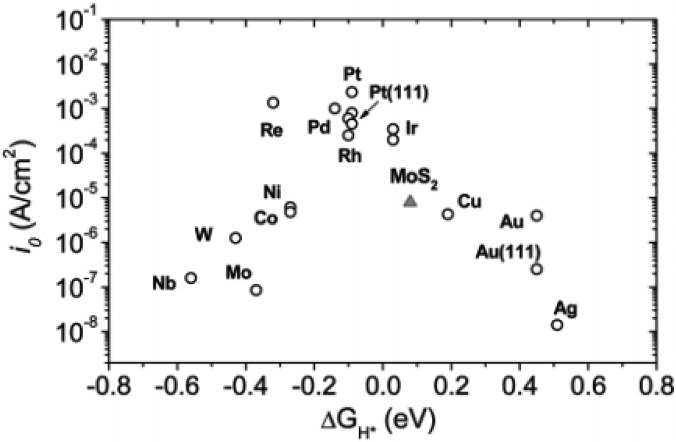
Figure 1
Figure 1
Exchange current density as a function of the hydrogen adsorption energy (ΔGH) of metal–hydrogen bonds for various pure metals. The experimental “volcano plot” indicates that Pt, with the most approachable zero hydrogen absorption energy, has the highest HER catalytic activity. Reprinted from the work of Chorkendorff et al. Copyright 2007 American Association for the Advancement of Science.
Figure 2
Figure 2
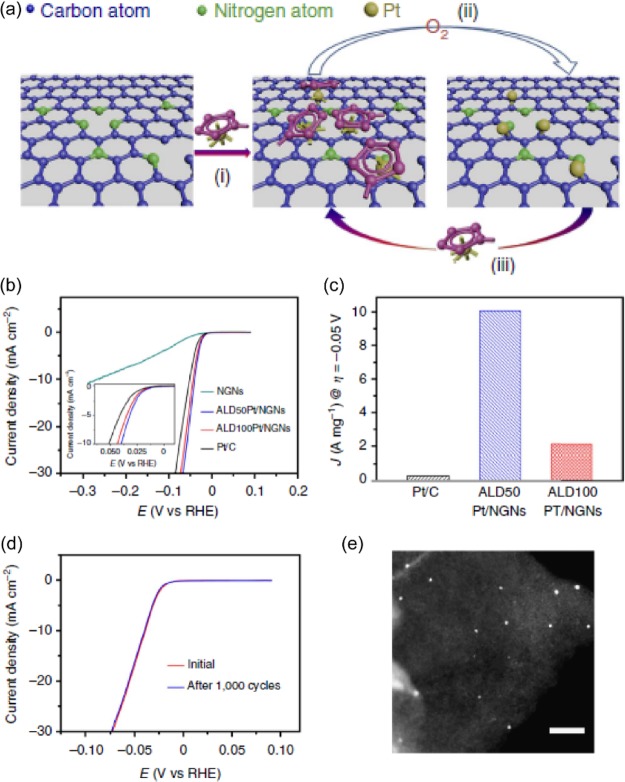
(a) Schematic of the formation of single Pt atoms on NDNs using the ALD cycle process. (b) HER catalytic activity evaluation for ALD Pt/NGNs and Pt/C benchmark catalysts in 0.5 M H2SO4. (c) Mass activity comparison of Pt/C and ALD Pt/NGNs obtained from 50 and 100 ALD cycles. (d) Stability response of ALD50Pt/NGNs before and after 1000 cyclic voltammetry cycles. (e) ADF STEM images of ALD50Pt/NGNs captured after the complete ALD process. Reproduced with permission from ref (18). Copyright 2015 Nature Publishing Group.
Figure 3
Figure 3
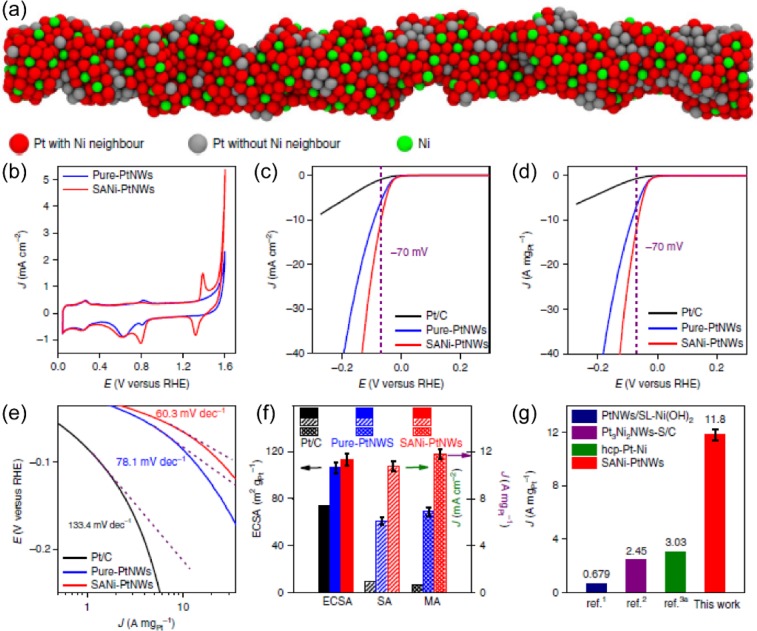
(a) Structural diagram of single atomic nickel species on ultrafine Pt nanowires (SANi-PtNWs). (b) Cyclic voltammetry curves of SANi-PtNWs and pure-PtNWs. LSV curves obtained by normalizing (c) ESCA and (d) Pt mass loading, (e) Tafel slope plot normalized by Pt mass loading, and (f) ECSA and special activity comparison of SANi-PtNWs, pure-PtNWs, and commercial Pt/C. (g) Mass activity comparison of SANi-PtNWs with those reported catalysts. Reproduced with permission from ref (7). Copyright 2019 Nature Publishing Group.
Figure 4
Figure 4
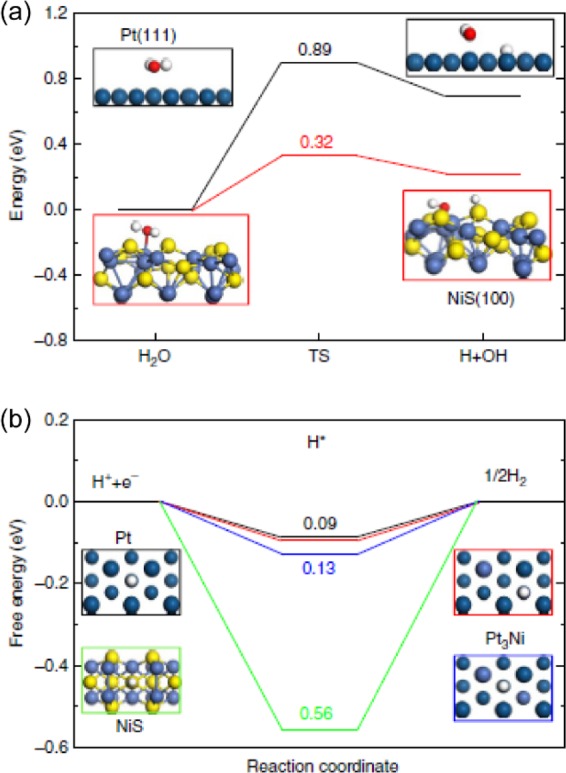
(a) DFT calculations of the water cleavage energy diagram on Pt(111) and NiS(100) facets. (b) Reaction free energy diagram of HER on Pt(111), NiS(100), and Pt3Ni (111) facets. Reproduced with permission from ref (15). Copyright 2017 Nature Publishing Group.
Figure 5
Figure 5
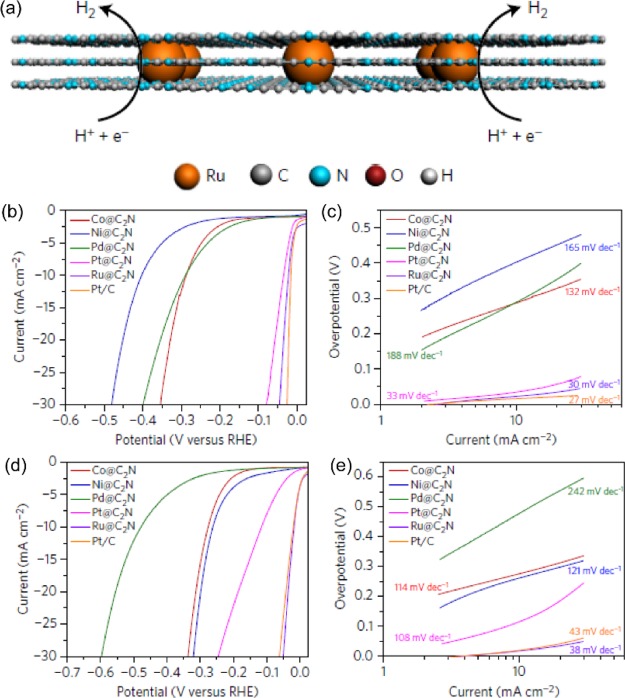
(a) Molecular structure of Ru@C2N, formed by supporting nanosized Ru on a C2N framework. LSV curves and Tafel plots of Co@C2N, Ni@C2N, Pd@C2N, Pt@C2N, and commercial Pt/C in (b,c) 0.5 M H2SO4 solution and (d,e) 1.0 M KOH solution. Panels a–e reproduced with permission from ref (22). Copyright 2017 Nature Publishing Group.
Figure 6
Figure 6
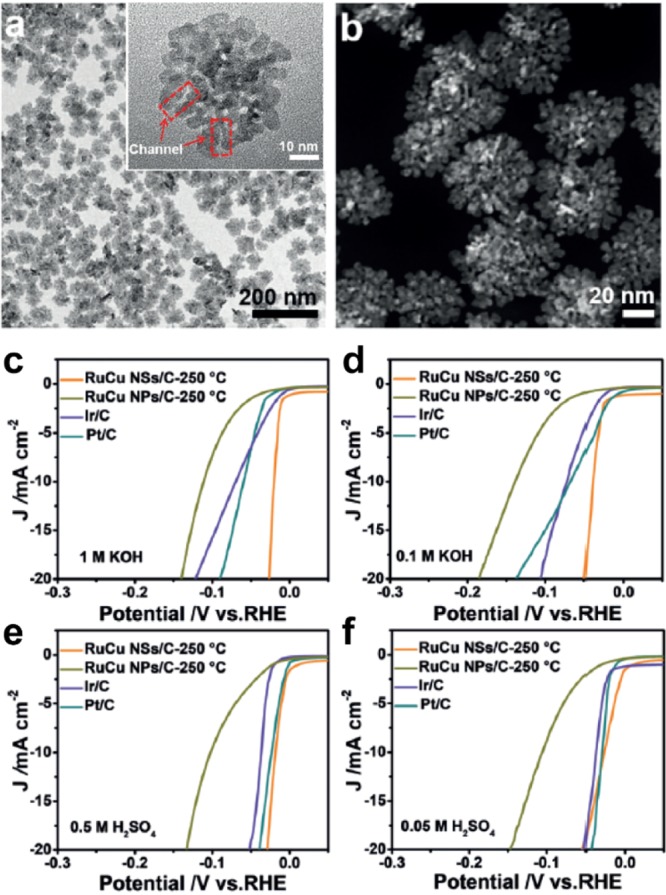
(a) TEM image and (b) HAADF-STEM image (inset: HRTEM images) of RuCu NSs. Polarization curves of RuCu/C-250 °C with different morphologies, Ir/C and Pt/C in (c) 1.0 M KOH, (d) 0.1 M KOH, (e) 0.5 M H2SO4, and (f) 0.05 M H2SO4. Panels a–f reprinted with permission from ref (23). Copyright 2019 John Wiley & Sons, Inc.
Figure 7
Figure 7
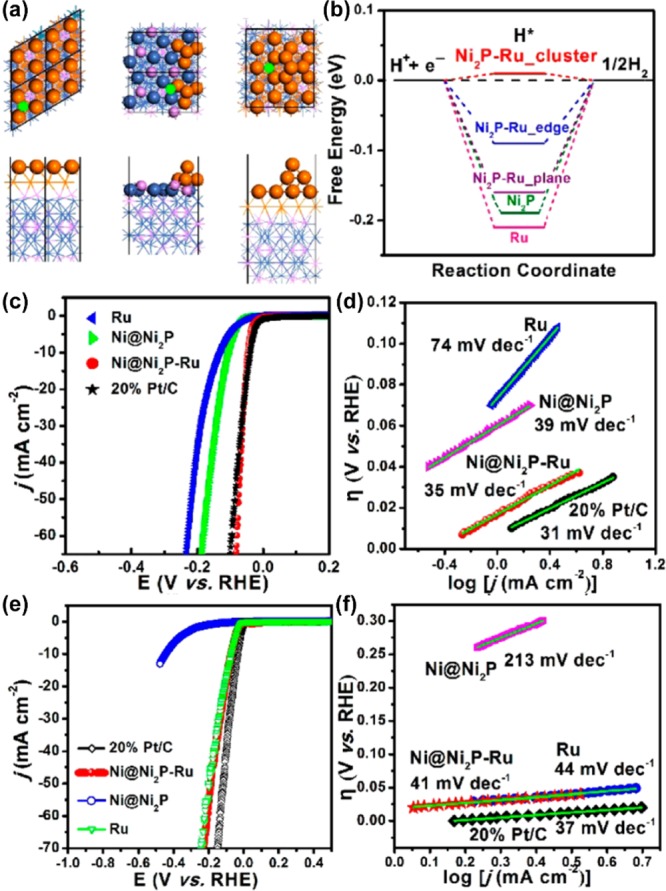
(a) Proposed structure of Ni2P–Ru viewed from different directions, the plane, edge, and Ni2P–Ru cluster. (b) The calculated reaction free energy diagrams of optimized Ni2P–Ru, Ni2P, and Ru, respectively. HER polarization curves and Tafel plot curves of Ni@Ni2P–Ru, Ni@Ni2P, Pt/C, and Ru in (c,d) 0.5 M H2SO4 and (e,f) 1.0 M KOH. Reproduced with permission from ref (11). Copyright 2018 American Chemical Society.
Figure 8
Figure 8
Theoretical calculations for hydrogen adsorption on Ir and IrNC. (a,b) The variation in electron density on the surface of Ir and IrNC in relation to H adsorption. (c) Density of states (DOS) of the surface-adsorbed H on the Ir sites of IrNC. (d) Free energy diagram of Ir and IrNC. Reproduced with permission from ref (25). Copyright 2019 Nature Publishing Group.
Figure 9
Figure 9
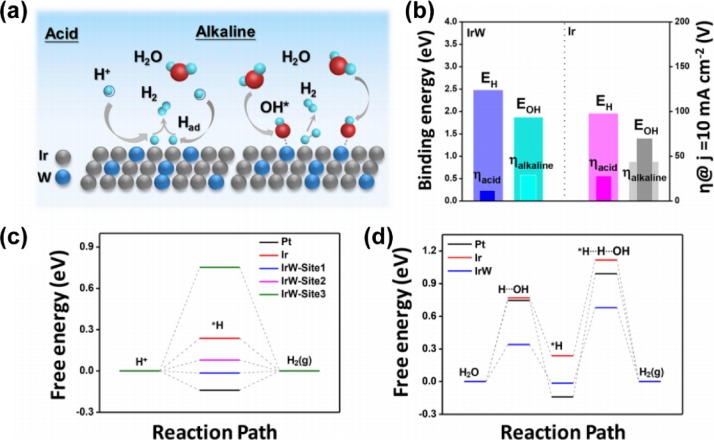
Reaction mechanism of IrW NDs toward HER in acidic and alkaline solutions. (a) Schematic HER reaction step on the surface of IrW NDs in acidic and alkaline environments. (b) Trends in HER performance under varied H and OH binding energies. (c) HER free energy diagram of Pt, Ir, and IrW at different reaction sites. (d) Free energy diagram of the alkaline Volmer–Heyrosky pathway. Reproduced with permission from ref (17). Copyright 2018 American Chemical Society.
Figure 10
Figure 10
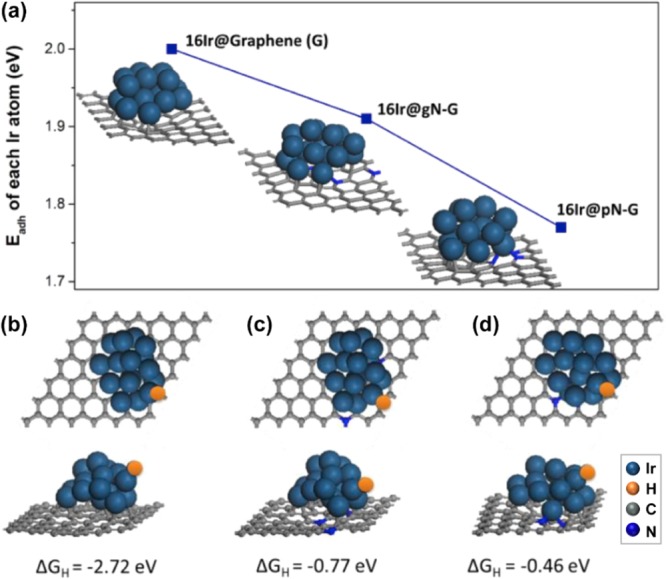
(a) Calculated adhesion energies of pristine graphene, graphitic N-doped graphene, and pyridinic N-doped graphene. Hydrogen-adsorbed energy and different views of Ir cluster anchored (b) pristine graphene, (c) graphitic N-doped graphene, and (d) pyridinic N-doped graphene. Reproduced from ref (27) with permission from Elsevier Inc., Copyright 2019.

References

    1. Jaramillo T. F.; Jørgensen K. P.; Bonde J.; Nielsen J. H.; Horch S.; Chorkendorff I. Identification of active edge sites for electrochemical H2 evolution from MoS2 nanocatalysts. Science 2007, 317, 100–102. 10.1126/science.1141483. - DOI - PubMed
    1. Digraskar R. V.; Sapner V. S.; Mali S. M.; Narwade S. S.; Ghule A. V.; Sathe B. R. CZTS decorated on graphene oxide as an efficient electrocatalyst for high-performance hydrogen evolution reaction. ACS Omega 2019, 4, 7650–7657. 10.1021/acsomega.8b03587. - DOI - PMC - PubMed
    1. Paul R.; Zhu L.; Chen H.; Qu J.; Dai L. Recent advances in carbon-based metal-free electrocatalysts. Adv. Mater. 2019, 31, 1806403–1806427. 10.1002/adma.201806403. - DOI - PubMed
    1. Kumar R.; Ahmed Z.; Rai R.; Gaur A.; Kumari S.; Maruyama T.; Bagchi V. Uniformly decorated molybdenum carbide/nitride nanostructures on biomass templates for hydrogen evolution reaction applications. ACS Omega 2019, 4, 14155–14161. 10.1021/acsomega.9b02321. - DOI - PMC - PubMed
    1. Li F.; Han G.; Noh H.-J.; Ahmad I.; Jeon I.-Y.; Baek J.-B. Mechanochemically assisted synthesis of a Ru catalyst for hydrogen evolution with performance superior to Pt in both acidic and alkaline media. Adv. Mater. 2018, 30, 1803676–1803683. 10.1002/adma.201803676. - DOI - PubMed

LinkOut - more resources