Case Reports
doi: 10.3201/eid2602.181667.
Rickettsia mongolitimonae Encephalitis, Southern France, 2018
- PMID: 31961319
- PMCID: PMC6986838
- DOI: 10.3201/eid2602.181667
Item in Clipboard
Case Reports
Rickettsia mongolitimonae Encephalitis, Southern France, 2018
Emerg Infect Dis.
2020 Feb.
Abstract
We report a case of Rickettsia sibirica mongolitimonae infection, an emerging tickborne rickettsiosis, with associated encephalitis in a 66-year-old man. Diagnosis was rapidly confirmed by quantitative PCR obtained from an eschar swab sample. The patient was successfully treated with oral doxycycline.
Keywords: France; Rickettsia mongolitimonae; bacteria; meningitis/encephalitis; tickborne rickettsioses; ticks; vector-borne infections.
Figures
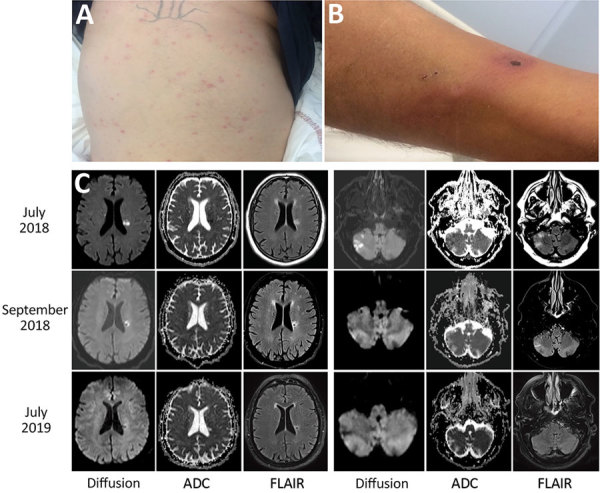
Clinical manifestations and cerebral magnetic resonance imaging of a 66-year-old man with Rickettsia sibirica mongolitimonae–associated encephalitis, southern France, 2018. A) Maculopapular rash. B) Black eschar and rope-like lymphangitis on the right leg. C) Magnetic resonance imaging with diffusion (B1000), ADC, and FLAIR. In July 2018, cytotoxic lesions were observed intra-axially and in the white matter of right cerebellar hemispheres with FLAIR hypersignal and with low ADC signal. In September 2018, these cytotoxic lesions regressed in diffusion with the appearance of a necrotic cavity facing the roof of the left lateral ventricle. In July 2019, disappearance of diffusion anomalies. Small necrotic cavity with after-effects on FLAIR and ADC signals. ADC, apparent diffusion coefficient; FLAIR, fluid-attenuated inversion recovery.
References
Publication types
MeSH terms
Substances
LinkOut - more resources
Full Text Sources
Medical