Trends in Pediatric Primary Care Visits Among Commercially Insured US Children, 2008-2016
- PMID: 31961428
- PMCID: PMC6990970
- DOI: 10.1001/jamapediatrics.2019.5509
Trends in Pediatric Primary Care Visits Among Commercially Insured US Children, 2008-2016
Abstract
Importance: Primary care is the foundation of pediatric care. While policy interventions have focused on improving access and quality of primary care, trends in overall use of primary care among children have not been described.
Objective: To assess trends in primary care visit rates and out-of-pocket costs, to examine variation in these trends by patient and visit characteristics, and to assess shifts to alternative care options (eg, retail clinics, urgent care, and telemedicine).
Design, setting, and participants: Observational cohort study of claims data from 2008 to 2016 for children 17 years and younger covered by a large national commercial health plan. Visit rate per 100 child-years was determined for each year overall, by child and geographic characteristics, and by visit type (eg, primary diagnosis), and trends were assessed with a series of child-year Poisson models. Data were analyzed from November 2017 to September 2019.
Main outcomes and measures: Visits to primary care and other settings.
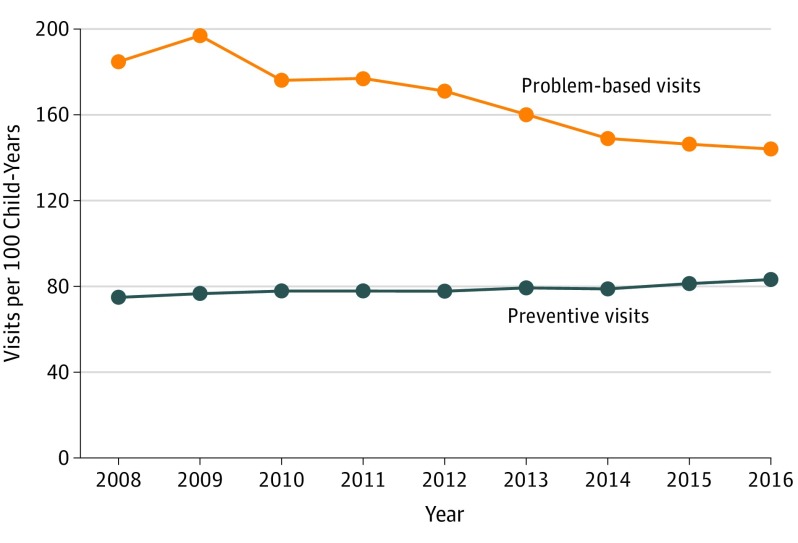
Results: This cohort study included more than 71 million pediatric primary care visits over 29 million pediatric child-years (51% male in 2008 and 2016; 37% between 12-17 years in 2008 and 38% between 12-17 years in 2016). Unadjusted results for primary care visit rates per 100 child-years decreased from 259.6 in 2008 to 227.2 in 2016, yielding a regression-estimated change in primary care visits across the 9 years of -14.4% (95% CI, -15.0% to -13.9%; absolute change: -32.4 visits per 100 child-years). After controlling for shifts in demographics, the relative decrease was -12.8% (95% CI, -13.3% to -12.2%). Preventive care visits per 100 child-years increased from 74.9 in 2008 to 83.2 visits in 2016 (9.9% change in visit rate; 95% CI, 9.0%-10.9%; absolute change: 8.3 visits per 100 child-years), while problem-based visits per 100 child-years decreased from 184.7 in 2008 to 144.1 in 2016 (-24.1%; 95% CI, -24.6% to -23.5%; absolute change: -40.6 visits per 100 child-years). Visit rates decreased for all diagnostic groups except for the behavioral and psychiatric category. Out-of-pocket costs for problem-based primary care visits increased by 42% during the same period. Per 100 child-years, visits to other acute care venues increased from 21.3 to 27.6 (30.3%; 95% CI, 28.5% to 32.1%; absolute change: 6.3 visits per 100 child-years) and visits to specialists from 45.2 to 53.5 (16.4%; 95% CI, 14.8% to 18.0%, absolute change: 8.3 visits per 100 child-years).
Conclusions and relevance: Primary care visit rates among commercially insured children decreased over the last decade. Increases in out-of-pocket costs and shifts to other venues appear to explain some of this decrease.
Conflict of interest statement
Figures
Comment in
-
Changing Pediatric Primary Care.JAMA Pediatr. 2020 Apr 1;174(4):327-328. doi: 10.1001/jamapediatrics.2019.5532. JAMA Pediatr. 2020. PMID: 31961391 No abstract available.
References
-
- Medical Home Initiatives for Children With Special Needs Project Advisory Committee; American Academy of Pediatrics . The medical home. Pediatrics. 2002;110(1, pt 1):184-186. - PubMed
-
- National Committee for Quality Assurance. HEDIS and performance measures. https://www.ncqa.org/hedis/. Accessed April 5, 2019.