Review
. 2020 Jan 16;9(1):223.
doi: 10.3390/cells9010223.

Zinc Finger Transcription Factor MZF1-A Specific Regulator of Cancer Invasion

Affiliations
Review

Zinc Finger Transcription Factor MZF1-A Specific Regulator of Cancer Invasion

Ditte Marie Brix et al. Cells. .

Abstract

Over 90% of cancer deaths are due to cancer cells metastasizing into other organs. Invasion is a prerequisite for metastasis formation. Thus, inhibition of invasion can be an efficient way to prevent disease progression in these patients. This could be achieved by targeting the molecules regulating invasion. One of these is an oncogenic transcription factor, Myeloid Zinc Finger 1 (MZF1). Dysregulated transcription factors represent a unique, increasing group of drug targets that are responsible for aberrant gene expression in cancer and are important nodes driving cancer malignancy. Recent studies report of a central involvement of MZF1 in the invasion and metastasis of various solid cancers. In this review, we summarize the research on MZF1 in cancer including its function and role in lysosome-mediated invasion and in the expression of genes involved in epithelial to mesenchymal transition. We also discuss possible means to target it on the basis of the current knowledge of its function in cancer.

Keywords: EMT; MZF1; PAK4; SUMOylation; cancer therapy; lysosome; lysosome-mediated invasion; phosphorylation; transcription factor; zinc finger.


Conflict of interest statement

The authors declare no conflict of interest.

Figures

Figure 1
Figure 1
MZF1 protein isoforms. Top: Domain structure of the full-length (734 amino acid) MZF1 isoform containing five distinct domains: acidic domain (A), SCAN domain (SCAN), transactivation domain (TAD), and 13 highly conserved Krüppel-like zinc finger motifs (Z) arranged in two domains. Middle: Domain structure of the putative (485 amino acid) “zinc finger only”-form of MZF1, that in addition to 13 zinc fingers also has the TAD domain. The amino terminus of the new, recently identified 450 kD zinc finger only isoform is marked with a dashed black line. Bottom: Domain structure of the 290 amino acids “SCAN domain only” form of MZF1 that in addition to the SCAN domain also has the acidic domain (A).
Figure 2
Figure 2
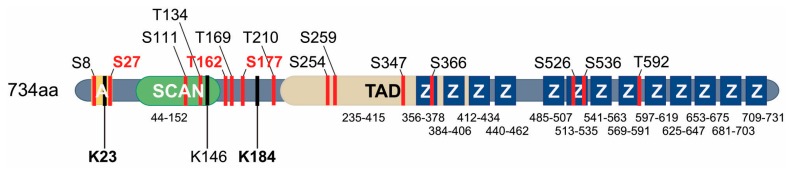
Schematic representation of the protein structure of full-length human MZF1 with reported SUMO-sites (K) and serine (S) and threonine (T) phosphorylation sites. The domain structure of MZF1 is presented as in Figure 1. The location of each indicated SUMO- and phospho-site is shown. The verified SUMO-sites are marked with bold font and the predicted SUMO-site (K146) is marked with regular font. The phospho-sites that are highlighted with red have been identified as ErbB2-responsive sites. Note that the serines 256, 274 and 294 corresponding to the ERK phosphorylation sites in the TAD of murine MZF1 have not yet been reported as phospho-sites in humans.
Figure 3
Figure 3
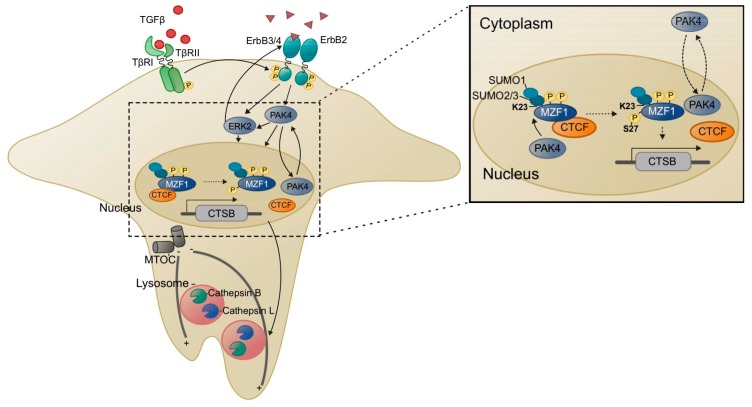
Graphical presentation of MZF1 activation and induction of CTSB expression in lysosome-mediated invasion as a response to ErbB2 signaling. ErbB2 activation, further supported by activation of TGFβ signaling, activates ERK2 and PAK4. Active PAK4 will phosphorylate MZF1 serine 27, if its adjacent lysine 23 is SUMOylated, which exposes MZF1 serine 27 to PAK4 phosphorylation. As a response to phosphorylation of serine 27, MZF1 association of its transcriptional repressors, e.g., CTCF, is prevented and MZF1 can now activate CTSB expression and lysosome redistribution, which leads to lysosome-mediated invasion.
Figure 4
Figure 4
Graphical presentation of cellular mechanisms activated in lysosome-mediated invasion. Peripheral lysosomes contribute to extracellular matrix (ECM) degradation both internally (left) and externally (right). Peripheral lysosomes degrade the ECM components that have been internalized by the cell e.g., via endocytosis. Peripheral lysosomes can secrete their contents, including cathepsin B, into the extracellular space via lysosomal exocytosis, a process where the lysosome membrane fuses with the plasma membrane, which allows the secretion of the lysosomal contents to the extracellular space. Secreted cathepsin B degrades the ECM components: type IV collagen, laminin and fibronectin and initiates the activation of the extracellular degradome by cleaving the pro-forms of urokinase plasminogen activator and MMP2 and MMP3, which are activators of MMP9 and MMP13.

References

    1. Gandhi A.K., Kang J., Havens C.G., Conklin T., Ning Y., Wu L., Ito T., Ando H., Waldman M.F., Thakurta A., et al. Immunomodulatory agents lenalidomide and pomalidomide co-stimulate T cells by inducing degradation of T cell repressors Ikaros and Aiolos via modulation of the E3 ubiquitin ligase complex CRL4(CRBN.) Br. J. Haematol. 2014;164:811–821. doi: 10.1111/bjh.12708. - DOI - PMC - PubMed
    1. Licht J.D., Shortt J., Johnstone R. From anecdote to targeted therapy: The curious case of thalidomide in multiple myeloma. Cancer Cell. 2014;25:9–11. doi: 10.1016/j.ccr.2013.12.019. - DOI - PMC - PubMed
    1. Peterson F.C., Hayes P.L., Waltner J.K., Heisner A.K., Jensen D.R., Sander T.L., Volkman B.F. Structure of the SCAN domain from the tumor suppressor protein MZF1. J. Mol. Biol. 2006;363:137–147. doi: 10.1016/j.jmb.2006.07.063. - DOI - PMC - PubMed
    1. Hromas R., Collins S.J., Hickstein D., Raskind W., Deaven L.L., O’Hara P., Hagen F.S., Kaushansky K. A retinoic acid-responsive human zinc finger gene, MZF-1, preferentially expressed in myeloid cells. J. Biol. Chem. 1991;266:14183–14187. - PubMed
    1. Morris J.F., Rauscher F.J., 3rd, Davis B., Klemsz M., Xu D., Tenen D., Hromas R. The myeloid zinc finger gene, MZF-1, regulates the CD34 promoter in vitro. Blood. 1995;86:3640–3647. - PubMed

Publication types

Substances