Review
. 2020 Jan 19;12(1):261.
doi: 10.3390/nu12010261.

Regulation of Skeletal Muscle Function by Amino Acids

Affiliations
Review

Regulation of Skeletal Muscle Function by Amino Acids

Yasutomi Kamei et al. Nutrients. .

Abstract

Amino acids are components of proteins that also exist free-form in the body; their functions can be divided into (1) nutritional, (2) sensory, and (3) biological regulatory roles. The skeletal muscle, which is the largest organ in the human body, representing ~40% of the total body weight, plays important roles in exercise, energy expenditure, and glucose/amino acid usage-processes that are modulated by various amino acids and their metabolites. In this review, we address the metabolism and function of amino acids in the skeletal muscle. The expression of PGC1α, a transcriptional coactivator, is increased in the skeletal muscle during exercise. PGC1α activates branched-chain amino acid (BCAA) metabolism and is used for energy in the tricarboxylic acid (TCA) cycle. Leucine, a BCAA, and its metabolite, β-hydroxy-β-methylbutyrate (HMB), both activate mammalian target of rapamycin complex 1 (mTORC1) and increase protein synthesis, but the mechanisms of activation appear to be different. The metabolite of valine (another BCAA), β-aminoisobutyric acid (BAIBA), is increased by exercise, is secreted by the skeletal muscle, and acts on other tissues, such as white adipose tissue, to increase energy expenditure. In addition, several amino acid-related molecules reportedly activate skeletal muscle function. Oral 5-aminolevulinic acid (ALA) supplementation can protect against mild hyperglycemia and help prevent type 2 diabetes. β-alanine levels are decreased in the skeletal muscles of aged mice. β-alanine supplementation increased the physical performance and improved the executive function induced by endurance exercise in middle-aged individuals. Further studies focusing on the effects of amino acids and their metabolites on skeletal muscle function will provide data essential for the production of food supplements for older adults, athletes, and individuals with metabolic diseases.

Keywords: PGC1α; amino acid; branched-chain amino acid (BCAA); energy expenditure; exercise; leucine; metabolic diseases; skeletal muscle; β-aminoisobutyric acid (BAIBA); β-hydroxy-β-methylbutyrate (HMB).


Conflict of interest statement

The authors declare no conflict of interest.

Figures
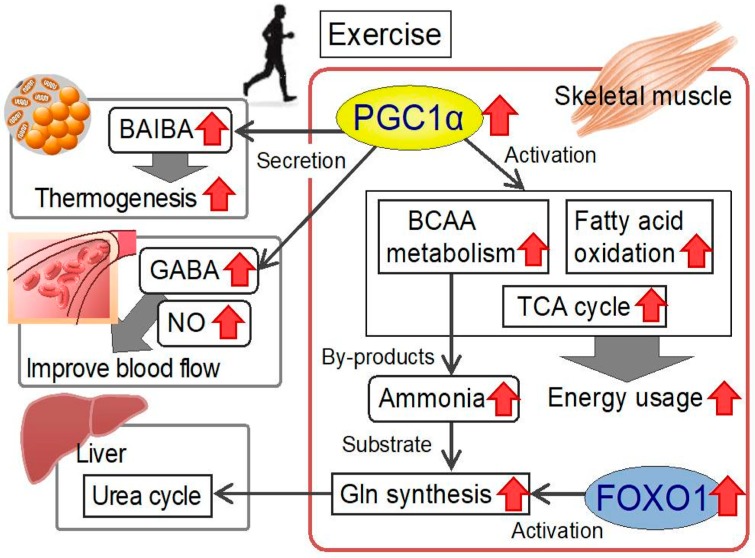
Figure 1
Figure 1
Metabolic changes in the skeletal muscle during exercise and amino acid-mediated interorgan effects. PGC1α expression in the skeletal muscle is increased by exercise. Increased PGC1α activates BCAA metabolism, fatty acid oxidation, and the TCA cycle and increases energy usage [20,24]. BCAA degradation leads to the formation of ammonia by-products. FOXO1 increases glutamine synthetase (adds ammonia to glutamic acid), resulting in the elimination of ammonia from the liver (urea cycle) [23]. In turn, exercise-induced PGC1α increases BAIBA, GABA, and arginine levels in the skeletal muscle [24]. BAIBA secreted from the skeletal muscle causes browning of white adipose tissue and increases thermogenesis [27]. GABA and arginine-derived NO may act on blood vessels and improve blood flow. Thus, in terms of preventing metabolic diseases, myokines are likely to be important, as myokines mediate the signaling of the favorable effects of exercise from the skeletal muscle to other organs. Ingestion of these amino acids as supplemental foods may improve human health. PGC1α, peroxisome proliferator-activated receptor γ coactivator 1-α; BCAA, branched-chain amino acid; TCA cycle, tricarboxylic acid cycle; FOXO1, forkhead box protein O1; Gln, glutamine; BAIBA, β-aminoisobutyric acid; GABA, γ-aminobutyric acid; NO, nitric oxide.
Figure 2
Figure 2
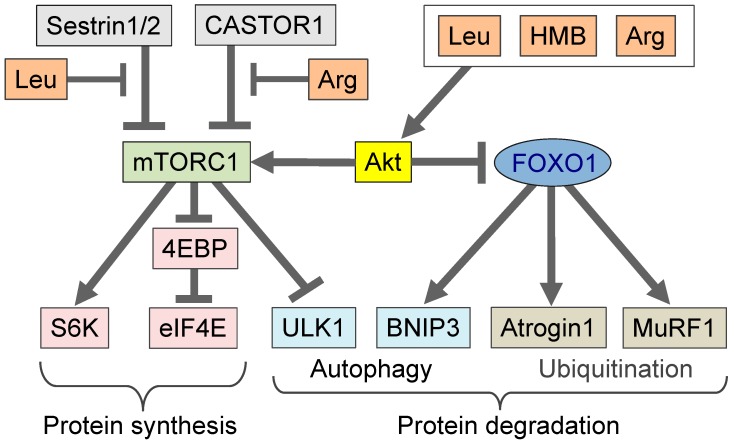
mTORC1 is activated by amino acids, such as leucine, HMB, and arginine. mTORC1 phosphorylates substrates, such as 4EBP and S6K, and increases protein synthesis. Moreover, in the presence of these amino acids, mTORC1 suppresses starvation signals, such as autophagy. Amino acids (leucine, HMB, and arginine) can activate Akt, leading to mTORC1 activation and FOXO1 suppression [28,34,35,36]. FOXO1 is a transcription factor that induces muscle atrophy. Suppression of FOXO1 transcriptional activity leads to decreased autophagy. Leucine interacts with Sestrin 1 or Sestrin 2 [5,32], and arginine interacts with CASTOR1 and activates mTORC1 [33]. The nature of the molecules involved in the amino acid-mediated pathway (e.g., the differences among leucine, HMB, and arginine) warrants further clarification. Leu, leucine; HMB, β-hydroxy-β-methylbutyrate; Arg, arginine; mTORC1, mammalian target of rapamycin complex 1; CASTOR1, cytosolic arginine sensor for mTORC1 subunit 1; FOXO1, forkhead box protein O1; S6K, S6 kinase; eIF4E, eukaryotic initiation factor 4E; 4EBP, eIF4E-binding protein; ULK1, unc-51 like autophagy activating kinase; BNIP3, Bcl-2 19 kDa interacting protein 3; MuRF1, muscle RING-finger protein-1.
Figure 3
Figure 3
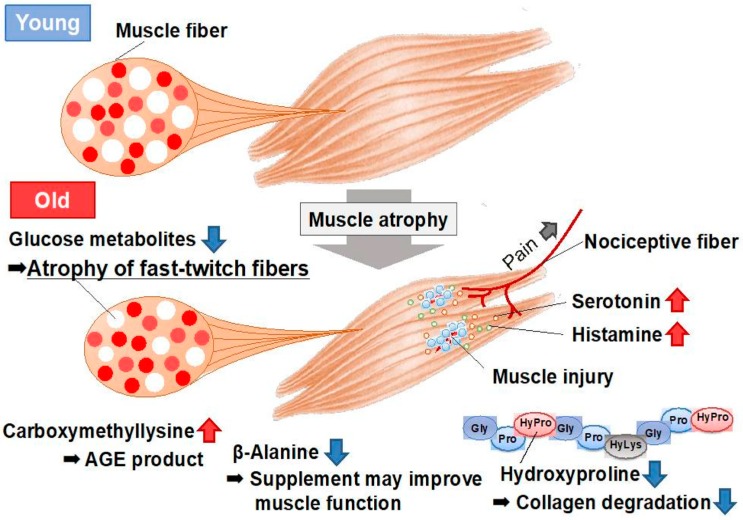
Metabolomic analysis of the skeletal muscles of young and aged mice [59]. Aged muscle exhibited atrophy, especially in fast-twitch fibers (white fibers), which was accompanied by decreased glycolytic metabolism. Increases in the levels of neurotransmitters (serotonin and histamine) were observed, which may indicate (or explain) muscle injury and pain in aged muscle. Carboxymethyllysine, which is an AGE product, also increased in aged muscle, whereas β-alanine markedly decreased. Supplementation with β-alanine may improve the muscle function in sarcopenia. AGE, advanced glycation end product.

References

    1. Salter D.N., Montgomery A.I., Hudson A., Quelch D.B., Elliott R.J. Lysine requirements and whole-body protein turnover in growing pigs. Br. J. Nutr. 1990;63:503–513. doi: 10.1079/BJN19900137. - DOI - PubMed
    1. Ishida A., Kyoya T., Nakashima K., Katsumata M. Muscle protein metabolism during compensatory growth with changing dietary lysine levels from deficient to sufficient in growing rats. J. Nutr. Sci. Vitaminol. 2011;57:401–408. doi: 10.3177/jnsv.57.401. - DOI - PubMed
    1. Ninomiya K. Food Science of Dashi and Umami Taste. Yakugaku Zasshi. 2016;136:1327–1334. doi: 10.1248/yakushi.16-00057-1. - DOI - PubMed
    1. Moro T., Ebert S.M., Adams C.M., Rasmussen B.B. Amino Acid Sensing in Skeletal Muscle. Trends Endocrinol. Metab. 2016;27:796–806. doi: 10.1016/j.tem.2016.06.010. - DOI - PMC - PubMed
    1. Wolfson R.L., Sabatini D.M. The Dawn of the Age of Amino Acid Sensors for the mTORC1 Pathway. Cell Metab. 2017;26:301–309. doi: 10.1016/j.cmet.2017.07.001. - DOI - PMC - PubMed

MeSH terms

Substances