Review
. 2020 Mar;107(3):409-418.
doi: 10.1002/JLB.3RI1219-425R. Epub 2020 Jan 22.

Regulation of IgE by T follicular helper cells

Affiliations
Review

Regulation of IgE by T follicular helper cells

Uthaman Gowthaman et al. J Leukoc Biol. 2020 Mar.

Abstract

Allergies to food and environmental antigens have steeply grown to epidemic proportions. IgE antibodies are key mediators of allergic disease, including life-threatening anaphylaxis. There is now compelling evidence that one of the hallmarks of anaphylaxis-inducing IgE molecules is their high affinity for allergen, and the cellular pathway to high-affinity IgE is typically through sequential switching of IgG B cells. Further, in contrast to the previously held paradigm that a subset of CD4+ T cells called Th2 cells promotes IgE responses, recent studies suggest that T follicular helper cells are crucial for inducing anaphylactic IgE. Here we discuss recent studies that have enabled us to understand the nature, induction, and regulation of this enigmatic antibody isotype in allergic sensitization.

Keywords: Allergy; Anaphylaxis; IgE; Tfh cells; Th2 cells.


Figures

FIGURE 1
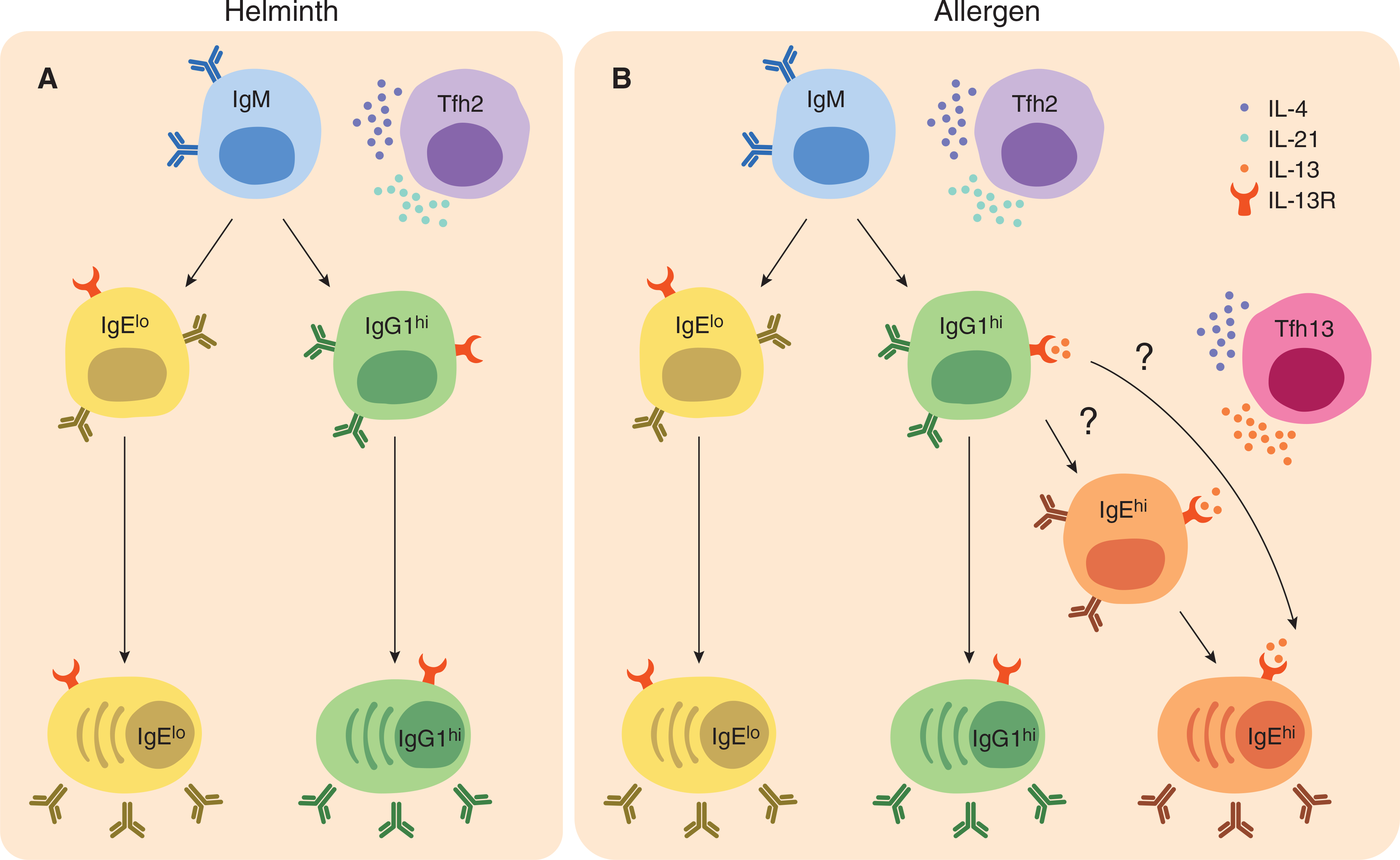
FIGURE 1. A model for IgE induction during helminth infections and allergen exposure.
In both helminth infections and allergic sensitization, Tfh2 cells that make IL-4 and IL-21 are induced. Tfh2 cells help B cells make high-affinity IgG and low-affinity IgE through direct switching of IgM B cells. Following activation, these B cells up-regulate the receptor for IL-13, yet little Tfh cell-derived IL-13 should be present. In contrast, during allergic sensitization, distinct populations of IL-4- and IL-13-producing Tfh13 cells are induced in addition to Tfh2 cells. Through their production of IL-13 and IL-4, Tfh13 cells promote sequential switching of high-affinity IgG1 to high-affinity IgE-producing plasma cells (PCs). It is unclear whether this switching occurs through a high-affinity IgE B cell intermediate, or whether high-affinity IgE-producing PCs directly differentiate from high-affinity IgG1 B cells (see question marks). Further, isotype-switched B cells and PCs during both helminth infection and allergen sensitization express IL-13 receptor (IL-13R); however, only during allergen sensitization, but not helminth infection, is IL-13 available to promote high-affinity IgE
FIGURE 2
FIGURE 2. Progressive differentiation and plasticity models of Tfh13 cell induction.
One possible pathway for Tfh13 cell induction is that Tfh13 cells progressively differentiate from IL-21+ Tfh cells (A, B). IL-21+ Tfh cells are induced early during an immune response, and they differentiate into IL-4-producing Tfh2 cells by up-regulating BATF, which induces IL-4 but not IL-5 or IL-13 production. These Tfh2 cells could in turn differentiate into Tfh13 cells through GATA3 upregulation (A). Alternatively, Tfh13 cells may also arise directly from IL-21+ Tfh cells (B). In contrast to progressive differentiation, a plasticity model suggests that Tfh13 cells and Tfh2 cells differentiate from Th2 cells (C). This pathway may be bi-directional as Tfh cells could also acquire a Th2 phenotype and migrate to the periphery as effector cells

References

    1. Marichal T, Starkl P, Reber LL, et al. A beneficial role for immunoglobulin E in host defense against honeybee venom. Immunity. 2013;39:963–975. - PMC - PubMed
    1. Galli SJ, Starkl P, Marichal T, Tsai M. Mast cells and IgE in defense against venoms: possible “good side” of allergy? Allergol Int. 2016;65:3–15. - PubMed
    1. Mukai K, Tsai M, Starkl P, Marichal T, Galli SJ. IgE and mast cells in host defense against parasites and venoms. Semin Immunopathol. 2016;38:581–603. - PMC - PubMed
    1. Palm NW, Rosenstein RK, Yu S, Schenten DD, Florsheim E, Medzhitov R. Bee venom phospholipase A2 induces a primary type 2 response that is dependent on the receptor ST2 and confers protective immunity. Immunity. 2013;39:976–985. - PMC - PubMed
    1. Finkelman FD, Rothenberg ME, Brandt EB, Morris SC, Strait RT. Molecular mechanisms of anaphylaxis: lessons from studies with murine models. J Allergy Clin Immunol. 2005;115:449–457. quiz 458. - PubMed

Publication types

Substances