County Jail Incarceration Rates and County Mortality Rates in the United States, 1987-2016
- PMID: 31967885
- PMCID: PMC6987920
- DOI: 10.2105/AJPH.2019.305413
County Jail Incarceration Rates and County Mortality Rates in the United States, 1987-2016
Abstract
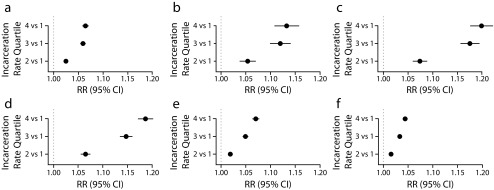
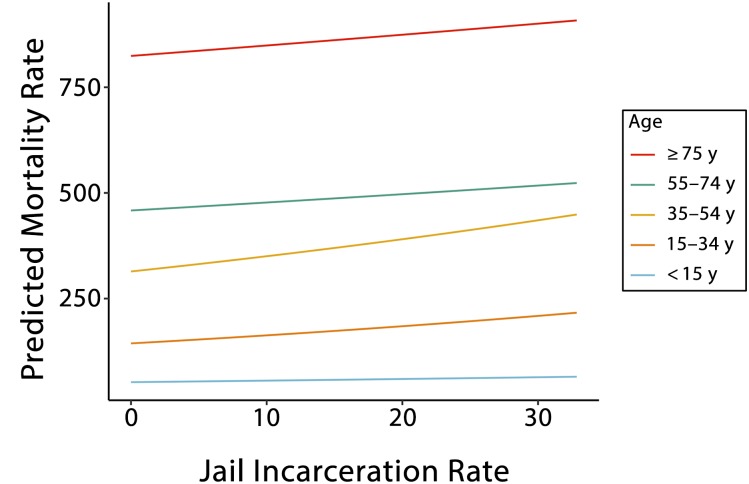
Objectives. To evaluate the relationship between changes in county jail incarceration rates and subsequent county mortality rates across the United States.Methods. We analyzed county jail incarceration rates from the Bureau of Justice Statistics from 1987 to 2016 for 1884 counties and mortality rates from the National Vital Statistics System. We fit 1-year-lagged quasi-Poisson 2-way fixed-effects models, controlling for unmeasured stable county characteristics, and measured time-varying confounders, including county poverty and crime rates.Results. A within-county increase in jail incarceration rates from the first to second quartile was associated with a 2.5% increase in mortality rates, adjusting for confounders (risk ratio [RR] = 1.03; 95% confidence interval [CI] = 1.02, 1.03). This association followed a dose-response relationship and was stronger for mortality among those aged 15 to 34 years (RR = 1.07; 95% CI = 1.06, 1.09).Conclusions. Within-county increases in jail incarceration rates are associated with increases in subsequent mortality rates after adjusting for important confounders.Public Health Implications. Our findings add to the growing body of empirical evidence of the harms of mass incarceration. The criminal justice reform and decarceration movements can use these findings as they develop strategies to end mass incarceration.
Figures
References
-
- Gideon L. Bridging the gap between health and justice. Health Justice. 2013;1:4.
-
- Turney K. Stress proliferation across generations? Examining the relationship between parental incarceration and childhood health. J Health Soc Behav. 2014;55(3):302–319. - PubMed
Publication types
MeSH terms
Grants and funding
LinkOut - more resources
Full Text Sources