Review
. 2020 Mar;40(3):e55-e64.
doi: 10.1161/ATVBAHA.119.313046. Epub 2020 Jan 23.

Cardiovascular Effects of Androgen Deprivation Therapy in Prostate Cancer: Contemporary Meta-Analyses

Affiliations
Review

Cardiovascular Effects of Androgen Deprivation Therapy in Prostate Cancer: Contemporary Meta-Analyses

Jiun-Ruey Hu et al. Arterioscler Thromb Vasc Biol. 2020 Mar.

Abstract

Androgen deprivation therapy is a cornerstone of prostate cancer treatment. Pharmacological androgen deprivation includes gonadotropin-releasing hormone agonism and antagonism, androgen receptor inhibition, and CYP17 (cytochrome P450 17A1) inhibition. Studies in the past decade have raised concerns about the potential for androgen deprivation therapy to increase the risk of adverse cardiovascular events such as myocardial infarction, stroke, and cardiovascular mortality, possibly by exacerbating cardiovascular risk factors. In this review, we summarize existing data on the cardiovascular effects of androgen deprivation therapy. Among the therapies, abiraterone stands out for increasing risk of cardiac events in meta-analyses of both randomized controlled trials and observational studies. We find a divergence between observational studies, which show consistent positive associations between androgen deprivation therapy use and cardiovascular disease, and randomized controlled trials, which do not show these associations reproducibly.

Keywords: androgen deprivation therapy; cardiooncology; cardiotoxicity; gonadotropin releasing hormone agonists; prostate cancer.


Figures
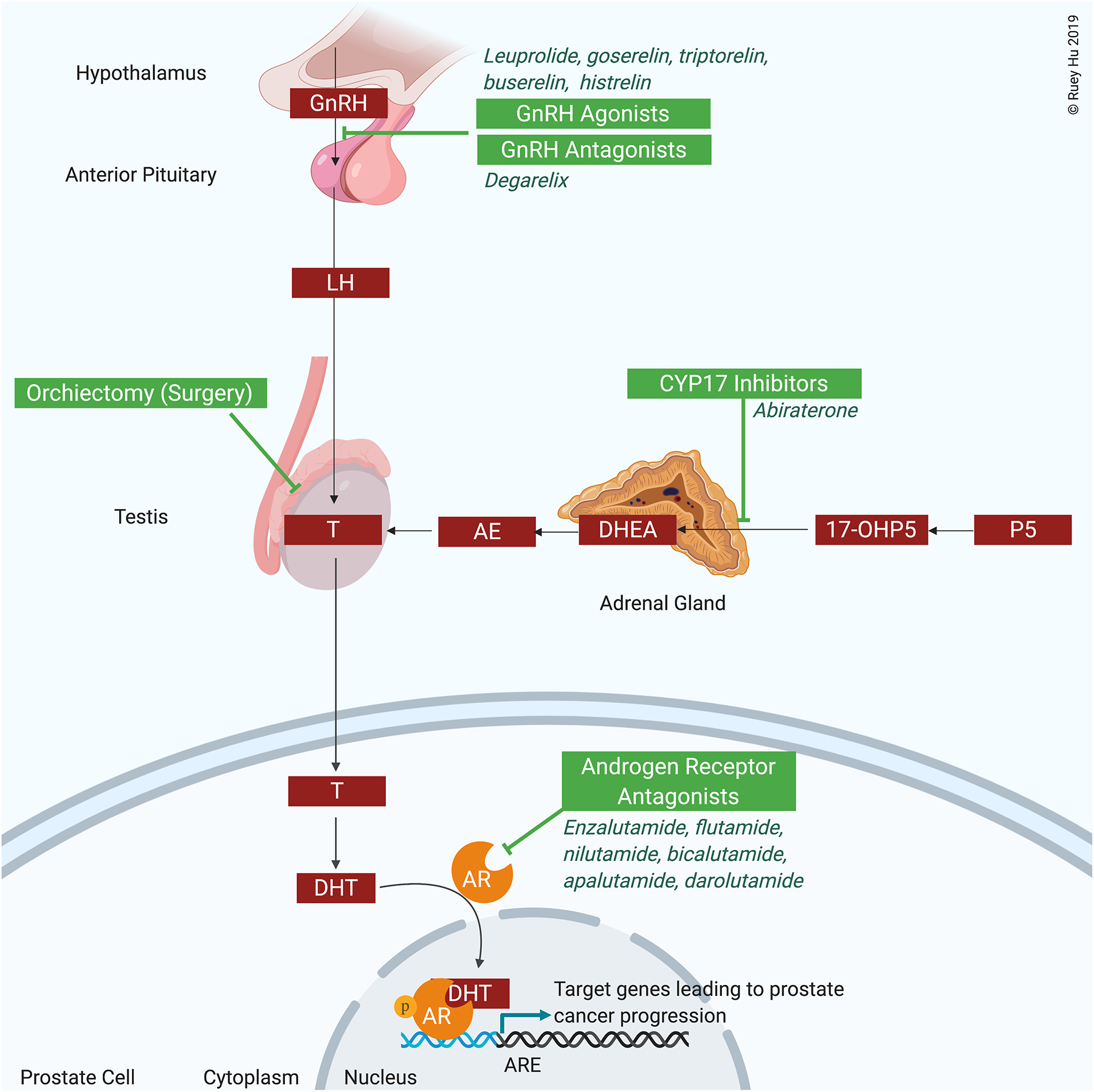
Figure 1:
Figure 1:
The hypothalamic-pituitary-gonadal axis and targets for androgen deprivation therapy in prostate cancer Abbreviations: 17-OHP5: 17α-hydroxypregnenolone; AE: androstenedione; AR: androgen receptor; DHEA: dihydroepiandrosterone; DHT: dihydrotestosterone; GnRH: gonadotropin releasing hormone; LH: luteinizing hormone; P5: pregnenolone; T: testosterone

References

    1. Bray F, Ferlay J, Soerjomataram I, Siegel RL, Torre LA, Jemal A. Global cancer statistics 2018: GLOBOCAN estimates of incidence and mortality worldwide for 36 cancers in 185 countries. CA Cancer J Clin. 2018;68(6):394–424. doi:10.3322/caac.21492 - DOI - PubMed
    1. Siegel RL, Miller KD, Jemal A. Cancer statistics, 2019. CA: A Cancer Journal for Clinicians. 2019;69(1):7–34. doi:10.3322/caac.21551 - DOI - PubMed
    1. Levine GN, D’Amico AV, Albertsen P, et al. Androgen-Deprivation Therapy in Prostate Cancer and Cardiovascular Risk. Circulation. 2010;121(6):833–840. doi:10.1161/CIRCULATIONAHA.109.192695 - DOI - PMC - PubMed
    1. Beyer DA, Amari F, Thill M, et al. Emerging gonadotropin-releasing hormone agonists. Expert Opinion on Emerging Drugs. 2011;16(2):323–340. doi:10.1517/14728214.2010.547472 - DOI - PubMed
    1. Barber M, Nguyen LS, Wassermann J, Spano J-P, Funck-Brentano C, Salem J-E. Cardiac arrhythmia considerations of hormone cancer therapies. Cardiovasc Res. 2019;115(5):878–894. doi:10.1093/cvr/cvz020 - DOI - PubMed

MeSH terms

Substances