. 2020 Mar 17;94(7):e02017-19.
doi: 10.1128/JVI.02017-19. Print 2020 Mar 17.

Development of a Highly Effective African Swine Fever Virus Vaccine by Deletion of the I177L Gene Results in Sterile Immunity against the Current Epidemic Eurasia Strain

Affiliations

Development of a Highly Effective African Swine Fever Virus Vaccine by Deletion of the I177L Gene Results in Sterile Immunity against the Current Epidemic Eurasia Strain

Manuel V Borca et al. J Virol. .

Abstract

African swine fever virus (ASFV) is the etiological agent of a contagious and often lethal disease of domestic pigs that has significant economic consequences for the swine industry. The disease is devastating the swine industry in Central Europe and East Asia, with current outbreaks caused by circulating strains of ASFV derived from the 2007 Georgia isolate (ASFV-G), a genotype II ASFV. In the absence of any available vaccines, African swine fever (ASF) outbreak containment relies on the control and culling of infected animals. Limited cross-protection studies suggest that in order to ensure a vaccine is effective, it must be derived from the current outbreak strain or at the very least from an isolate with the same genotype. Here, we report the discovery that the deletion of a previously uncharacterized gene, I177L, from the highly virulent ASFV-G produces complete virus attenuation in swine. Animals inoculated intramuscularly with the virus lacking the I177L gene, ASFV-G-ΔI177L, at a dose range of 102 to 106 50% hemadsorbing doses (HAD50), remained clinically normal during the 28-day observational period. All ASFV-G-ΔI177L-infected animals had low viremia titers, showed no virus shedding, and developed a strong virus-specific antibody response; importantly, they were protected when challenged with the virulent parental strain ASFV-G. ASFV-G-ΔI177L is one of the few experimental vaccine candidate virus strains reported to be able to induce protection against the ASFV Georgia isolate, and it is the first vaccine capable of inducing sterile immunity against the current ASFV strain responsible for recent outbreaks.IMPORTANCE Currently, there is no commercially available vaccine against African swine fever. Outbreaks of this disease are devastating the swine industry from Central Europe to East Asia, and they are being caused by circulating strains of African swine fever virus derived from the Georgia 2007 isolate. Here, we report the discovery of a previously uncharacterized virus gene, which when deleted completely attenuates the Georgia isolate. Importantly, animals infected with this genetically modified virus were protected from developing ASF after challenge with the virulent parental virus. Interestingly, ASFV-G-ΔI177L confers protection even at low doses (102 HAD50) and remains completely attenuated when inoculated at high doses (106 HAD50), demonstrating its potential as a safe vaccine candidate. At medium or higher doses (104 HAD50), sterile immunity is achieved. Therefore, ASFV-G-ΔI177L is a novel efficacious experimental ASF vaccine protecting pigs from the epidemiologically relevant ASFV Georgia isolate.

Keywords: ASF; ASFV; African swine fever virus; vaccine.


Figures

FIG 1
FIG 1
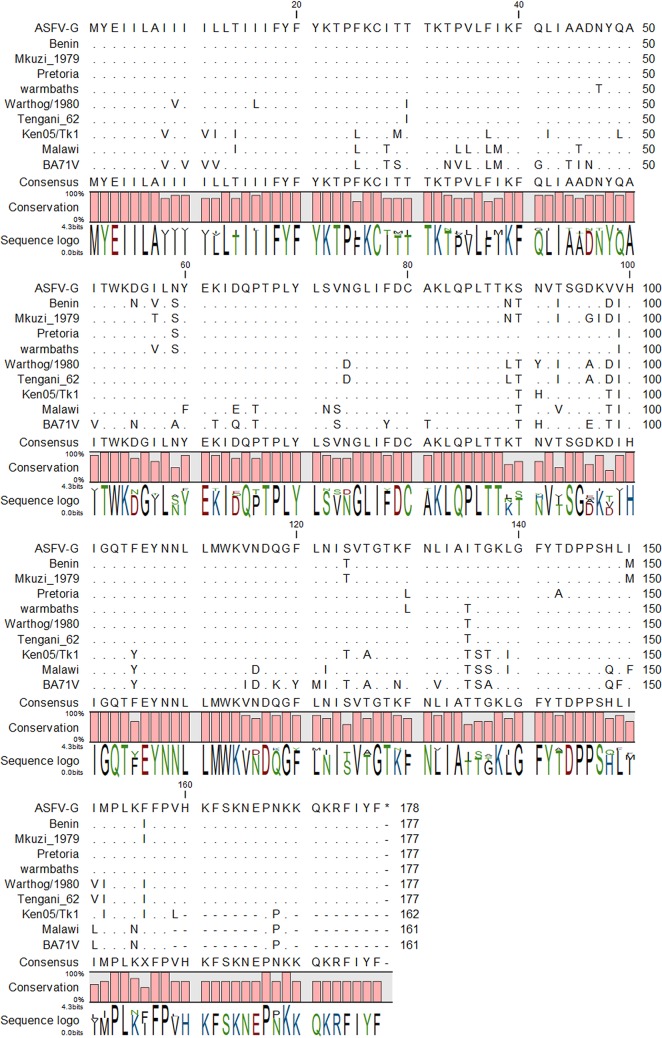
Multiple-sequence alignment of the indicated ASFV isolates of viral protein I177L, with matching residues represented as periods and gaps in the sequence represented by dashes. The degree of conservation between the sequences is represented below the sequences.
FIG 2
FIG 2
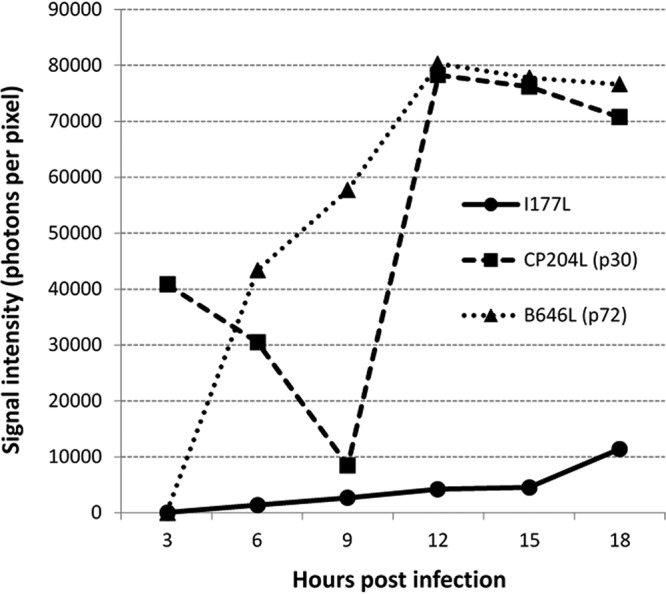
Time course of I177L gene transcriptional activity. Shown are averaged microarray signal intensities (photons per pixel) of ASFV I177L, CP204L, and B646L open reading frame RNA prepared from ex vivo pig macrophages infected with ASFV at 3, 6, 9, 12, 15, and 18 h postinfection.
FIG 3
FIG 3
Diagram indicating the position of the I177L open reading frame in the ASFV-G genome (top). A donor plasmid with arms homologous to ASFV-G and the mCherry under the control of the p72 promoter was used to introduce the final genomic changes (bottom) to create ASFV-Georgia-ΔI177L, where the sequence of the donor plasmid mCherry reporter (red) is introduced to replace the ORF of I177L, as indicated.
FIG 4
FIG 4
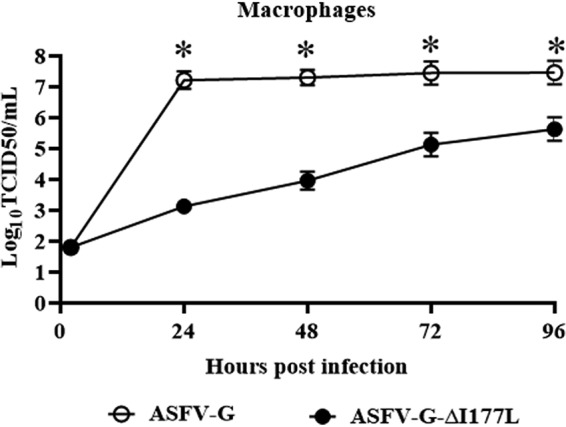
In vitro growth characteristics of ASFV-Georgia-ΔI177L and parental ASFV-G. Primary swine macrophage cell cultures were infected (MOI, 0.01) with each of the viruses and the virus yield titrated at the indicated times postinfection. Data represent the means of the results from three independent experiments. The sensitivity of virus detection is ≥1.8 log10 HAD50/ml. Significant differences (*) in viral yields between the two viruses at specific times points were determined using the Holm-Sidak method (α = 0.05), without assuming a consistent standard deviation. All calculations were conducted on the software GraphPad Prism version 8. TCID50, 50% tissue culture infective dose.
FIG 5
FIG 5
Viremia titers detected in pigs i.m. inoculated with either 102 HAD50 of ASFV-Georgia-ΔI177L or 102 HAD50 of ASFV-G. Each curve represents values from individual animals in each group. The sensitivity of virus detection was ≥1.8 log10 HAD50/ml.
FIG 6
FIG 6
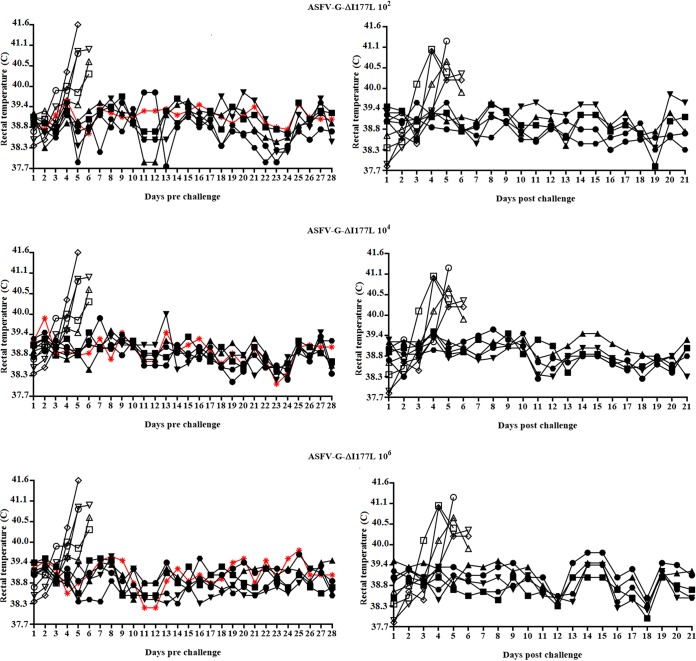
Kinetics of body temperature values in pigs i.m. inoculated with either 102, 104, or 106 HAD50 (top of each panel) of ASFV-Georgia-ΔI177L (filled symbols), mock inoculated (sentinels, shown in red), or 102 HAD50 of ASFV-G (open symbols) (left) and after the challenge with 102 HAD50 of ASFV-G (right). Each curve represents an individual animal’s values in each group. Data from sentinel animals are depicted in red.
FIG 7
FIG 7
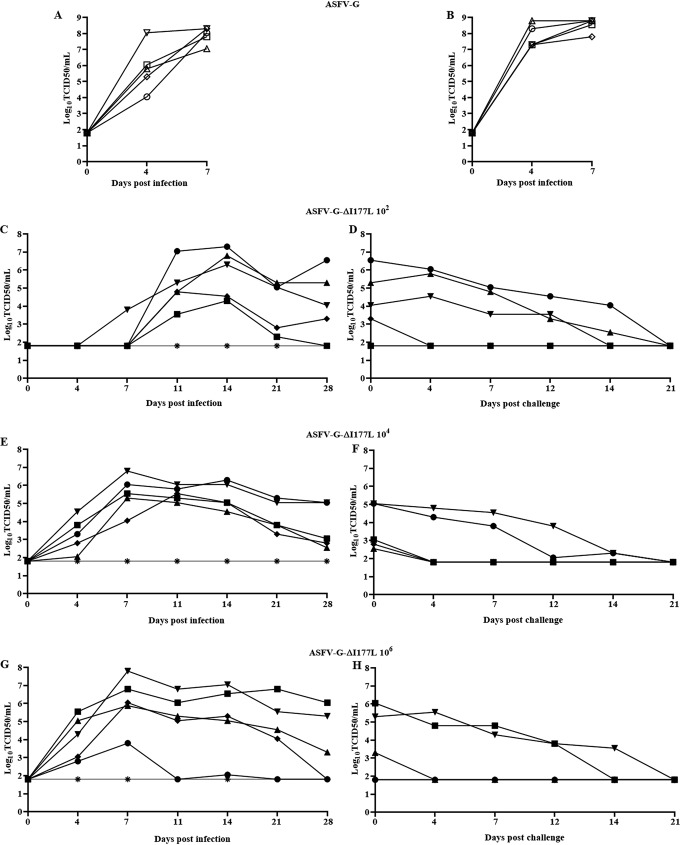
Viremia titers detected in pigs i.m. inoculated with either ASFV-Georgia-ΔI177L or ASFV-G. (A to H) Animals were inoculated with either 102 HAD50 of ASFV-G (A and B) or ASFV-Georgia-ΔI177L at doses of 102 (C and D), 104 (E and F), or 106 (G and H) HAD50. (C to H) Viremias in ASFV-Georgia-ΔI177L-inoculated animals before (C, E, and G) or after (D, F, and H) the challenge with 102 HAD50 of ASFV-G. Each curve represents values from individual animals in each group. The sensitivity of virus detection was ≥1.8 log10 HAD50/ml50/ml. Data from sentinel animals are depicted in red.
FIG 8
FIG 8
(A to F) Anti-ASFV antibody (IgM mediated [A, C, and E] and IgG mediated [B, D, and F]) titers detected by ELISA in pigs i.m. inoculated with either 102, 104, or 106 HAD50 of ASFV-Georgia-ΔI177L. Each curve represents values from individual animals in each group.

References

    1. Tulman ER, Delhon GA, Ku BK, Rock DL. 2009. African swine fever virus, p 43–87. In Van Etten JL. (ed), Lesser known large dsDNA viruses, vol 328 Springer-Verlag, Berlin, Germany.
    1. Costard S, Wieland B, de Glanville W, Jori F, Rowlands R, Vosloo W, Roger F, Pfeiffer DU, Dixon LK. 2009. African swine fever: how can global spread be prevented? Philos Trans R Soc Lond B Biol Sci 364:2683–2696. doi:10.1098/rstb.2009.0098. - DOI - PMC - PubMed
    1. Chapman DA, Darby AC, Da Silva M, Upton C, Radford AD, Dixon LK. 2011. Genomic analysis of highly virulent Georgia 2007/1 isolate of African swine fever virus. Emerg Infect Dis 17:599–605. doi:10.3201/eid1704.101283. - DOI - PMC - PubMed
    1. Coggins L. 1974. African swine fever virus. Pathogenesis. Prog Med Virol 18:48–63. - PubMed
    1. Forman AJ, Wardley RC, Wilkinson PJ. 1982. The immunological response of pigs and guinea pigs to antigens of African swine fever virus. Arch Virol 74:91–100. doi:10.1007/bf01314703. - DOI - PubMed

Publication types

LinkOut - more resources