. 2020 Jan 22;10(1):953.
doi: 10.1038/s41598-020-57587-6.

Regulation and Maturation of the Shewanella oneidensis Sulfite Reductase SirA

Affiliations

Regulation and Maturation of the Shewanella oneidensis Sulfite Reductase SirA

Kenneth L Brockman et al. Sci Rep. .

Abstract

Shewanella oneidensis, a metal reducer and facultative anaerobe, expresses a large number of c-type cytochromes, many of which function as anaerobic reductases. All of these proteins contain the typical heme-binding motif CXXCH and require the Ccm proteins for maturation. Two c-type cytochrome reductases also possess atypical heme-binding sites, the NrfA nitrite reductase (CXXCK) and the SirA sulfite reductase (CX12NKGCH). S. oneidensis MR-1 encodes two cytochrome c synthetases (CcmF and SirE) and two apocytochrome c chaperones (CcmI and SirG). SirE located in the sir gene cluster is required for the maturation of SirA, but not NrfA. Here we show that maturation of SirA requires the combined function of the two apocytochrome c chaperones CcmI and SirG. Loss of either protein resulted in decreased sulfite reductase. Furthermore, SirA was not detected in a mutant that lacked both chaperones, perhaps due to misfolding or instability. These results suggest that CcmI interacts with SirEFG during SirA maturation, and with CcmF during maturation of NrfA. Additionally, we show that CRP regulates expression of sirA via the newly identified transcriptional regulatory protein, SirR.


Conflict of interest statement

The authors declare no competing interests.

Figures

Figure 1
Figure 1
Arrangement of the sir and ccm gene clusters on the S. oneidensis chromosome. Letters correspond to the sir or ccm gene names unless indicated otherwise.
Figure 2
Figure 2
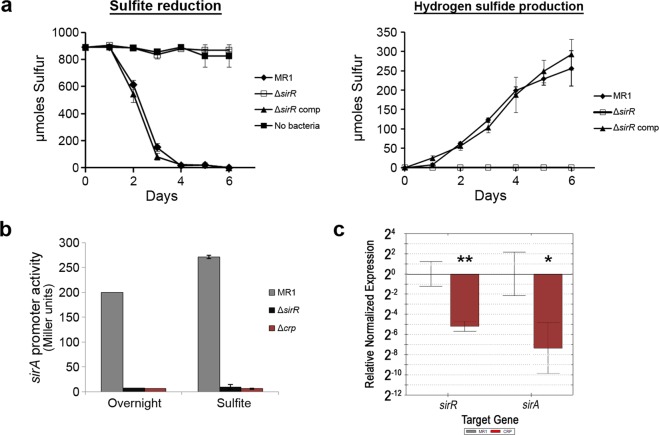
SirR regulates sulfite reduction via regulation of sirA expression. (a) Sulfite reduction is indicated by loss of sulfite (SO3) and accumulation of hydrogen sulfide (H2S). Loss of sirR completely abolished sulfite reduction. Complementation of sirR restored sulfite reduction to wild type levels. (b) Activity of the sirA promoter was measured by lacZ-promoter fusions. Beta-galactosidase activity was measured after overnight aerobic growth or anerobic growth with sulfite as the sole electron acceptor. Both sirR and crp were required for expression of the sulfite reductase operon, as indicated by loss of lacZ expression in the ΔsirR and Δcrp mutants. (c) Expression of sirR and sirA in the wild-type MR-1 and Δcrp mutant. CRP was required for wild-type level expression of sirR and sirA, which indicated that CRP was required for optimal expression of sirR as well as sirA. *p < 0.05, **p < 0.005, ANOVA.
Figure 3
Figure 3
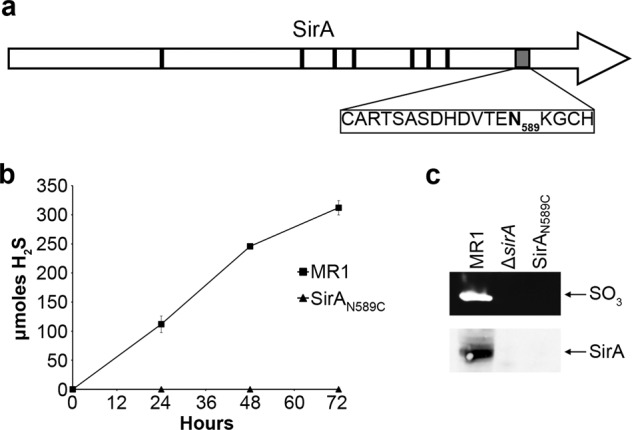
The atypical heme binding site of SirA is required for maturation and stability. (a) Locations of typical and atypical heme binding sites of SirA. Black boxes indicate typical CXXCH binding sites, the gray box indicates the atypical CX12NKGCH binding site. Asparagine 589 (bolded) was changed to a cystine to restore the atypical binding site to the typical CXXCH motif. (b) Shewanella that expressed the wildtype or mutated SirA were grown anaerobically on sulfite. The SirAN589C mutant was unable to reduce sulfite, as indicated by lack of hydrogen sulfide production. (c) Whole cell extracts from the wildtype, ΔsirA and SirAN589C strains were tested for sulfite reductase activity and the SirA protein. Neither ΔsirA nor SirAN589C cell extracts had an active sulfite reductase or a band that reacted with antibodies directed against SirA. Full-length blots/gels are presented in Supplementary Fig. S3.
Figure 4
Figure 4
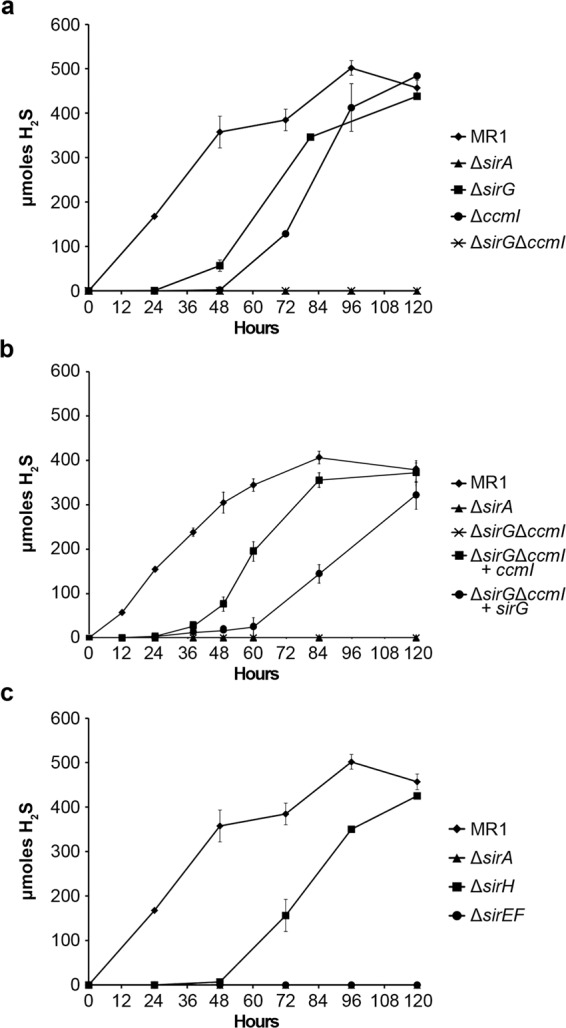
Cytochrome maturation and heme lyase components are required for optimal sulfite reduction. Wildtype and mutant S. oneidensis were grown anaerobically with sulfite as the sole electron acceptor. Sulfite reduction was indicated by the production of hydrogen sulfide (H2S). (a) Loss of either heme chaperone, SirG or CcmI, resulted in a lag in sulfite reduction, likely due to a reduction in functionally active reductase. Sulfite activity was abolished when both sirG and ccmI were deleted. (b) Sulfite reductase activity of the ΔsirGΔccmI double mutant was partially restored, similar to that of the respected single mutant, when complemented with either sirG or ccmI. (c) Loss of the heme lyase components SirH or SirEF resulted in decreased sulfite reduction. The ΔsirH mutant exhibited a 48-hour lag in sulfite reduction compared to wildtype, whereas the ΔsirEF mutant lacked any sulfite reduction. The ΔsirA mutant served as a negative control for sulfite reduction in all assays.
Figure 5
Figure 5
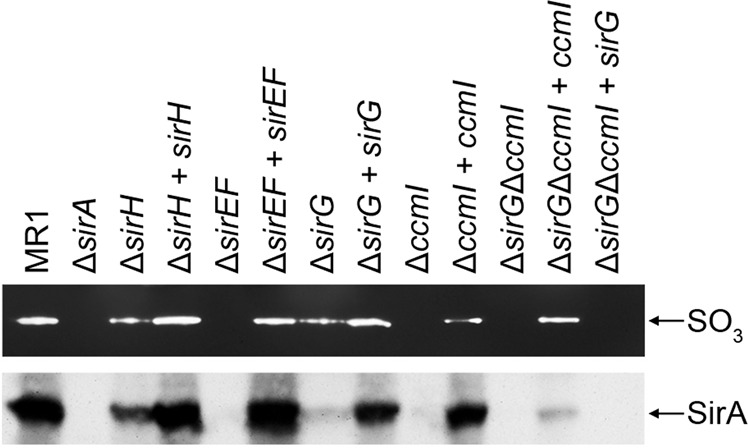
Sulfite reductase activity and protein levels of wild-type, mutant, and complemented mutant cell extracts. Upper panel. Sulfite reductase activity was indicated by bands of clearing. No activity was observed in extracts from ΔsirA, ΔsirEF, ΔccmI or ΔccmIΔsirG. Reduced activity was observed in cell extracts from ΔsirH and ΔsirG. Complementation restored reductase activity to wildtype levels, except with ΔccmI, which partially restored activity. Lower panel. Western blot analysis of the cell extracts was performed using antibodies against SirA. Reactive bands that corresponded to SirA are indicated. Reduced SirA was detected in extracts from ΔsirH and ΔsirG compared to wildtype and was absent in extracts from ΔsirA, ΔsirEF, ΔccmI and ΔccmIΔsirG. Complementation restored SirA levels similar to that of the wildtype or corresponding single mutants, in the case of the ΔsirGΔccmI mutant. Full-length blots/gels are presented in Supplementary Fig. S5.
Figure 6
Figure 6
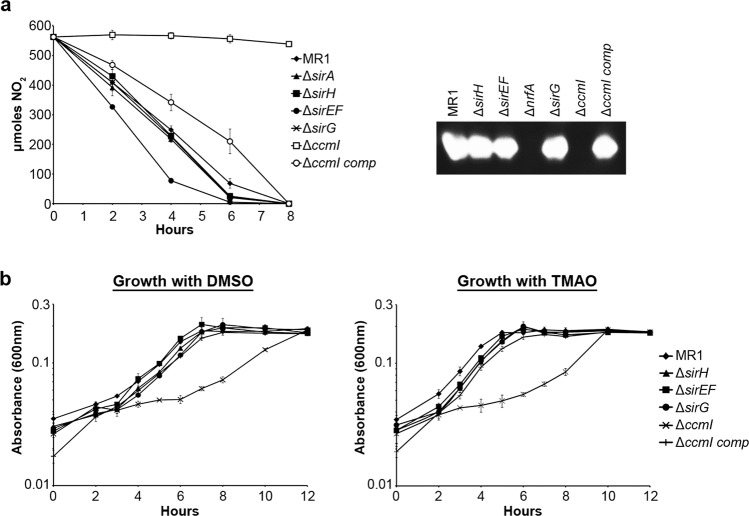
The sir cytochrome maturation genes are not involved in maturation of the NrfA nitrite reductase. (a) Nitrite reduction was not significantly decreased in any of the sir mutants, however the ΔsirEF mutants reduced nitrite faster than the wildtype. As anticipated, ΔccmI was unable to reduce nitrite and reduction was restored by complementation. Enzymatic activity of the nitrate reductase was not affected in any of the sir mutants. There was no nitrite reductase activity in the cell lysates of ΔnrfA or ΔccmI. (b) ΔsirH, ΔsirEF and ΔsirG were all able to grow on DMSO or TMAO similar to wildtype. The ΔccmI mutant exhibited a lag in growth with either DMSO or TMAO, which was restored by complementation. Full-length gel is presented in Supplementary Fig. S4.

References

    1. Fredrickson JK, et al. Towards environmental systems biology of Shewanella. Nature reviews. Microbiology. 2008;6:592–603. doi: 10.1038/nrmicro1947. - DOI - PubMed
    1. Beliaev AS, Saffarini DA. Shewanella putrefaciens mtrB encodes an outer membrane protein required for Fe(III) and Mn(IV) reduction. Journal of bacteriology. 1998;180:6292–6297. - PMC - PubMed
    1. Beliaev AS, Saffarini DA, McLaughlin JL, Hunnicutt D. MtrC, an outer membrane decahaem c cytochrome required for metal reduction in Shewanella putrefaciens MR-1. Molecular microbiology. 2001;39:722–730. doi: 10.1046/j.1365-2958.2001.02257.x. - DOI - PubMed
    1. Cruz-Garcia C, Murray AE, Klappenbach JA, Stewart V, Tiedje JM. Respiratory nitrate ammonification by Shewanella oneidensis MR-1. Journal of bacteriology. 2007;189:656–662. doi: 10.1128/jb.01194-06. - DOI - PMC - PubMed
    1. Dos Santos JP, Iobbi-Nivol C, Couillault C, Giordano G, Mejean V. Molecular analysis of the trimethylamine N-oxide (TMAO) reductase respiratory system from a Shewanella species. Journal of molecular biology. 1998;284:421–433. doi: 10.1006/jmbi.1998.2155. - DOI - PubMed

Publication types

MeSH terms

Supplementary concepts