


Genome-wide gene-environment analyses of major depressive disorder and reported lifetime traumatic experiences in UK Biobank
- PMID: 31969693
- PMCID: PMC7305950
- DOI: 10.1038/s41380-019-0546-6
Genome-wide gene-environment analyses of major depressive disorder and reported lifetime traumatic experiences in UK Biobank
Erratum in
-
Correction: Genome-wide gene-environment analyses of major depressive disorder and reported lifetime traumatic experiences in UK Biobank.Mol Psychiatry. 2021 Sep;26(9):5465. doi: 10.1038/s41380-020-0779-4. Mol Psychiatry. 2021. PMID: 32424234 No abstract available.
Abstract
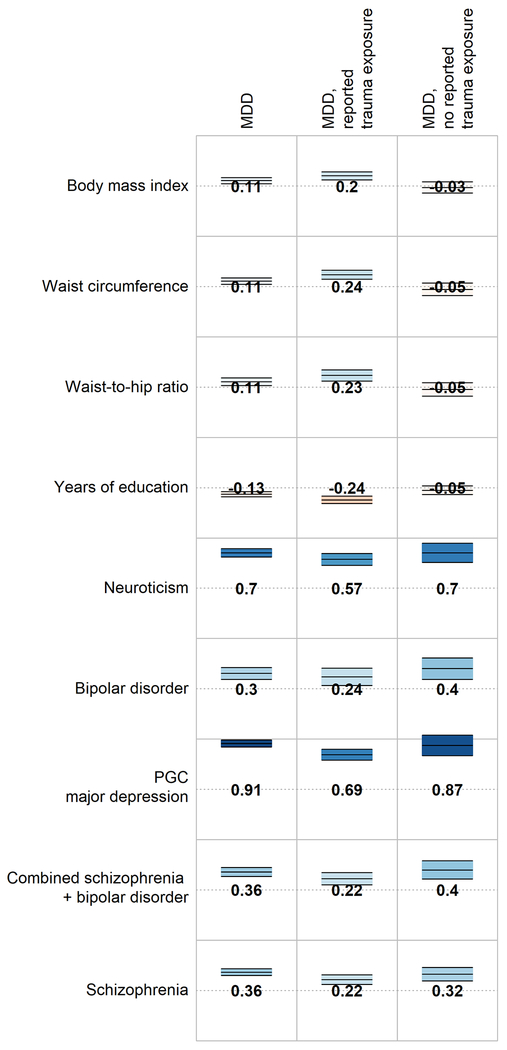
Depression is more frequent among individuals exposed to traumatic events. Both trauma exposure and depression are heritable. However, the relationship between these traits, including the role of genetic risk factors, is complex and poorly understood. When modelling trauma exposure as an environmental influence on depression, both gene-environment correlations and gene-environment interactions have been observed. The UK Biobank concurrently assessed Major Depressive Disorder (MDD) and self-reported lifetime exposure to traumatic events in 126,522 genotyped individuals of European ancestry. We contrasted genetic influences on MDD stratified by reported trauma exposure (final sample size range: 24,094-92,957). The SNP-based heritability of MDD with reported trauma exposure (24%) was greater than MDD without reported trauma exposure (12%). Simulations showed that this is not confounded by the strong, positive genetic correlation observed between MDD and reported trauma exposure. We also observed that the genetic correlation between MDD and waist circumference was only significant in individuals reporting trauma exposure (rg = 0.24, p = 1.8 × 10⁻⁷ versus rg = -0.05, p = 0.39 in individuals not reporting trauma exposure, difference p = 2.3 × 10⁻⁴). Our results suggest that the genetic contribution to MDD is greater when reported trauma is present, and that a complex relationship exists between reported trauma exposure, body composition, and MDD.
Conflict of interest statement
Conflict of Interest
No authors report a conflict of interest associated with the research presented in this paper.
Figures
References
-
- GBD 2016 Disease and Injury Incidence and Prevalence Collaborators. Global, regional, and national incidence, prevalence, and years lived with disability for 328 diseases and injuries for 195 countries, 1990-2016: a systematic analysis for the Global Burden of Disease Study 2016. Lancet 2017; 390: 1211–1259. - PMC - PubMed
-
- McManus S, Bebbington P, Jenkins R, Brugha T. Mental Health and Wellbeing in England: Adult Psychiatric Morbidity Survey 2014: a Survey Carried Out for NHS Digital by NatCen Social Research and the Department of Health Sciences, University of Leicester. NHS Digital, 2016.
-
- Nanni V, Uher R, Danese A. Childhood maltreatment predicts unfavorable course of illness and treatment outcome in depression: a meta-analysis. Am J Psychiatry 2012; 169: 141–151. - PubMed
-
- Kessler RC. The effects of stressful life events on depression. Annu Rev Psychol 1997; 48: 191–214. - PubMed
Publication types
MeSH terms
Grants and funding
- MC_UU_00007/10/MRC_/Medical Research Council/United Kingdom
- MR/N015746/1/MRC_/Medical Research Council/United Kingdom
- MC_QA137853/MRC_/Medical Research Council/United Kingdom
- DH_/Department of Health/United Kingdom
- G0200243/MRC_/Medical Research Council/United Kingdom
- U01 MH109514/MH/NIMH NIH HHS/United States
- R01 MH124871/MH/NIMH NIH HHS/United States
- MC_PC_12028/MRC_/Medical Research Council/United Kingdom
- U01 MH109528/MH/NIMH NIH HHS/United States
- U01 MH109532/MH/NIMH NIH HHS/United States
- T32 MH017119/MH/NIMH NIH HHS/United States
- MC_PC_17228/MRC_/Medical Research Council/United Kingdom
- MR/T04604X/1/MRC_/Medical Research Council/United Kingdom
- G0801418/MRC_/Medical Research Council/United Kingdom
- MR/L023784/2/MRC_/Medical Research Council/United Kingdom
- MC_PC_17209/MRC_/Medical Research Council/United Kingdom
- MR/L010305/1/MRC_/Medical Research Council/United Kingdom
