


Co-expression network analysis predicts a key role of microRNAs in the adaptation of the porcine skeletal muscle to nutrient supply
- PMID: 31969983
- PMCID: PMC6966835
- DOI: 10.1186/s40104-019-0412-z
Co-expression network analysis predicts a key role of microRNAs in the adaptation of the porcine skeletal muscle to nutrient supply
Abstract
Background: The role of non-coding RNAs in the porcine muscle metabolism is poorly understood, with few studies investigating their expression patterns in response to nutrient supply. Therefore, we aimed to investigate the changes in microRNAs (miRNAs), long intergenic non-coding RNAs (lincRNAs) and mRNAs muscle expression before and after food intake.
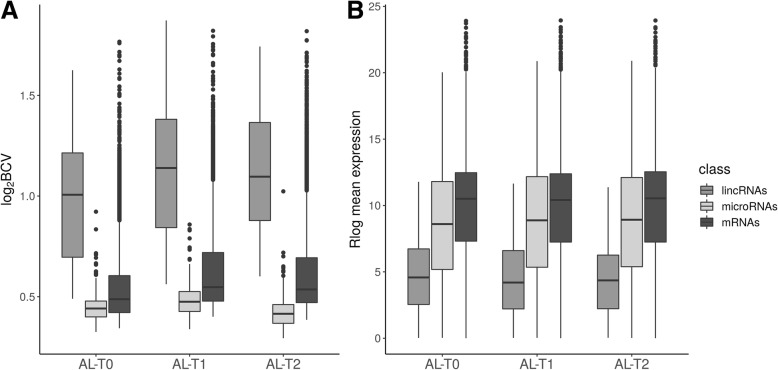
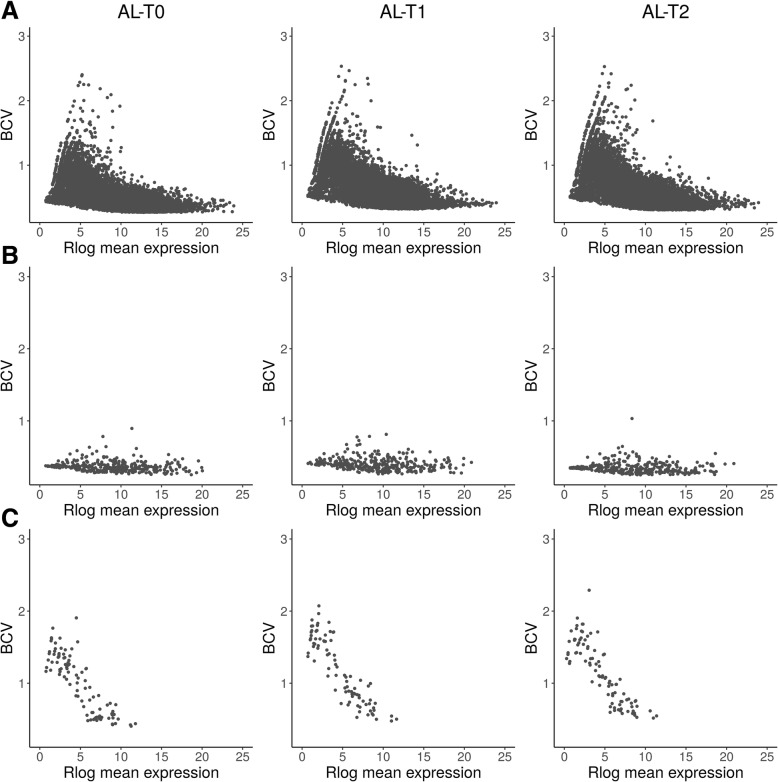
Results: We measured the miRNA, lincRNA and mRNA expression levels in the gluteus medius muscle of 12 gilts in a fasting condition (AL-T0) and 24 gilts fed ad libitum during either 5 h. (AL-T1, N = 12) or 7 h. (AL-T2, N = 12) prior to slaughter. The small RNA fraction was extracted from muscle samples retrieved from the 36 gilts and sequenced, whereas lincRNA and mRNA expression data were already available. In terms of mean and variance, the expression profiles of miRNAs and lincRNAs in the porcine muscle were quite different than those of mRNAs. Food intake induced the differential expression of 149 (AL-T0/AL-T1) and 435 (AL-T0/AL-T2) mRNAs, 6 (AL-T0/AL-T1) and 28 (AL-T0/AL-T2) miRNAs and none lincRNAs, while the number of differentially dispersed genes was much lower. Among the set of differentially expressed miRNAs, we identified ssc-miR-148a-3p, ssc-miR-22-3p and ssc-miR-1, which play key roles in the regulation of glucose and lipid metabolism. Besides, co-expression network analyses revealed several miRNAs that putatively interact with mRNAs playing key metabolic roles and that also showed differential expression before and after feeding. One case example was represented by seven miRNAs (ssc-miR-148a-3p, ssc-miR-151-3p, ssc-miR-30a-3p, ssc-miR-30e-3p, ssc-miR-421-5p, ssc-miR-493-5p and ssc-miR-503) which putatively interact with the PDK4 mRNA, one of the master regulators of glucose utilization and fatty acid oxidation.
Conclusions: As a whole, our results evidence that microRNAs are likely to play an important role in the porcine skeletal muscle metabolic adaptation to nutrient availability.
Keywords: Co-expression analysis; Pig; Regulatory impact factor; Skeletal muscle; lincRNAs; microRNAs.
© The Author(s). 2020.
Conflict of interest statement
Competing interestsThe authors declare that they have no competing interests.
Figures



References
-
- Benítez R, Núñez Y, Óvilo C. Nutrigenomics in farm animals. J Invest Genomics. 2017;4:1.
-
- Ayuso M, Fernández A, Núñez Y, Benítez R, Isabel B, Barragán C, et al. Comparative analysis of muscle transcriptome between pig genotypes identifies genes and regulatory mechanisms associated to growth, fatness and metabolism. PLoS One. 2015;10:e0145162. doi: 10.1371/journal.pone.0145162. - DOI - PMC - PubMed
LinkOut - more resources
Full Text Sources
Research Materials
