Emerging role of nanosuspensions in drug delivery systems
- PMID: 31969986
- PMCID: PMC6964012
- DOI: 10.1186/s40824-020-0184-8
Emerging role of nanosuspensions in drug delivery systems
Abstract
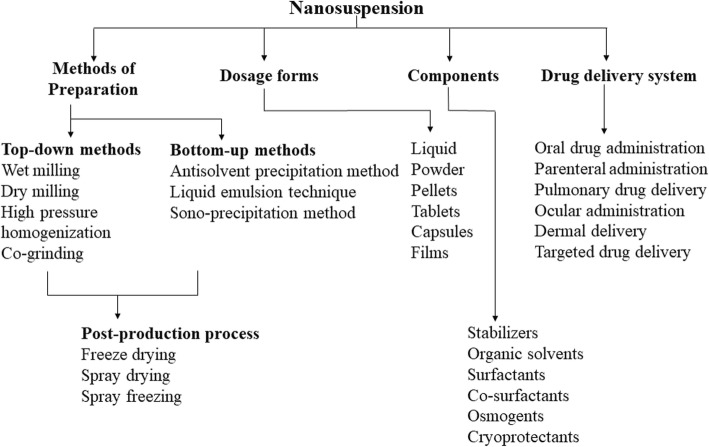
Rapid advancement in drug discovery process is leading to a number of potential new drug candidates having excellent drug efficacy but limited aqueous solubility. By virtue of the submicron particle size and distinct physicochemical properties, nanosuspension has the potential ability to tackle many formulation and drug delivery issues typically associated with poorly water and lipid soluble drugs. Conventional size reduction equipment such as media mill and high-pressure homogenizers and formulation approaches such as precipitation, emulsion-solvent evaporation, solvent diffusion and microemulsion techniques can be successfully implemented to prepare and scale-up nanosuspensions. Maintaining the stability in solution as well as in solid state, resuspendability without aggregation are the key factors to be considered for the successful production and scale-up of nanosuspensions. Due to the considerable enhancement of bioavailability, adaptability for surface modification and mucoadhesion for drug targeting have significantly expanded the scope of this novel formulation strategy. The application of nanosuspensions in different drug delivery systems such as oral, ocular, brain, topical, buccal, nasal and transdermal routes are currently undergoing extensive research. Oral drug delivery of nanosuspension with receptor mediated endocytosis has the promising ability to resolve most permeability limited absorption and hepatic first-pass metabolism related issues adversely affecting bioavailability. Advancement of enabling technologies such as nanosuspension can solve many formulation challenges currently faced among protein and peptide-based pharmaceuticals.
Keywords: Drug delivery systems; Formulation components; Manufacturing methods; Nanosuspension.
© The Author(s). 2020.
Conflict of interest statement
Competing interestThe authors declare that they have no competing interests.
Figures
References
-
- Adibkia K, Siahi Shadbad MR, Nokhodchi A, Javadzedeh A, Barzegar-Jalali M, Barar J, Mohammadi G, Omidi Y. Piroxicam nanoparticles for ocular delivery: physicochemical characterization and implementation in endotoxin-induced uveitis. J Drug Target. 2007;15(6):407–416. doi: 10.1080/10611860701453125. - DOI - PubMed
-
- Alaei S, Ghasemian E, Vatanara A. Spray drying of cefixime nanosuspension to form stabilized and fast dissolving powder. Powder Technol. 2016;288:241–248. doi: 10.1016/j.powtec.2015.10.051. - DOI
-
- Bharti K, Mittal P, Mishra B. Formulation and characterization of fast dissolving oral films containing buspirone hydrochloride nanoparticles using design of experiment. J Drug Delivery Sci Technol. 2019;49:420–432. doi: 10.1016/j.jddst.2018.12.013. - DOI
Publication types
LinkOut - more resources
Full Text Sources
Other Literature Sources