


Targeting the undruggable: exploiting neomorphic features of fusion oncoproteins in childhood sarcomas for innovative therapies
- PMID: 31970591
- PMCID: PMC6994515
- DOI: 10.1007/s10555-019-09839-9
Targeting the undruggable: exploiting neomorphic features of fusion oncoproteins in childhood sarcomas for innovative therapies
Abstract
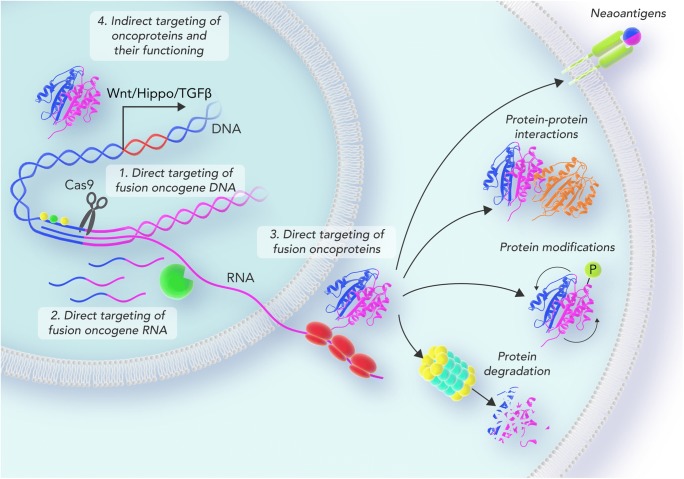
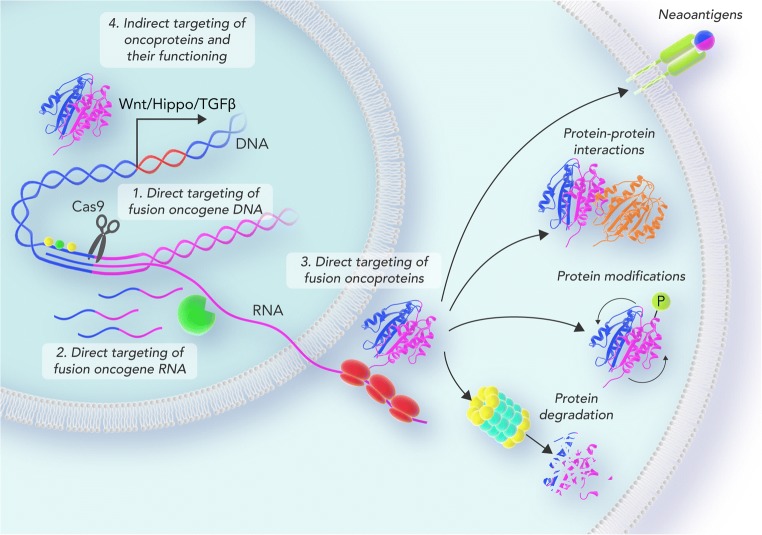
While sarcomas account for approximately 1% of malignant tumors of adults, they are particularly more common in children and adolescents affected by cancer. In contrast to malignancies that occur in later stages of life, childhood tumors, including sarcoma, are characterized by a striking paucity of somatic mutations. However, entity-defining fusion oncogenes acting as the main oncogenic driver mutations are frequently found in pediatric bone and soft-tissue sarcomas such as Ewing sarcoma (EWSR1-FLI1), alveolar rhabdomyosarcoma (PAX3/7-FOXO1), and synovial sarcoma (SS18-SSX1/2/4). Since strong oncogene-dependency has been demonstrated in these entities, direct pharmacological targeting of these fusion oncogenes has been excessively attempted, thus far, with limited success. Despite apparent challenges, our increasing understanding of the neomorphic features of these fusion oncogenes in conjunction with rapid technological advances will likely enable the development of new strategies to therapeutically exploit these neomorphic features and to ultimately turn the "undruggable" into first-line target structures. In this review, we provide a broad overview of the current literature on targeting neomorphic features of fusion oncogenes found in Ewing sarcoma, alveolar rhabdomyosarcoma, and synovial sarcoma, and give a perspective for future developments. Graphical abstract Scheme depicting the different targeting strategies of fusion oncogenes in pediatric fusion-driven sarcomas. Fusion oncogenes can be targeted on their DNA level (1), RNA level (2), protein level (3), and by targeting downstream functions and interaction partners (4).
Keywords: Ewing sarcoma; Fusion oncogene; Rhabdomyosarcoma; Synovial sarcoma; Targeted therapy.
Conflict of interest statement
The authors declare that they have no conflict of interest.
Figures
References
-
- Delattre Olivier, Zucman Jessica, Plougastel Béatrice, Desmaze Chantal, Melot Thomas, Peter Martine, Kovar Heinrich, Joubert Isabelle, de Jong Pieter, Rouleau Guy, Aurias Alain, Thomas Gilles. Gene fusion with an ETS DNA-binding domain caused by chromosome translocation in human tumours. Nature. 1992;359(6391):162–165. - PubMed
-
- Mitelman F, Johansson B and Mertens F (Eds.). (2019). Mitelman Database of Chromosome Aberrations and Gene Fusions in Cancer. Retrieved from https://mitelmandatabase.isb-cgc.org. Accessed 29 October 2019
Publication types
MeSH terms
Substances
LinkOut - more resources
Full Text Sources
Other Literature Sources
Medical
Research Materials
Miscellaneous
