


Application of Behavioral Economics Principles Improves Participation in Mailed Outreach for Colorectal Cancer Screening
- PMID: 31972609
- PMCID: PMC7056051
- DOI: 10.14309/ctg.0000000000000115
Application of Behavioral Economics Principles Improves Participation in Mailed Outreach for Colorectal Cancer Screening
Abstract
Introduction: Colorectal cancer (CRC) is a major cause of cancer-related morbidity and mortality in the United States. Although various interventions have improved screening rates, they often require abundant resources and can be difficult to implement. Social psychology and behavioral economics principles offer an opportunity for low-cost and easy-to-implement strategies but are less common in clinical settings.
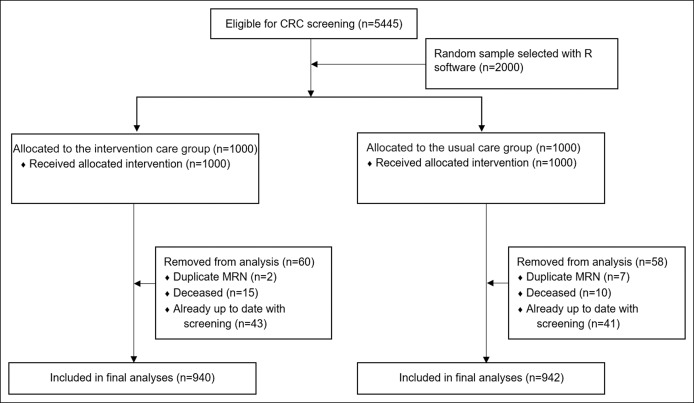
Methods: We randomized 2,000 patients aged 50-75 years eligible for CRC screening to one of the 2 mailed interventions: a previously used text-based letter describing and offering fecal immunochemical testing (FIT) and colonoscopy (usual care arm); or a letter leveraging social psychology and behavioral economics principles (e.g., implied scarcity and choice architecture), minimal text, and multiple images to offer FIT and colonoscopy (intervention arm). We compared total screening uptake, FIT uptake, and colonoscopy uptake at 1-month intervals in each group.
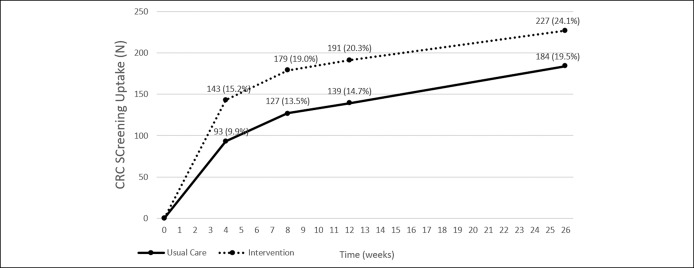
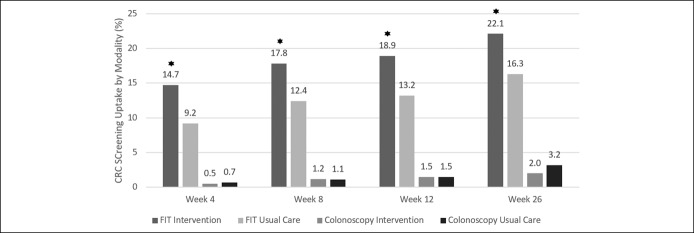
Results: There were 1,882 patients included in the final analysis. The mean age was 69.3 years, and baseline characteristics in the 2 groups were similar. Screening completion at 26 weeks was 19.5% in the usual care arm (16.3% FIT vs 3.2% colonoscopy, P < 0.01) and 24.1% in the intervention arm (22.1% FIT vs 2.0% colonoscopy, P < 0.01) (P = 0.02).
Discussion: Among primary care patients aged 50-75 years in an academic setting, mailed CRC outreach employing social psychology and behavioral economics principles led to a higher participation in CRC screening than usual care mailed outreach.
Translational impact: Mailed interventions to increase CRC screening should incorporate social psychology and behavioral economics principles to improve participation.
Figures
References
-
- Siegel R, Desantis C, Jemal A. Colorectal cancer statistics, 2014. CA Cancer J Clin 2014;64(2):104–17. - PubMed
-
- Smith RA, Andrews K, Brooks D, et al. Cancer screening in the United States, 2016: A review of current American Cancer Society guidelines and current issues in cancer screening. CA Cancer J Clin 2016;66(2):96–114. - PubMed
-
- US Preventive Services Task Force, Bibbins-Domingo K, Grossman DC, et al. Screening for colorectal cancer: US Preventive Services Task Force Recommendation Statement. JAMA 2016;315(23):2564–75. - PubMed
-
- 80% by 2018. National Colorectal Cancer Roundtable (http://nccrt.org/what-we-do/80-percent-by-2018/). Accessed February 4, 2019.
