. 2020 Jan 23;21(1):8.
doi: 10.1186/s40360-020-0385-8.

Silibinin attenuates adipose tissue inflammation and reverses obesity and its complications in diet-induced obesity model in mice

Affiliations

Silibinin attenuates adipose tissue inflammation and reverses obesity and its complications in diet-induced obesity model in mice

Mohammad Alsaggar et al. BMC Pharmacol Toxicol. .

Abstract

Background: Obesity is a multifactorial chronic disease that comprises several pathological events, such as adipose hypertrophy, fatty liver and insulin resistance. Inflammation is a key contributer to development of these events, and therefore, targeting inflammation is increasingly considered for management of obesity and its complications. The aim of the current study was to investigate therapeutic outcomes of anti-inflammatory activities of the natural compound Silibinin in reversing obesity and its complication in mice.

Methods: C57BL/6 male mice were fed high-fat diet for 8 weeks until development of obesity, and then injected with 50 mg/kg silibinin intraperitoneally twice per week, or vehicle for 8 weeks. Throughout the experiment, mice were continuously checked for body weight and food intake, and glucose tolerance test was performed toward the end of the experiment. Animals were sacrificed and serum and tissues were collected for biochemical, histological, and gene expression analysis to assess silibinin effects on adipose inflammation, fat accumulation, liver adipogenesis and glucose homeostasis.

Results: Silibinin treatment reversed adipose tissue inflammation and adipocyte hypertrophy, and blocked progression in weight gain and obesity development with no significant effects on rates of food intake. Silibinin also reversed fatty liver disease and restored glucose homeostasis in treated animals, and reversed hyperglycemia, hyperinsulinemia and hypertriglyceridemia.

Conclusion: In this study, we demonstrated that silibinin as an anti-inflammatory therapy is a potential alternative to manage obesity, as well as its related complications. Moreover, silibinin-based therapies could further evolve as a novel treatment to manage various inflammation-driven disorders.

Keywords: Anti-inflammatory therapy; Fatty liver disease; Glucose homeostasis; Insulin resistance; Obesity; Silibinin.


Conflict of interest statement

The authors have no conflicts of interests to disclose.

Figures
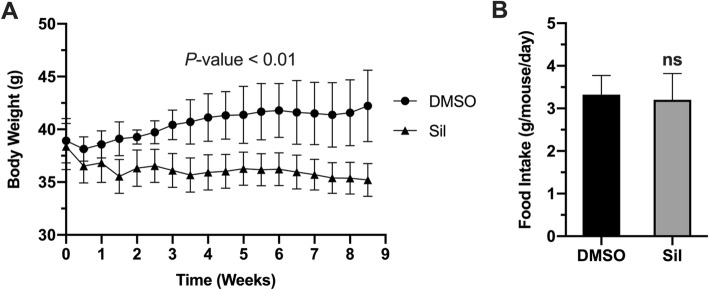
Fig. 1
Fig. 1
Silibinin blocks progression of obesity. (a) Average body weights of silibinin- treated and control animals. P-value on top represents statistical significance calculated by repeated measures ANOVA test. (b) Average food intake per mouse per day for both groups. Values represent group average ± SD (n = 5). ns: nonsignificant
Fig. 2
Fig. 2
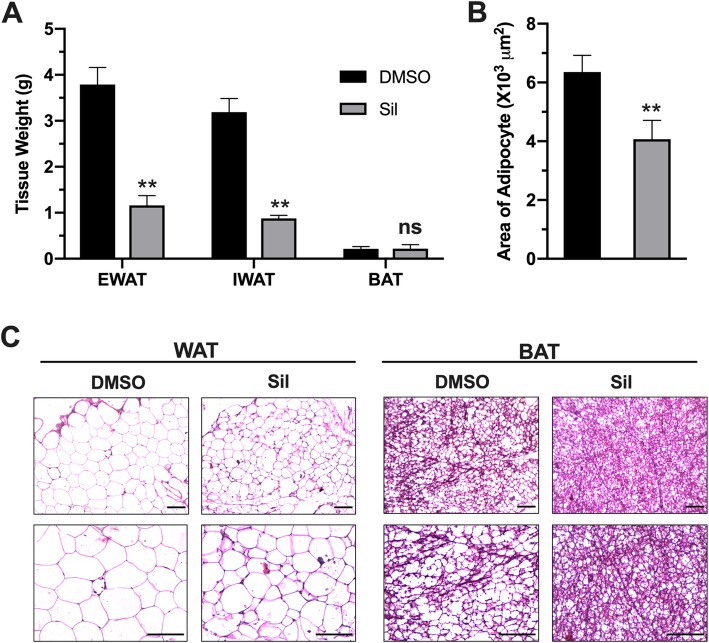
Silibinin treatment suppressed adipose tissue hypertrophy. (a) Average weights of epididymal WAT, inguinal WAT and BAT collected from treated and control animals. (b) Average areas of adipocytes in epididymal WAT of treated and control animals. (c) Representative images of H&E staining of WAT and BAT. Upper panels represent at 20X magnification, while lower panels represent 40X magnification (scale bars = 100 μm). Values in A and B represent averages ± SD (n = 5). *: P < 0.05, **: P < 0.01, ns: nonsignificant
Fig. 3
Fig. 3
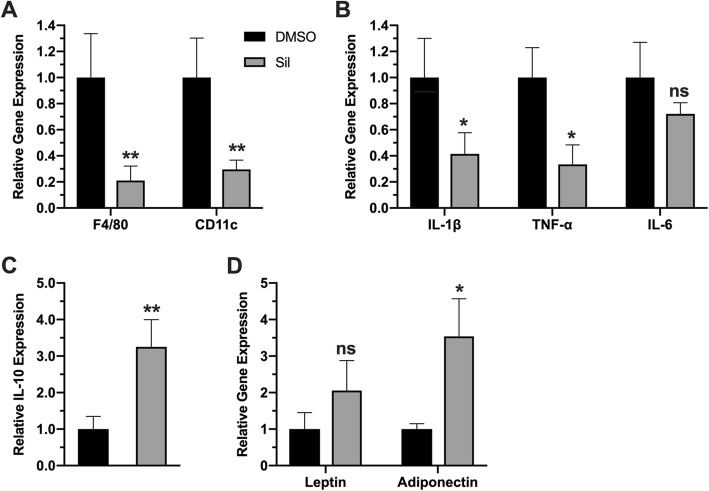
Silibinin treatment reversed inflammatory phenotype toward anti-inflammatory gene expression. Adipose tissue gene expression levels of inflammatory cells markers F4/80 and CD11c (a), proinflammatory cytokines TNF-a, IL-1β and IL-6 (b), anti-inflammatory cytokine IL-10 (c) and the adipokines leptin and adiponectin (d). Values represent averages ± SD (n = 5). *: P < 0.05, **: P < 0.01, ns: nonsignificant
Fig. 4
Fig. 4
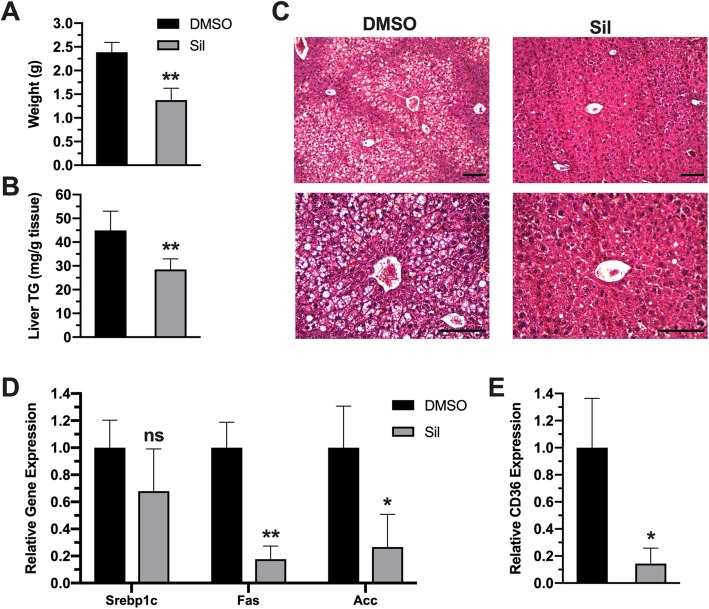
Silibinin reversed fatty liver in treated animals. (a) average liver weights of control and treated animals. (b) TG level in liver tissues of control and treatment groups. (c) H&E analysis of liver sections of both groups. Upper panels represent at 20X magnification, while lower panels represent 40X magnification (scale bars = 100 μm). (d) Expression levels of lipogenic genes srebp1c, fas and Acc in both groups (e) Expression levels of lipid transporter cd36 in both groups. Values represent averages ± SD (n = 5). *: P < 0.05, **: P < 0.01, ns: nonsignificant
Fig. 5
Fig. 5
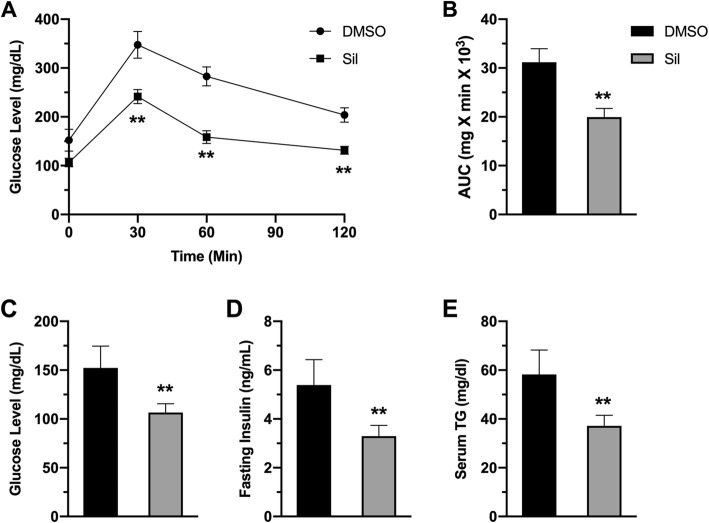
Silibinin restored glucose homeostasis. (a) Blood glucose level as a function of time in intraperitoneal glucose tolerance test (IPGTT). (b) area under the curve of IPGTT results. (c) Fasting blood glucose in both groups. (d) Fasting blood insulin in both groups. (e) Blood TG levels in both groups. Values represent averages ± SD (n = 5). *: P < 0.05, **: P < 0.01, ns: nonsignificant

References

    1. Sikaris KA. The clinical biochemistry of obesity. Clin Biochem Rev. 2004;25(3):165–181. - PMC - PubMed
    1. Kelly T, et al. Global burden of obesity in 2005 and projections to 2030. Int J Obes. 2008;32(9):1431–1437. doi: 10.1038/ijo.2008.102. - DOI - PubMed
    1. Kanneganti TD, Dixit VD. Immunological complications of obesity. Nat Immunol. 2012;13(8):707–712. doi: 10.1038/ni.2343. - DOI - PubMed
    1. Saunders KH, et al. Obesity pharmacotherapy. Med Clin North Am. 2018;102(1):135–148. doi: 10.1016/j.mcna.2017.08.010. - DOI - PubMed
    1. Monteiro R, Azevedo I. Chronic inflammation in obesity and the metabolic syndrome. Mediat Inflamm. 2010;2010:289645. - PMC - PubMed

Publication types

MeSH terms