. 2021 Jan 1;106(1):220-229.
doi: 10.3324/haematol.2019.240440.

Desialylation of O-glycans on glycoprotein Ibα drives receptor signaling and platelet clearance

Affiliations

Desialylation of O-glycans on glycoprotein Ibα drives receptor signaling and platelet clearance

Yingchun Wang et al. Haematologica. .

Abstract

During infection neuraminidase desialylates platelets and induces their rapid clearance from circulation. The underlying molecular basis, particularly the role of platelet glycoprotein (GP)Ibα therein, is not clear. Utilizing genetically altered mice we report that the extracellular domain of GPIbα, but neither von Willebrand factor nor ADAM17 (a disintegrin and metalloprotease 17), is required for platelet clearance induced by intravenous injection of neuraminidase. Lectin binding to platelets following neuraminidase injection over time revealed that the extent of desialylation of O-glycans correlates with the decrease of platelet count in mice. Injection of α2,3-neuraminidase reduces platelet counts in wild-type but not in transgenic mice expressing only a chimeric GPIbα that misses most of its extracellular domain. Neuraminidase treatment induces unfolding of the O-glycosylated mechanosensory domain in GPIbα as monitored by single-molecule force spectroscopy, increases the exposure of the ADAM17 shedding cleavage site in the mechanosensory domain on the platelet surface, and induces ligand-independent GPIb-IX signaling in human and murine platelets. These results suggest that desialylation of O-glycans of GPIbα induces unfolding of the mechanosensory domain, subsequent GPIb-IX signaling including amplified desialylation of N-glycans, and eventually rapid platelet clearance. This new molecular mechanism of GPIbα-facilitated clearance could potentially resolve many puzzling and seemingly contradicting observations associated with clearance of desialylated or hyposialylated platelets.


Figures
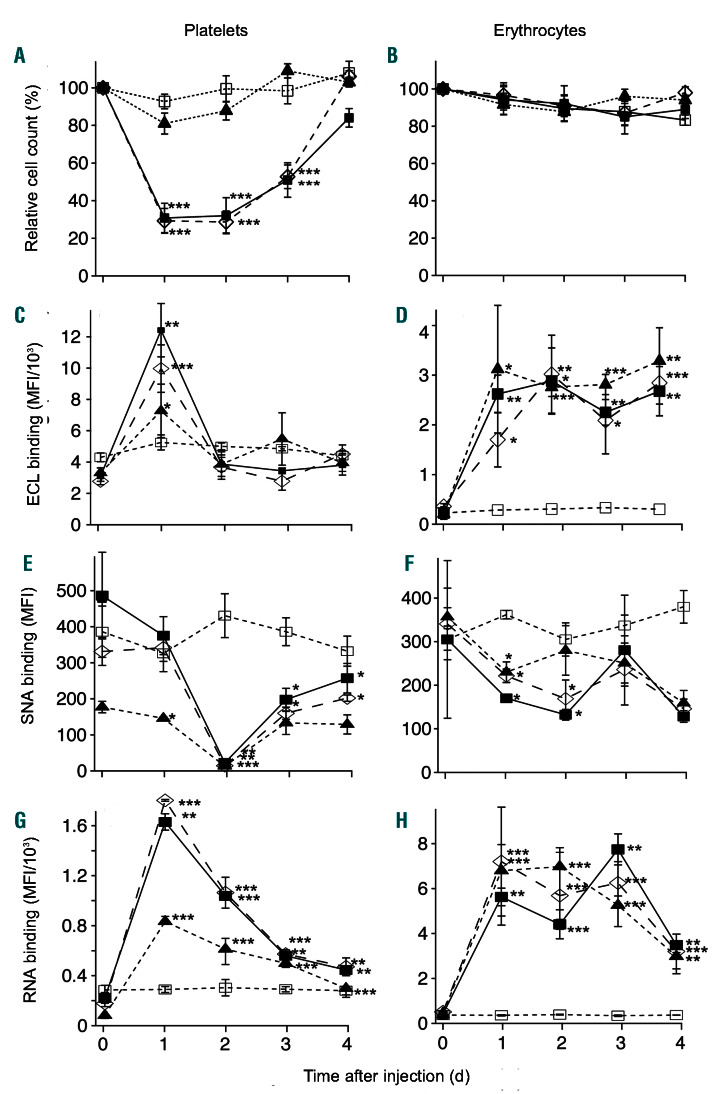
Figure 1.
Figure 1.
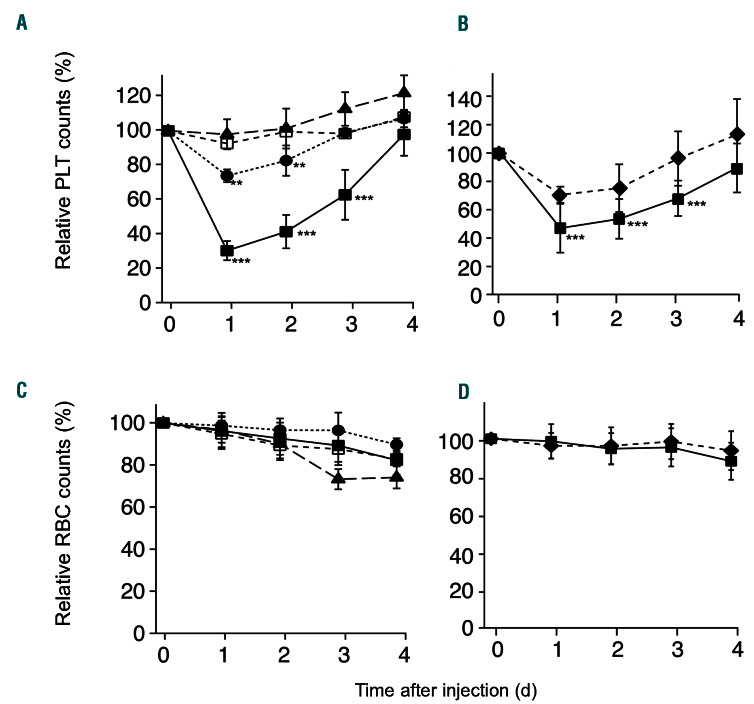
Effects of infused bacterial α2,3,6,8-neuraminidase on platelets and erythrocytes in mice. A. ureafaciens neuraminidase (0.5 mU/g of body weight) was injected intravenously into wild-type (WT) (), VWF-/- (), or IL4R-IbαTg (▲) mice. Injection of saline into wild-type mice () was performed for comparison. Blood were collected from each mouse via facial vein immediately before (t=0) or days after the injection. Counts of (A) platelets and (B) erythrocytes were performed on a cell counter and normalized with the count before the injection being 100% (mean±standard deviation [SD], n=4). (C, E, G) Platelets and (D, F, H) erythrocytes in the collected whole blood were labeled with cellspecific antibodies and noted lectins (mean±SD, n=3). Each cell was identified through the bound antibody and concurrently the bound lectin detected by flow cytometry. The mean fluorescence intensity (MFI) was calculated for the entire cell population and plotted over the course of days after neuraminidase injection. Comparison to the saline result was performed by unpaired twotailed Student’s t-test. *P<0.05; **P<0.01; ***P<0.001.
Figure 2.
Figure 2.
Efficacy of α2,3- neuraminidase i njection in mediating platelet clearance in mic e. (A, C) α2,3-neuraminidase (0.6 U/g of body weight) was i njected intravenously into wild-type (WT) (), GPIbα-/- (), or IL4RIbαTg (▲) mice. According to the information sheet supplied by the manufacturer, the activity of 1U α2,3-neuraminidase is equivalent of 1 mU A . ur eafaci ens neuraminidase. For comparison, saline was concur rently injected i nto the same strains (corresponding open sym bols). (B, D ) α 2,3-neuram inidase was inje cted intravenously into St3gal1MK-/- () and its littermate WT () mice. Blood wa s colle cted from each mouse via facial vein immediately before (t=0) or days following the injection. Counts of (A,B) platelets and (C,D) erythrocytes were performed on a CBC counter and normal ized wi th the co unt befo re the inje ction being 100% (mean±standard deviation, n=4-7).
Figure 3.
Figure 3.
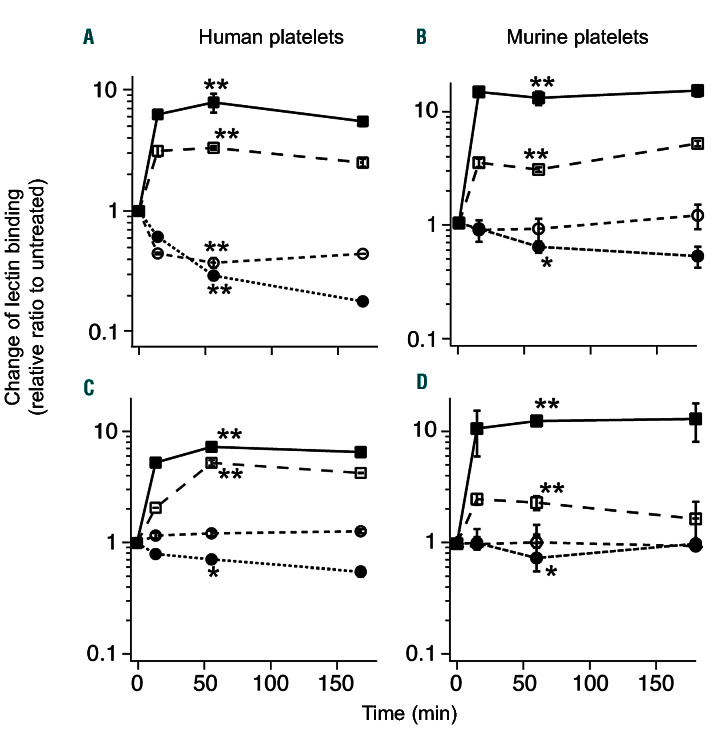
Changes in lectin bindings to platelets following treatment of α2,3,6,8- or α2,3-neuraminidase in vitro. Citrated (A, C) human or (B, D) wild-type (WT) murine platelets were collected and treated with (A, B) 10 mU/ml α2,3,6,8-neuraminidase or (C, D) α2,3-neuraminidase at the equivalent activity level at 37˚C for 15, 60, and 180 minutes (min) before being analyzed for lectin binding. The glycan content was detected by flow cytometry using Fluorescein isothiocyanate (FITC)- conjugated PNA (), FITCECL (), FITC-SNA() and biotinconjugated MAL-ΙΙ combined with FITC-streptavidin (). The mean fluorescence intensity was quantified for the entire cell population and normalized to untreated sample (0 min). Data are shown as mean ± standard deviation, n=4. Results at 60 min are compared to those of untreated sample by unpaired t-test. *P<0.05; **P<0.01.
Figure 4.
Figure 4.
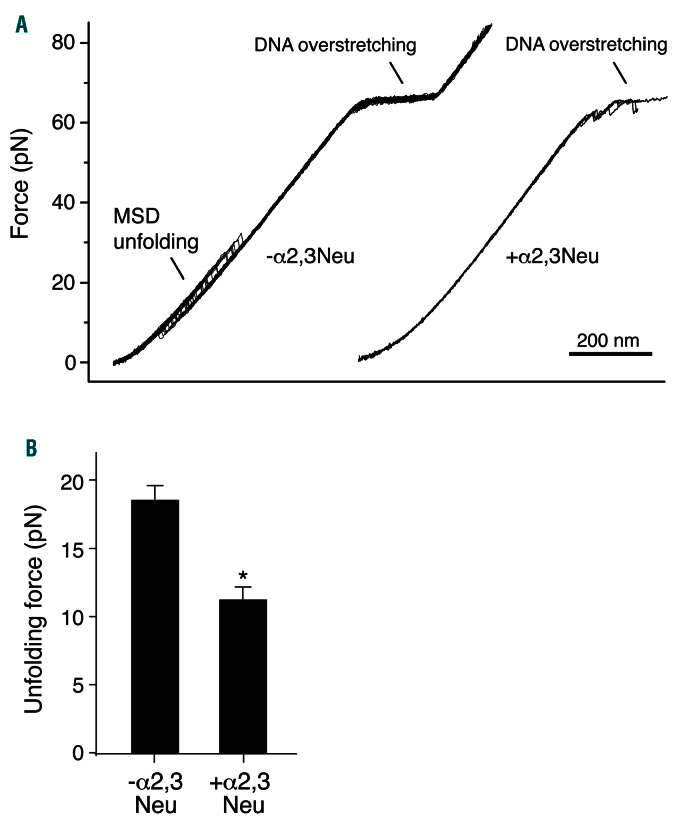
Desialylation of O-glycans induces unfolding of the mechanosensory domain (MSD) in recombinant GPIb-IX. (A) Overlaid consecutive force-distance traces of pulling MSD under a speed of 200 nm/s without (left) and with (right) prior treatment of α2,3-neuraminidase. (B) Averaged MSD unfolding force without (n=49) or with (n=15) treatment of α2,3-neuraminidase. Error bars are standard error of the mean. *P<0.05 by unpaired t-test.
Figure 5.
Figure 5.
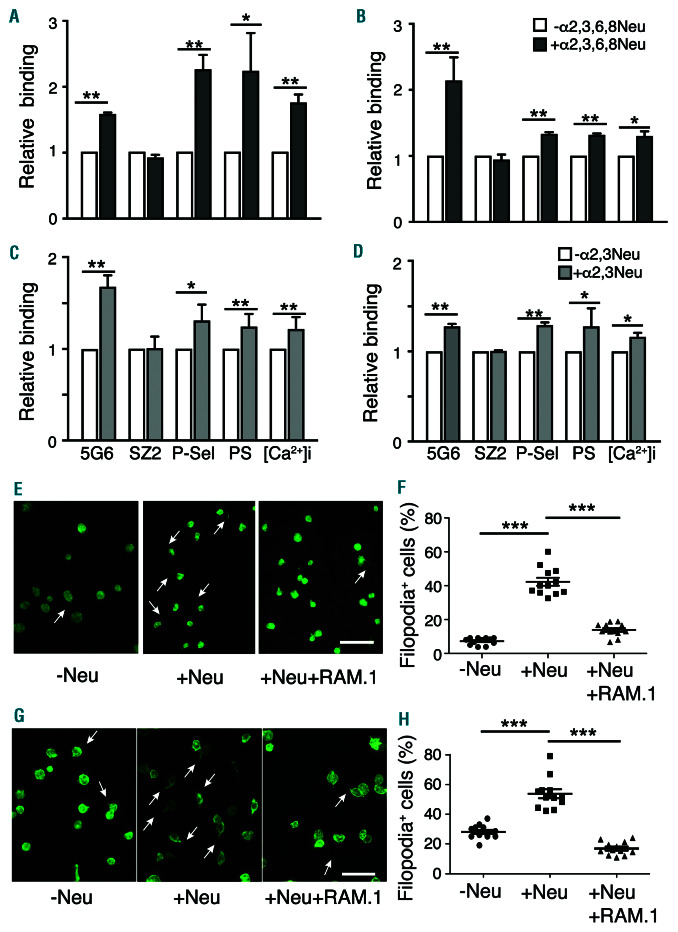
Desialylation induces unfolding of the mechanosensory domain (MSD) and GPIb-IX signaling in platelets. Citrated washed (A,C) hTg or (B,D) human platelets (1x10⁶ cells, with 2mM EDTA) were treated with or without α2,3,6,8-neuraminidase or α2,3-neuraminidase at 37˚C for 30 minutes (min). Monoclonal anti-GPIbα antibodies 5G6 and SZ2, anti-P-selectin antibody, GFP-LactC2, or Fura-2 were then added for 30 min, and the samples were fixed and analyzed by flow cytometry. The mean fluorescence intensity (MFI) was measured for each cell population and normalized against that of untreated platelets (mean±standard deviation [SD], n=4). *P<0.05; **P<0.01 by unpaired t-test. (E-H) Confocal fluorescence images of washed (E) hTg and (G) human platelets that had been treated with PBS buffer (-Neu), α2,3,6,8-neuraminidase (+Neu), or neuraminidase plus 1.5 mg/mL anti- GPIbb antibody RAM.1 (+Neu+RAM.1). White arrowheads mark some filopodia in platelets. Scale bar, 10 μm. (F, H) Quantification of filopodia in (F) hTg and (H) human platelets (mean±SD, n=11-12). Images of filopodia from 11-12 view fields (~80-110 platelets per view field) in two independent experiments were visually examined, and counted for comparison. **P<0.01; ***P<0.001 by unpaired Student’s t-test.
Figure 6.
Figure 6.
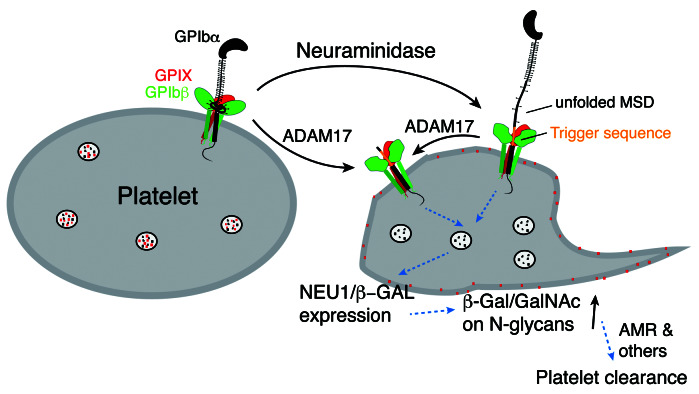
A model for the desialylation-mediated GPIb-IX signaling and platelet clearance. In this model, exogenous neuraminidase removes sialic acids from O-glycans in GPIbα, thereby inducing unfolding of the mechanosensory (MSD), exposure of the Trigger sequence therein, GPIb-IX signaling into the platelet, surface expression of Neu1, and exposure of b-galactoses (b-Gal) on N-glycans of many glycoproteins, which are recognized by the Ashwell-Morell receptor and other receptors for clearance. Unfolding of the MSD also increases the accessibility of the ADAM17 shedding cleavage site in the MSD, facilitates shedding of GPIbα, which results in the exposure of the Trigger sequence.

Comment in

References

    1. Gasic GJ, Gasic TB, Stewart CC. Antimetastatic effects associated with platelet reduction. Proc Natl Acad Sci U S A. 1968;61(1):46-52. - PMC - PubMed
    1. Choi SI, Simone JV, Jorney LJ. Neuraminidase-induced thrombocytopenia in rats. Br J Haematol. 1972;22(1):93-101. - PubMed
    1. Grewal PK, Aziz PV, Uchiyama S, et al. Inducing host protection in pneumococcal sepsis by preactivation of the Ashwell- Morell receptor. Proc Natl Acad Sci U S A. 2013;110(50):20218-20223. - PMC - PubMed
    1. Xiang B, Zhang G, Guo L, et al. Platelets protect from septic shock by inhibiting macrophage-dependent inflammation via the cyclooxygenase 1 signalling pathway. Nat Commun. 2013;4:2657. - PMC - PubMed
    1. Rumjantseva V, Grewal PK, Wandall HH, et al. Dual roles for hepatic lectin receptors in the clearance of chilled platelets. Nat Med. 2009;15(11):1273-1280. - PMC - PubMed

Publication types

Substances

LinkOut - more resources