. 2020 Mar;214(3):669-690.
doi: 10.1534/genetics.119.302860. Epub 2020 Jan 23.

New Roles for the Heterochronic Transcription Factor LIN-29 in Cuticle Maintenance and Lipid Metabolism at the Larval-to-Adult Transition in Caenorhabditis elegans

Affiliations

New Roles for the Heterochronic Transcription Factor LIN-29 in Cuticle Maintenance and Lipid Metabolism at the Larval-to-Adult Transition in Caenorhabditis elegans

Patricia Abete-Luzi et al. Genetics. 2020 Mar.

Abstract

Temporal regulation of gene expression is a crucial aspect of metazoan development. In the roundworm Caenorhabditis elegans, the heterochronic pathway controls multiple developmental events in a time-specific manner. The most downstream effector of this pathway, the zinc-finger transcription factor LIN-29, acts in the last larval stage (L4) to regulate elements of the larval-to-adult switch. Here, we explore new LIN-29 targets and their implications for this developmental transition. We used RNA-sequencing to identify genes differentially expressed between animals misexpressing LIN-29 at an early time point and control animals. Among 230 LIN-29-activated genes, we found that genes encoding cuticle collagens were overrepresented. Interestingly, expression of lin-29 and some of these collagens was increased in adults with cuticle damage, suggesting a previously unknown function for LIN-29 in adult cuticle maintenance. On the other hand, genes involved in fat metabolism were enriched among 350 LIN-29-downregulated targets. We used mass spectrometry to assay lipid content in animals overexpressing LIN-29 and observed reduced fatty acid levels. Many LIN-29-repressed genes are normally expressed in the intestine, suggesting cell-nonautonomous regulation. We identified several LIN-29 upregulated genes encoding signaling molecules that may act as mediators in the regulation of intestinally expressed genes encoding fat metabolic enzymes and vitellogenins. Overall, our results support the model of LIN-29 as a major regulator of adult cuticle synthesis and integrity, and as the trigger for metabolic changes that take place at the important transition from rapid growth during larval life to slower growth and offspring production during adulthood.

Keywords: Caenorhabditis elegans; collagen; gene expression; heterochronic; metabolism.


Figures

Figure 1
Figure 1
Early expression of LIN-29 results in body morphology and vulval defects. Nomarski images of hs::control (A, C, and E) or hs::lin-29 (B, D, and F) animals that were subjected to heat shock early in development. (A and B) Adult animals that were given a single heat shock in both the L2 and L4 stages. (C–F) Animals were given a single heat shock in both the L2 and L3 stages, and scored in the L4 (C and D) or the adult (E and F) stage. Single arrowhead in D indicates an underinduced vulva in the L4 stage. Double arrowhead in F indicates an L4 stage vulva (compare to hs::control L4, C) in an adult hs::lin-29 animal (note the presence of unlaid, late-stage embryos in the uterus). Bar, 50 µm.
Figure 2
Figure 2
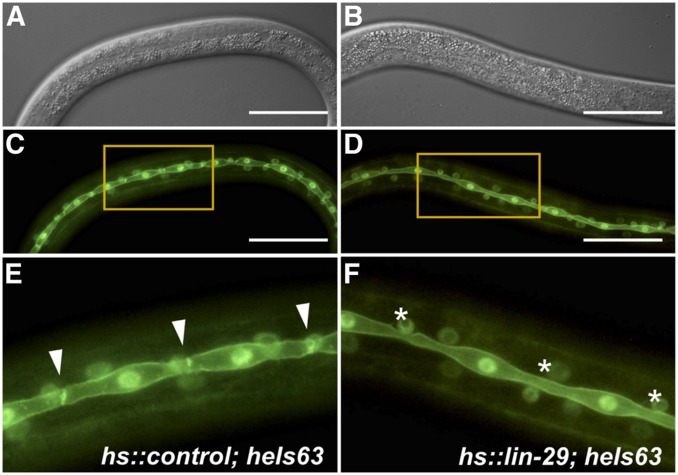
Early expression of LIN-29 is sufficient to cause precocious seam cell fusion. Shown here are synchronized L3 stage animals expressing nuclear and plasma membrane localized GFP in the hypodermal seam cells (from array heIs63) and carrying either hs::control (A, C, and E) or hs::lin-29 (B, D, and F). Populations of animals were given a heat shock in the late L2 (see Table 3; Materials and Methods). Nomarski (A and B) and epifluorescence (C and D) microscopy of larvae 5 hr after heat shock. Precocious seam cell fusion is observed, as seen in the magnified view (E and F; from insets shown in C and D): cell junctions between seam cells are still present in the hs::control strain (E; arrowheads) but are absent in animals carrying hs::lin-29 (F; asterisks). Bar, 50 µm.
Figure 3
Figure 3
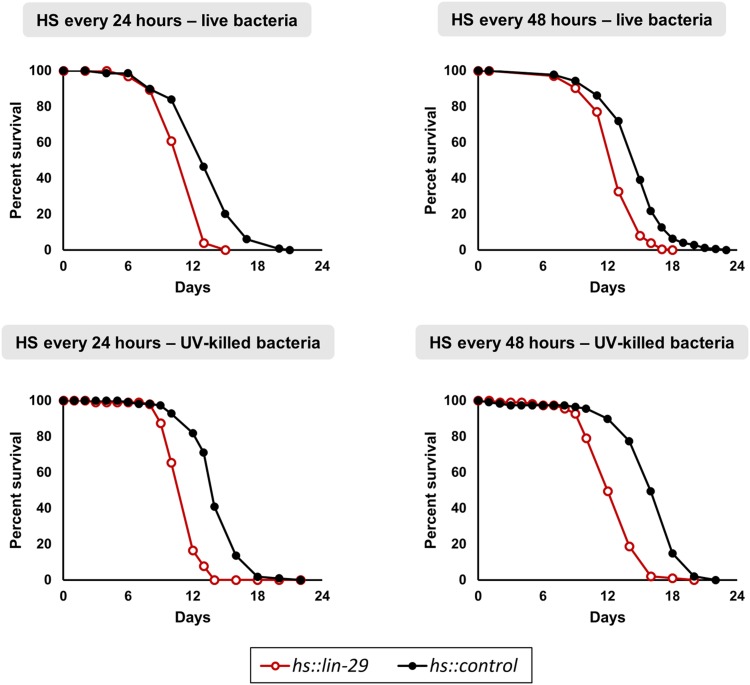
Periodic adult overexpression of LIN-29 shortens life span. Synchronized adult animals carrying either hs::lin-29 or hs::control were periodically exposed to heat shock either every 24 or every 48 hr, and fed with either live or dead bacteria. Cohorts were FUdR-sterilized and followed until the last individual died. Survival curves were computed using the Kaplan–Meier estimator and statistical differences between hs::lin-29 and hs::control groups were calculated with the log-rank test (in all cases P < 0.0001). In all four conditions both mean and maximum life span were shorter in hs::lin-29 animals (see Table S1).
Figure 4
Figure 4
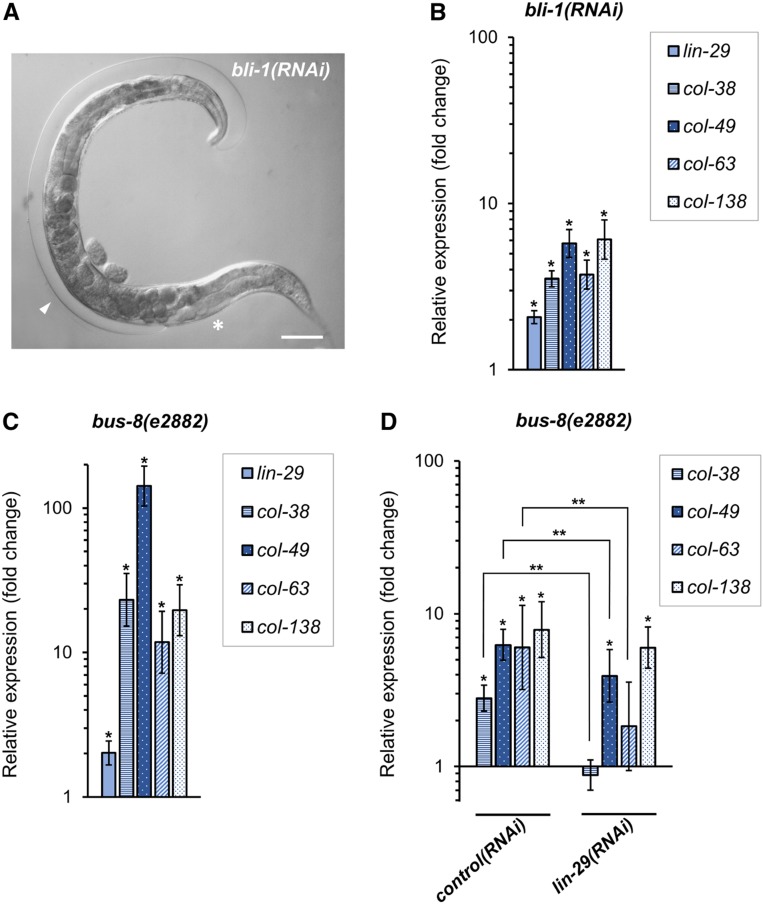
Upregulation of lin-29 and col gene targets of LIN-29 in adults in response to defects in cuticle integrity. (A) Adult bli-1(RNAi) hermaphrodite showing Blister phenotype. Asterisk indicates normal cuticle, arrowhead indicates fluid-filled, Blistered cuticle. Bar, 50 µm. (B and C) Endogenous expression of lin-29 and known lin-29-regulated cuticle collagen genes col-38, col-49, col-63, and col-138 assessed by RT-qPCR in synchronized (B) young adults after bli-1(RNAi) feeding treatment (quantification was relative to expression in animals fed HT115 bacteria carrying empty RNAi vector control; see Materials and Methods); and (C) day 1 adults with bus-8(e2882) loss-of-function background (quantification was relative to expression in wild-type animals; both groups were fed standard OP50 bacteria). (D) RT-qPCR was used to measure endogenous col gene expression in day 1 adult bus-8(e2882) animals fed with HT115 bacteria containing either lin-29(RNAi) vector or empty-vector control. In both groups, quantification was relative to wild type animals fed HT115 with empty-vector control. Error bars represent SEM. Unpaired t-test analyses were performed comparing to respective controls (* P < 0.05) or between the indicated groups (D; ** P < 0.05).
Figure 5
Figure 5
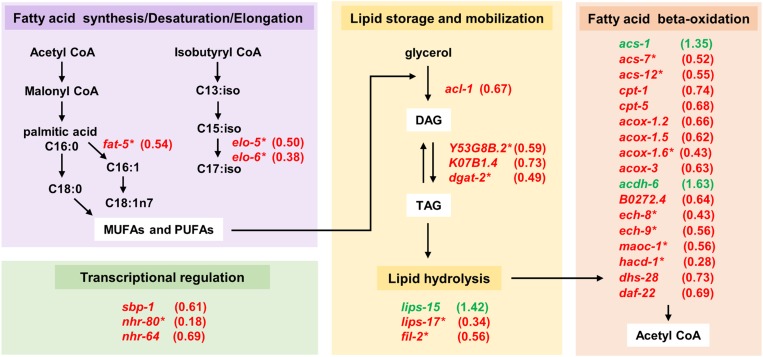
LIN-29-regulated genes involved in lipid metabolism. Genes that were upregulated (green font) or downregulated (red font) upon misexpression of LIN-29 in the L3 stage are shown, with their respective fold change in parenthesis. Genes are grouped into broad categories (colored boxes) based on their gene product function in lipid metabolism. Note that there are more enzymes involved in these processes; however, only genes with a significant change (P < 0.05) upon LIN-29 overexpression are shown here. *LIN-29 target genes that were regulated ≥1.7-fold.
Figure 6
Figure 6
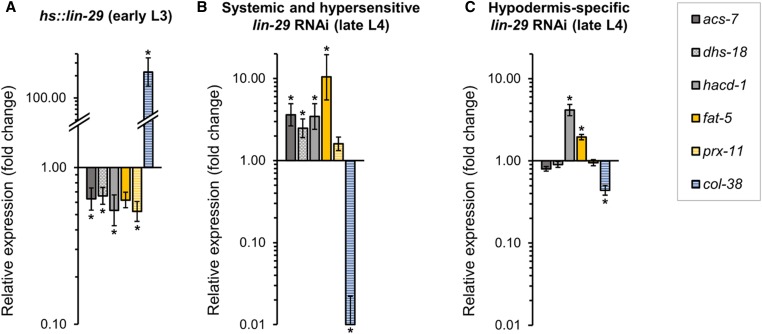
LIN-29 represses intestinal genes involved in fatty acid metabolism and beta-oxidation in the L4 stage. Endogenous expression of intestinally expressed genes acs-7, dhs-18, hacd-1, fat-5, as well as peroxisome factor prx-11, was assessed by RT-qPCR in (A) hs::lin-29 animals 1 hr after induction in the early L3 stage (quantification relative to hs::control strain), and (B and C) L4 stage larvae after lin-29(RNAi) treatment (quantification relative to empty-vector control) in two different backgrounds: (B) a strain containing the RNAi-hypersensitive mutation rrf-3(pk1426), in which RNAi is stronger and effective in all tissues; and (C) a nonhypersensitive strain, where RNAi is only effective in the hypodermis (NR222; see Materials and Methods). In all cases, known LIN-29 upregulated gene col-38 (Abete-Luzi and Eisenmann 2018) was analyzed as a control for efficacy of lin-29 heat-shock induction and lin-29 RNAi. Error bars represent SEM. * P < 0.05 (unpaired t-test).
Figure 7
Figure 7
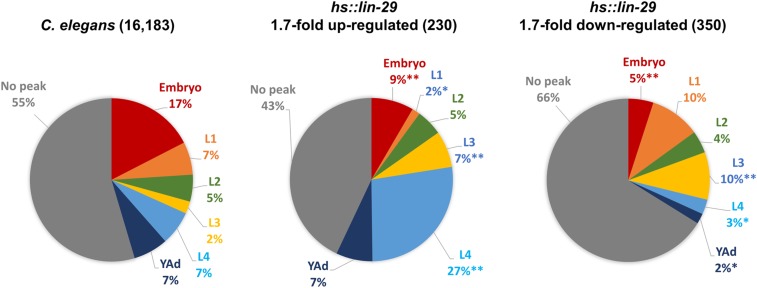
Genes that normally peak in the L4 stage are overrepresented among LIN-29 upregulated targets. Temporal expression peaks were assessed for the indicated gene sets based on modENCODE RNA-seq data (Gerstein et al. 2010) using criteria from Jackson et al. (2014): genes showing ≥35% of their total developmental expression in one stage were identified as having a peak in that stage (color coded), the remainder are indicated as “no peak” (gray). Distributions for all genes in each set were calculated, displayed as percentages and compared to the genomic distribution (left). ** P < 0.0001 and * P < 0.01 (chi-square with Yates correction).
Figure 8
Figure 8
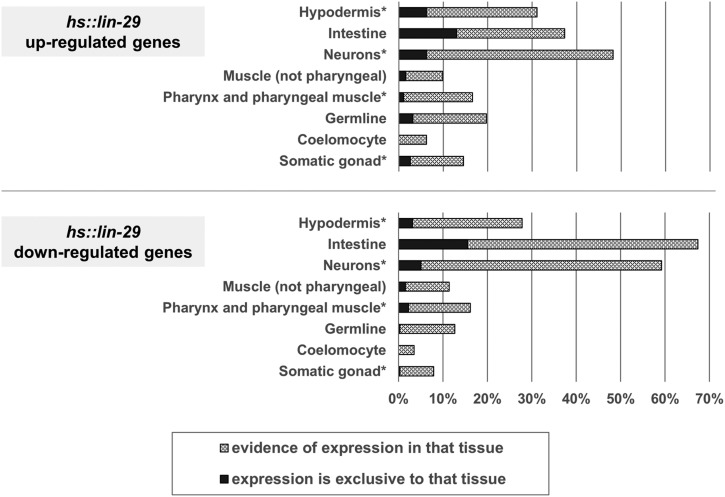
Spatial expression patterns of LIN-29 target genes. Spatial expression data available for 193 of 230 upregulated genes (top) and for 316 of 350 downregulated genes (bottom) was obtained (see Materials and Methods) and plotted as percentages of genes with expression in the indicated tissues. Tissues where LIN-29 is known to be expressed are denoted with an asterisk. Percentages sum to >100% because many genes are expressed in multiple tissues.
Figure 9
Figure 9
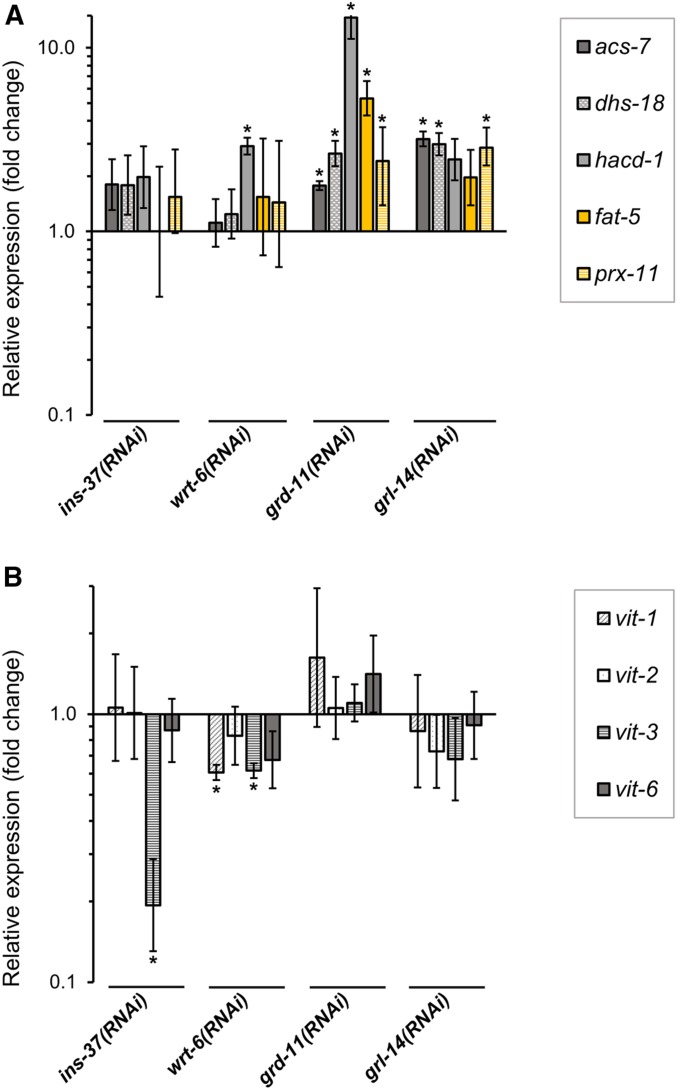
Four lin-29 target genes that encode signaling molecules regulate expression of LIN-29 intestinal targets in the L4 stage. Endogenous expression of five metabolic genes downregulated upon LIN-29 expression (acs-7, dhs-18, hacd-1, fat-5, and prx-11; A), and four vitellogenin genes previously shown to require lin-29 for their expression (vit-1, vit-2, vit-3 and vit-6; Dowen et al. 2016; B) was evaluated by RT-qPCR in late L4 stage ins-37(RNAi), wrt-6(RNAi), grd-11(RNAi)l or grl-14(RNAi) animals. Quantifications were relative to expression in animals treated with empty-vector RNAi control. Error bars represent SEM. * P < 0.05 (unpaired t-test).
Figure 10
Figure 10
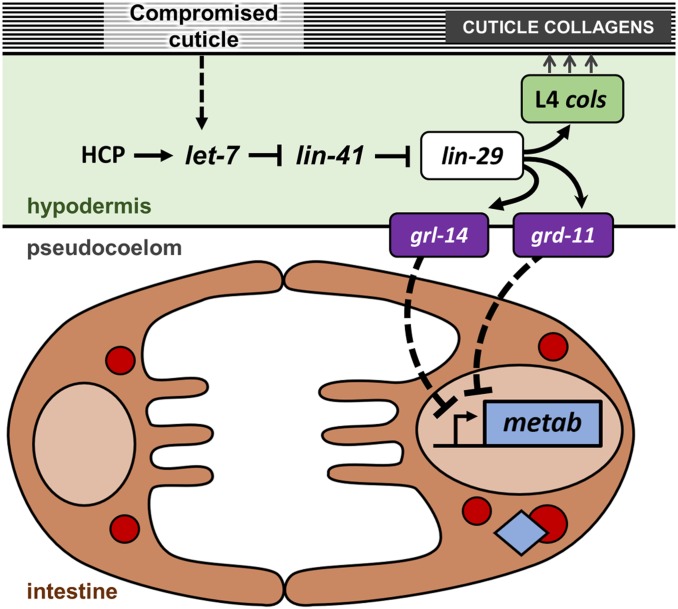
Model of the roles of LIN-29 and its target genes in the hypodermis and intestine. In the hypodermis, lin-29 expression is regulated by the heterochronic pathway (HPC) acting through let-7 and lin-41. LIN-29 activates expression of many L4 and adult specific cuticle collagen (col) genes which contribute to the adult cuticle. Cuticle damage in the adult [e.g., in bli-1(RNAi) animals] signals through let-7 to increase expression of lin-29 and col genes. Dashed lines indicate that a mechanism is not yet known. Hypodermal LIN-29 also activates expression of signaling genes (grd-11 and grl-14 are shown as examples), which act to reduce expression of genes involved in fat metabolism in the intestine.

References

    1. Abbott A. L., Alvarez-Saavedra E., Miska E. A., Lau N. C., Bartel D. P. et al. , 2005. The let-7 MicroRNA family members mir-48, mir-84, and mir-241 function together to regulate developmental timing in Caenorhabditis elegans. Dev. Cell 9: 403–414. 10.1016/j.devcel.2005.07.009 - DOI - PMC - PubMed
    1. AbdelRaheim S. R., and McLennan A. G., 2002. The Caenorhabditis elegans Y87G2A.14 Nudix hydrolase is a peroxisomal coenzyme A diphosphatase. BMC Biochem. 3: 5 10.1186/1471-2091-3-5 - DOI - PMC - PubMed
    1. Abete-Luzi P., and Eisenmann D. M., 2018. Regulation of C. elegans L4 cuticle collagen genes by the heterochronic protein LIN-29. Genesis 56: 1–8. 10.1002/dvg.23106 - DOI - PMC - PubMed
    1. Abraham M. C., Lu Y., and Shaham S., 2007. A morphologically conserved nonapoptotic program promotes linker cell death in Caenorhabditis elegans. Dev. Cell 12: 73–86. 10.1016/j.devcel.2006.11.012 - DOI - PubMed
    1. Abrahante J. E., Miller E. A., and Rougvie A. E., 1998. Identification of heterochronic mutants in Caenorhabditis elegans: temporal misexpression of a collagen:green fluorescent protein fusion gene. Genetics 149: 1335–1351. - PMC - PubMed

Publication types

MeSH terms