. 2020 Feb 11;117(6):3319-3325.
doi: 10.1073/pnas.1903496117. Epub 2020 Jan 23.

Designing effective control of dengue with combined interventions

Affiliations

Designing effective control of dengue with combined interventions

Thomas J Hladish et al. Proc Natl Acad Sci U S A. .

Abstract

Viruses transmitted by Aedes mosquitoes, such as dengue, Zika, and chikungunya, have expanding ranges and seem unabated by current vector control programs. Effective control of these pathogens likely requires integrated approaches. We evaluated dengue management options in an endemic setting that combine novel vector control and vaccination using an agent-based model for Yucatán, Mexico, fit to 37 y of data. Our intervention models are informed by targeted indoor residual spraying (TIRS) experiments; trial outcomes and World Health Organization (WHO) testing guidance for the only licensed dengue vaccine, CYD-TDV; and preliminary results for in-development vaccines. We evaluated several implementation options, including varying coverage levels; staggered introductions; and a one-time, large-scale vaccination campaign. We found that CYD-TDV and TIRS interfere: while the combination outperforms either alone, performance is lower than estimated from their separate benefits. The conventional model hypothesized for in-development vaccines, however, performs synergistically with TIRS, amplifying effectiveness well beyond their independent impacts. If the preliminary performance by either of the in-development vaccines is upheld, a one-time, large-scale campaign followed by routine vaccination alongside aggressive new vector control could enable short-term elimination, with nearly all cases avoided for a decade despite continuous dengue reintroductions. If elimination is impracticable due to resource limitations, less ambitious implementations of this combination still produce amplified, longer-lasting effectiveness over single-approach interventions.

Keywords: dengue; dengue vaccines; mathematical modeling; vector control.


Conflict of interest statement

The authors declare no competing interest.

Figures
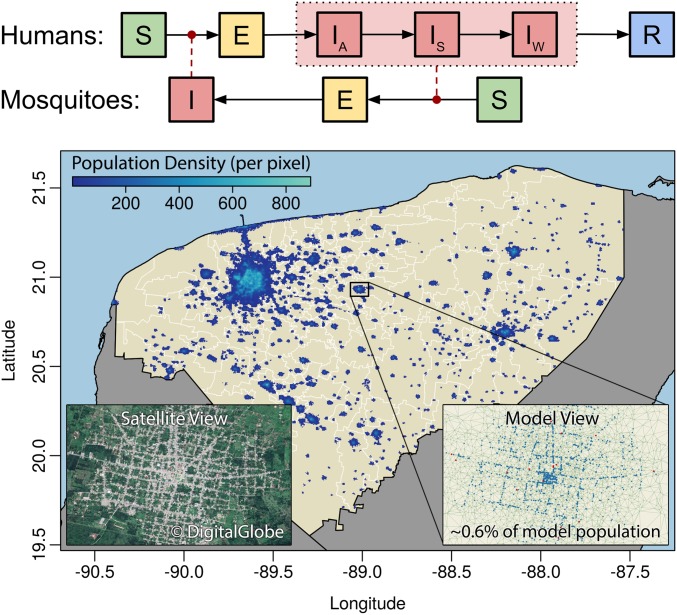
Fig. 1.
Fig. 1.
Agent-based model structure. (Upper) Our model’s state transition diagram for individual humans (E, Exposed; I, infectious [A, asymptomatic; S, symptomatic; and W, withdrawn from daily activity]; R, recovered; and S, susceptible) and mosquitoes (E, exposed; I, infectious; and S, susceptible). Solid arrows denote possible transitions; dashed arrows denote the influence of infectious mosquitoes and humans on DENV transmission rates. For humans, this series of transitions can occur for each serotype; each mosquito may only be infected by a single serotype. (Lower) Overall model spatial structure, zooming to Izamal (Insets) to illustrate detailed structure. Households, workplaces, and schools (Right Inset) are placed based on government data and are consistent with satellite imagery (Left Inset); SI Appendix, Fig. S1 shows enlarged versions of Insets. Pixel size in density map is 430 × 460 m.
Fig. 2.
Fig. 2.
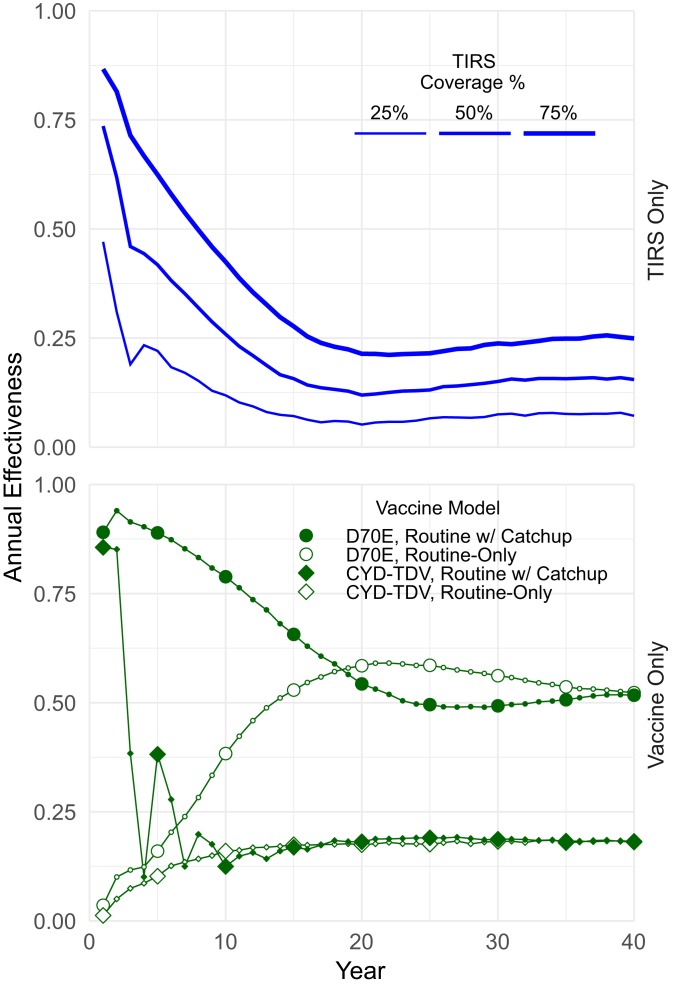
Simulated performance for single interventions. Overall annual effectiveness for TIRS-only (Upper; blue) and vaccine-only interventions (Lower; green). Results are aggregated annually, with some points enlarged for readability. We generally use the visual distinctions introduced in this figure throughout the manuscript.
Fig. 3.
Fig. 3.
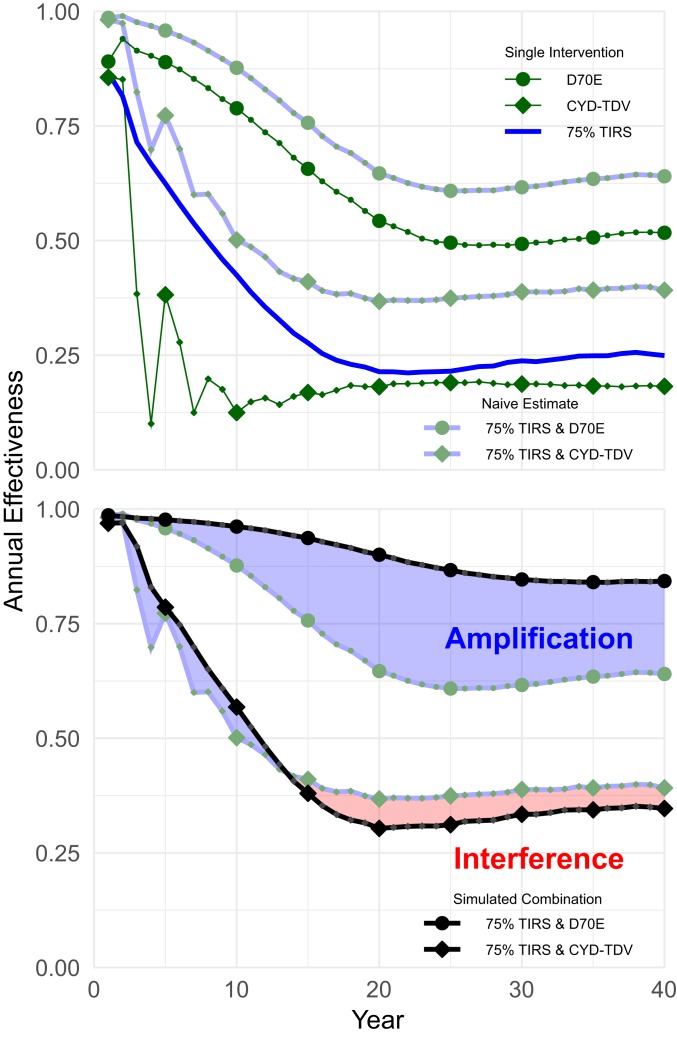
Estimated vs. simulated combined effectiveness. Naïve estimates of combination performance (Upper) calculated by assuming that single interventions act independently. Actual simulation (Lower) shows that performance of combined interventions may exceed (amplification) or fall short of (interference) naïve estimates.
Fig. 4.
Fig. 4.
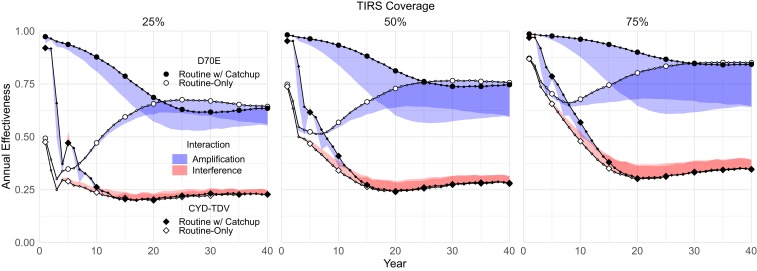
Combined intervention effectiveness. D70E combined with TIRS ([Left] 25%, [Center] 50%, and [Right] 75% coverage) quickly results in dengue control that equals or exceeds naïve estimates. Because CYD-TDV eligibility depends on past natural infection, reducing DENV transmission with TIRS leads to interference in our model.
Fig. 5.
Fig. 5.
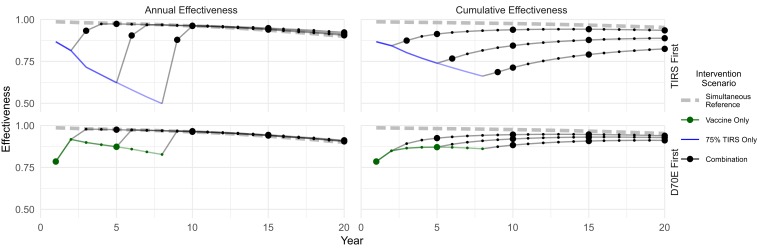
Staggered starts for D70E combinations. Staggered starts (by 2, 5, and 8 y) for both TIRS followed by D70E (Upper) and D70E followed by TIRS (Lower) compared with concurrent start (dashed gray lines). Delaying either D70E or TIRS has limited impact: after the second intervention is introduced, annual effectiveness rapidly approaches that of simultaneous starts. All staggered scenarios have 75% TIRS coverage and routine vaccination with a smaller, slower, one-time catch-up campaign.
Fig. 6.
Fig. 6.
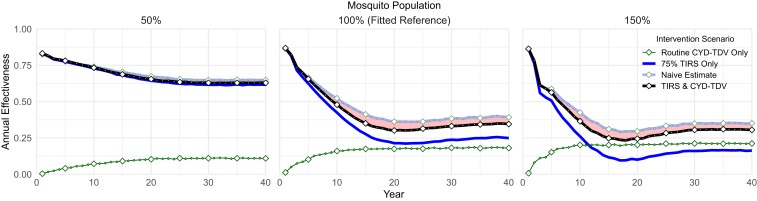
CYD-TDV sensitivity to mosquito population density. As transmission increases, long-term performance of routine CYD-TDV combinations approaches the naïve estimate. Combinations consistently outperform either intervention alone, although only marginally outperforming TIRS in the lowest transmission setting.

References

    1. Bhatt S., et al. , The global distribution and burden of dengue. Nature 496, 504–507 (2013). - PMC - PubMed
    1. World Health Organization , Dengue: Guidleines for Diagnosis, Treatment, Prevention and Control (WHO/TDR, Geneva, Switzerland, 2009). - PubMed
    1. San Martín J. L., et al. , The epidemiology of dengue in the Americas over the last three decades: A worrisome reality. Am. J. Trop. Med. Hyg. 82, 128–135 (2010). - PMC - PubMed
    1. Guzman M. G., et al. , Dengue: A continuing global threat. Nat. Rev. Microbiol. 8(suppl. 12), S7–S16 (2010). - PMC - PubMed
    1. Brady O. J., et al. , Refining the global spatial limits of dengue virus transmission by evidence-based consensus. PLoS Neglected Trop. Dis. 6, e1760 (2012). - PMC - PubMed

Publication types

Substances